Health & Personal Awareness | Listen Free 🎧 | Contact 📧
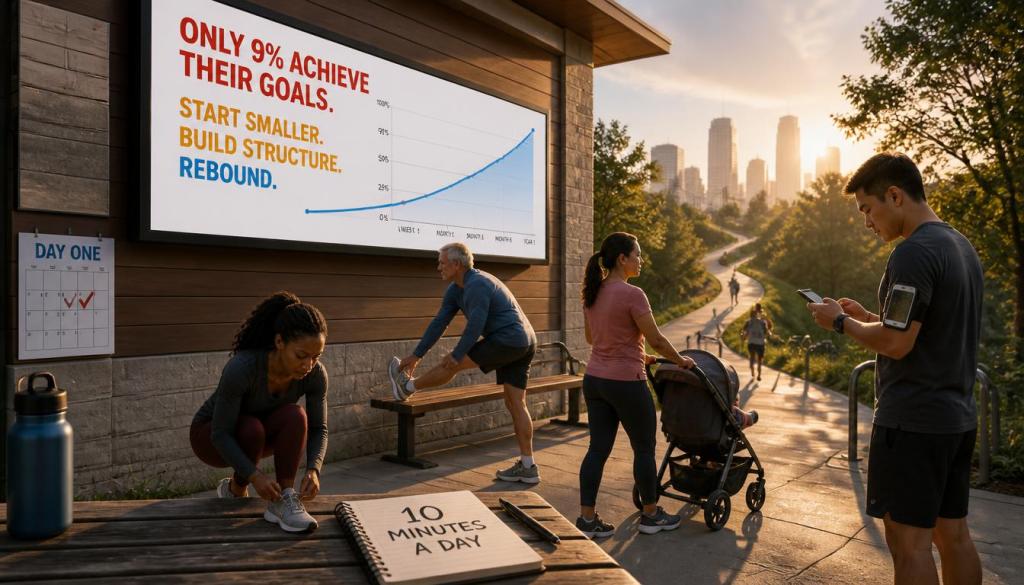
Every January, millions of Americans make health resolutions. By February, most have abandoned them. Only 9 percent of Americans who make resolutions actually achieve them. But new research reveals that the difference between those who succeed and those who fail is not willpower. It is structure, mindset, and the willingness to start smaller than you think you should.
The Resolution Gap: Intent vs. Achievement
The data on health resolutions tells a sobering story. Heading into 2026, 82 percent of Americans planned to make at least one New Year’s resolution, according to the American Psychiatric Association’s Healthy Minds Poll. Physical fitness topped the list at 44 percent, followed by financial goals at 42 percent, and mental health at 38 percent — a figure that has risen 5 percent year over year.
But follow-through collapses quickly. About 77 percent of people stick with their goal after one week. By one month, that drops to 55 percent. Fewer than 1 in 5 maintain the change long-term, according to clinical research on behavior change.
The reasons are predictable: goals that are too ambitious, motivation mistaken for strategy, and “all-or-nothing” thinking that treats a single missed workout as total failure. As one behavioral analysis put it, “Sustainable health journeys are built on consistency—not perfection”.
What Predicts Individual Achievement?
Research into successful goal pursuit points to a specific set of factors that separate those who achieve from those who abandon.
1. An “Iterative Mindset”
A 2026 study published in Current Psychology (N = 370 for health habits; N = 915 for work habits) identified an “iterative mindset” as a key predictor of habit automaticity, weight loss, and productivity. The mindset has three components:
- Assessing setbacks without triggering negative emotions — reframing and releasing failures rather than dwelling on them
- Iterating to remain in-effort — continuing to try even when progress is slow
- Practicing what is working repetitively — doubling down on strategies that show results
The study concluded that habits are effective because they “free up cognitive resources and provide resilience in the face of stressors”.
2. Specific, Approach-Oriented Goals
Vague goals like “eat healthier” are harder to follow than specific actions. Research shows you are more likely to stick with a goal that is specific, fun, and trackable. Experts recommend setting approach-oriented goals — “I’ll walk 30 minutes a day” instead of “I’ll stop being lazy”.
3. Accountability and Public Commitment
People who publicly commit to a goal or share it with a resolution buddy are significantly more likely to persist. The social dimension of behavior change is not incidental — it is central.
The Breakthrough: Brain Health Is Trainable at Any Age
Perhaps the most encouraging finding from recent research is that cognitive decline is not inevitable. A landmark three-year study published in Nature Scientific Reports tracked nearly 4,000 adults ages 19 to 94 and found that brain health can be measurably improved at any age.
The study used the BrainHealth Index (BHI), a multidimensional metric that measures three pillars: clarity (thinking skills), connectedness (social purpose), and emotional balance (mental resilience).
Key findings:
- No ceiling for improvement: Even top-tier performers continued to improve over 1,000 days
- The low-starter advantage: Participants with the lowest baseline scores demonstrated the most significant rates of improvement — “poor brain health is not a life sentence”
- Small habits, big impact: 5 to 15 minutes of daily micro-training and brain-healthy habits produced the highest scores
- Universal potential: Younger adults saw gains equal to those in their 70s and 80s
“For too long, we’ve operated under the outdated notion that we need to wait until something bad happens to our brain before we do anything for it,” said Sandra Bond Chapman, PhD, chief director of the Center for BrainHealth at UT Dallas. “This study reminds us that our brain is not defined by age, it is defined by possibility”.
The study also documented a “rebound effect” — participants used cognitive strategies to recover, maintain, or even increase brain health during major life stressors such as personal illness, job loss, or caregiving.
What Works: A Blueprint for Individual Achievement
Combining the research, a clear blueprint emerges for those seeking to achieve health goals — whether they are resolutions made in January or commitments made in September.
Start smaller than you think you should. Instead of daily workouts, begin with 10–15 minutes of movement. Instead of a complete diet overhaul, commit to one balanced meal per day.
Be specific. Decide when you will act, where it fits into your day, and what you will do if plans change.
Build a backup plan. Life happens. Create a simple alternative for busy days: short walks instead of long workouts, easy nutritious meals instead of skipping food.
Track your progress. Tools like Strides, Habitica, or Coach.me can help you stay motivated and accountable.
Embrace the rebound. Setbacks are not failures. The iterative mindset — assessing setbacks without negative emotion, iterating, and practicing what works — predicts long-term success.
Commit publicly. Share your goal with someone who will hold you accountable. Research shows this significantly increases persistence.
The Bottom Line
Only 9 percent of Americans achieve their health resolutions. The difference is not talent, willpower, or luck. It is structure, mindset, and the willingness to start smaller than you think you should. Brain health is trainable at any age. Habits free up cognitive resources. And setbacks, when approached with the right mindset, are not failures — they are data.
For anyone still carrying a goal that feels out of reach: the science says you can get there. You just have to stop waiting for motivation and start building structure.
Sources
American Psychiatric Association: “More Americans Plan Mental Health Resolutions Heading Into 2026” (January 2, 2026)
Progressive Grocer: “Consumers Prioritize Physical Well-Being in 2026 Resolutions” (January 5, 2026)
Action News 5: “Best Life: Resolution revolution and the science of sticking with it” (January 1, 2026)
Atlas Clinical Research: “Why January Health Journeys So Often Stall—and How to Stick With Yours” (January 14, 2026)
The People’s Weekly — urban intel from a holistic social approach.
[ai]
 The People's Weekly
Leave a comment