Politics & Policy | Listen Free 🎧 | Contact 📧
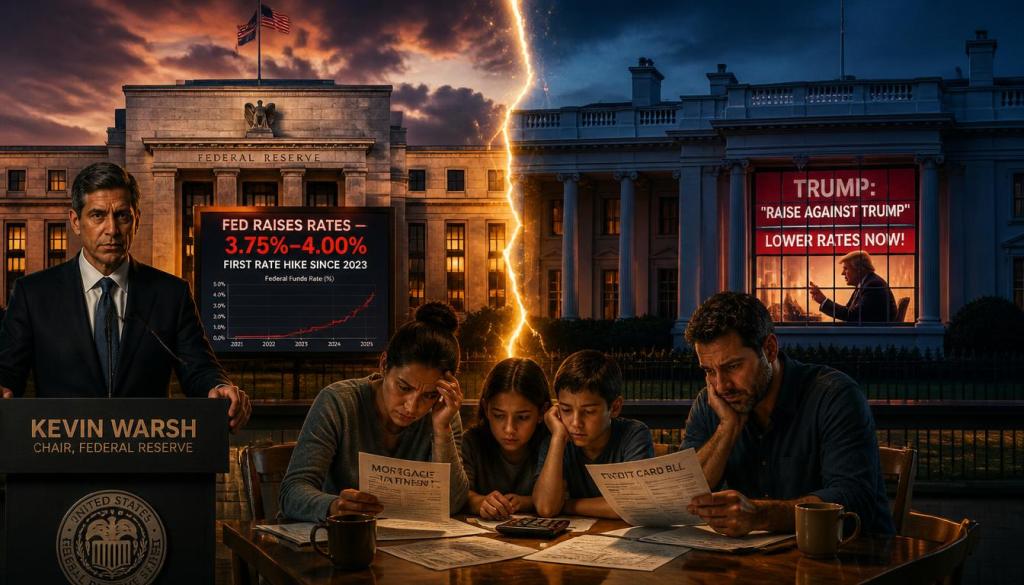
The Federal Reserve raised its benchmark interest rate by a quarter of a percentage point on Wednesday — the first increase since July 2023 — pushing the target range to 3.75% to 4.00% and setting up a direct confrontation with President Donald Trump less than 50 days before the midterm elections.
The Federal Open Market Committee voted unanimously to hike rates, with Fed Chair Kevin Warsh citing inflation that has remained above the central bank’s 2% target for more than five years. “The plain fact is that inflation is too high, and has been for too long,” Warsh said at a press conference following the decision. “We removed a dose of accommodation so that financial and credit conditions would be more consistent with our ultimate objectives.”
The Case for the Hike: Inflation Has Not Been Tamed
The Fed’s decision rests on data that shows price pressures remain stubbornly elevated.
The Labor Department reported last week that the consumer price index rose 3.4% year-over-year in August — unchanged from July but still well above the Fed’s 2% target. The monthly increase quadrupled from July, hitting 0.4%. Core inflation, which excludes volatile food and energy prices, rose at a hotter-than-expected pace. Producer prices rebounded from 4.8% to 5.4% year-over-year.
The sources of inflation are multiple: the ongoing U.S.-Iran war has pushed energy prices higher, Trump’s tariff policies have raised the cost of imported goods, and the AI data center boom has strained supply chains for electricity and technology equipment.
Warsh noted that “too many categories of products and services” were showing annualized price gains above 3% on both a six-month and twelve-month basis. “This summer’s inflation readings do not tell me that underlying trends have meaningfully improved,” he said.
Diane Swonk, chief economist at KPMG, said inflation had “forced the Fed’s hand.” “Price pressures remain too elevated and too persistent for policymakers to look through, while the economy and labor market have held up well enough to absorb tighter policy.”
The Fed also raised its year-end forecast for its preferred inflation gauge, the Personal Consumption Expenditures price index, to 3.7% — up from its June projection of 3.6%.
The Case Against the Hike: Economic Strain on Households
The decision carries significant risks, particularly for working families already under financial pressure.
Trump reacted angrily to the decision, calling it a “raise against Trump” and accusing the FOMC of making decisions for political reasons. “The board is very hostile, very political,” Trump told reporters. He said U.S. interest rates should be at 1% or lower, writing on Truth Social: “LOWER THE INTEREST RATES FOR THE UNITED STATES OF AMERICA, AND FAST!”
The White House called the decision “rather unfortunate.” National Economic Council Director Kevin Hassett said before the meeting that inflation is improving and the Fed doesn’t need to raise rates. He said Trump “100% respects the independence of Kevin Warsh” and would “100% support” whatever the central bank decides — while conceding Trump wouldn’t be “super happy” about a rate increase.
The human stakes are significant:
- Mortgage rates have already been climbing, with the 10-year Treasury yield topping 5% for the first time since 2023. The average 30-year fixed mortgage rate sits at 6.76%.
- Credit card APRs above 20% will reprice within one to two billing cycles.
- Home equity lines of credit adjust immediately.
- Small business loans tied to the prime rate become more expensive.
- Moody’s Analytics estimates the average household’s bills have increased by approximately $1,760 since the U.S. launched military strikes against Iran in late February.
- Consumer sentiment fell significantly in September, with one-year inflation expectations rising from 4.0% to 4.6%.
The Independence Question: A Test of Fed Credibility
The rate hike is also a test of the Fed’s independence under a president who has repeatedly pressured the central bank.
Warsh, whom Trump appointed in January after souring on former Chair Jerome Powell, has so far been spared the direct attacks Trump aimed at his predecessor. Notably, Trump’s post-decision criticism targeted the FOMC board — not Warsh personally. “You might as well vote with the board because it’s not going to matter,” Trump said. “The board is very hostile, very political.”
Warsh responded with a firm defense of the Fed’s independence. “Part of the independence of the Federal Reserve is that we stay in our lane,” he said. “Independence is a two-way street. We let people that do trade policy and fiscal policy stay in their lane, too.”
Maurice Obstfeld, a senior fellow at the Peterson Institute for International Economics and former chief economist at the International Monetary Fund, framed the dilemma: “The Fed will either incur the president’s wrath or damage its own credibility in the markets — and the latter could have far more serious long-term consequences for inflation.”
Warsh was confirmed after a contentious Senate process in which Democratic lawmakers accused him of being a “sock puppet” for Trump — a charge he denied.
Who Benefits, Who Is Harmed
The practical impact of the rate hike depends on where Americans sit financially.
Those who may benefit:
- Savers with high-yield savings accounts and certificates of deposit will earn slightly more on their deposits.
- Bondholders with existing fixed-rate bonds may see the value of new bonds rise.
- Those with fixed-rate debt — including fixed-rate mortgages and fixed-rate auto loans — are unaffected.
Those who are harmed:
- Credit card holders carrying balances will see their minimum payments increase.
- Homebuyers seeking new mortgages will face higher costs.
- HELOC holders will see their payments rise immediately.
- Small business owners planning to borrow for equipment, inventory, or expansion will face higher rates and potentially tighter lending standards.
- Equity investors may see stock valuations pressured as bonds offer more attractive returns.
As one market analysis put it: “The practical impact depends on where someone sits financially. Savers may benefit from higher short-term yields, while borrowers, equity investors, and floating-rate private-credit borrowers face increasingly expensive capital.”
The Path Forward: More Hikes Likely
This hike may not be the last. The Fed’s updated projections show that 16 of 18 officials expect at least one more increase this year, with the median projection for the federal funds rate rising from 3.8% to 4.1% by year-end. The median projection for 2027 also rose by 50 basis points.
The 10-year Treasury yield rose above 5% during Warsh’s press conference, reflecting market expectations of further tightening. Two-year Treasury yields — the most sensitive to Fed policy — climbed to 4.73%.
The Fed also raised its projection for GDP growth by year-end to 2.3%, up 0.1 percentage points, citing the resilience of the U.S. economy as a marker of its ability to absorb tighter financial conditions.
The Midterm Stakes
With the midterms less than 50 days away, the Fed’s decision carries significant political weight. The economy and affordability are already the top issues for voters. Republicans face a stern test, with Democrats seeking to wrest control of both houses of Congress.
Trump has argued that lower rates would spur economic activity and help his party. The Fed’s decision — made by a board he appointed but does not control — complicates that political calculus.
As one analysis noted: “The reverse is also true. With the White House demanding lower rates, standing pat when investors widely expected an increase would feed the suspicion that Warsh was accommodating the president who appointed him.”
The Bottom Line
The Fed’s rate hike is a calculated bet that the long-term damage of entrenched inflation outweighs the short-term pain of higher borrowing costs. For savers, it offers modest relief. For borrowers, it adds another layer of pressure. For the president, it is a rebuke. For the central bank, it is a test of its credibility.
The question now is whether inflation will respond — and whether the economy can absorb tighter policy without tipping into recession.
The effort to build better communities and a better America starts with you. Contact your state representatives and political party’s state, city or county office today and sign up, to give or do what you can to make America better for all.
Sources
BSS News/AFP: “US Fed raises rates to tackle ‘too high’ inflation, irking Trump” (September 17, 2026)
The Edge Malaysia: “Fed raises rates to curb inflation, drawing rebuke from Trump” (September 17, 2026)
The Wall Street Journal: “Warsh’s Arrival Ended Trump’s War With the Fed. A Rate Hike Would Test the Truce.” (September 15, 2026)
Washington Examiner: “‘Stay in our lane’: Warsh vows Fed independence after hiking rates” (September 16, 2026)
CNBC: “How Trump could reignite the Fed independence fight after Warsh’s rate hike” (September 16, 2026)
AP News: “Fed rate hike likely means more expensive credit cards and mortgages, but savers may rejoice” (September 16, 2026)
Siebert: “Wall Street Already Raised Rates. Now the Fed Signs the Receipt.” (September 16, 2026)
The People’s Weekly — urban intel from a holistic social approach.
[ai]
 The People's Weekly
Leave a comment