Finance & Investing | Listen Free 🎧 | Contact 📧
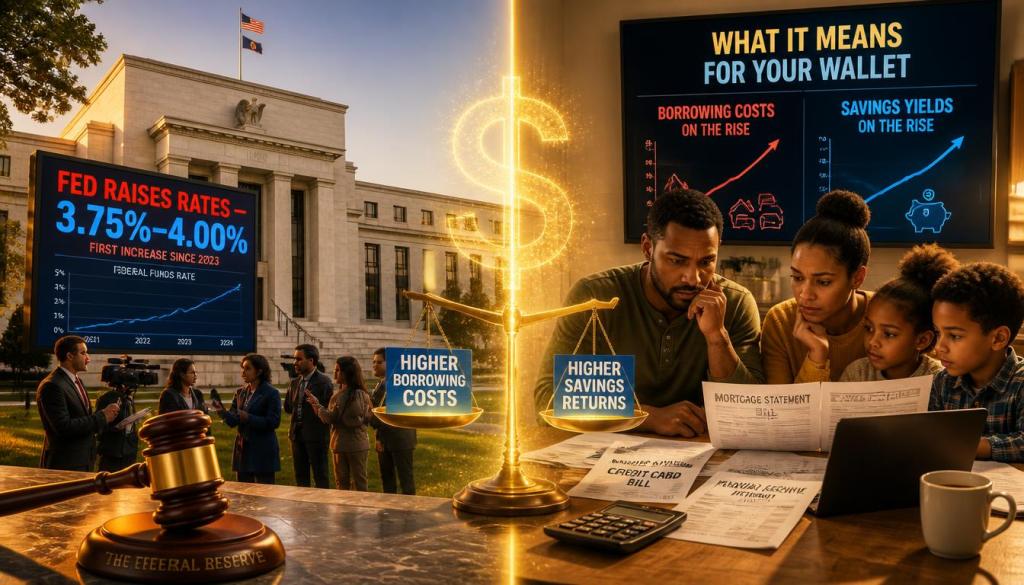
The Federal Reserve raised its benchmark interest rate by a quarter of a percentage point on Wednesday — the first increase since July 2023 — pushing the target range to 3.75% to 4.00% . The move was approved unanimously by all 12 members of the Federal Open Market Committee and came despite public pressure from President Trump to cut rates .
Fed Chair Kevin Warsh said the bank had to act on inflation: “The plain fact is that inflation is too high and has been for too long” .
So what does this actually mean for your money? The effects vary widely depending on what kind of debt you carry — and whether you’re a borrower or a saver.
Credit Cards: Rates Heading Toward Record Highs
Most credit cards have variable rates tied directly to the prime rate, which moves in lockstep with the Fed’s benchmark. When the federal funds rate rises, credit card APRs follow within one or two billing cycles .
“Cardholders should expect their credit card’s APR to rise a quarter-point in the next couple of months. For most people, this one rate increase won’t amount to more than a dollar or two added to their monthly bill, but for those already struggling with card debt, any increase is definitely unwelcome.”
— Matt Schulz, LendingTree’s Chief Consumer Finance Analyst
Combined, a 25-basis-point hike will cost credit card users roughly $2 billion in interest charges over the next 12 months, according to WalletHub.
The takeaway: If you carry a balance, your minimum payment will tick up. If you have high-yield savings, the gap between what you earn and what you owe may narrow — but not enough to offset the cost of revolving debt.
Mortgages: A Mixed Picture
If you already have a fixed-rate mortgage, nothing changes. That rate is locked in regardless of what the Fed does .
But for new homebuyers, the picture is more complicated. Mortgage rates track the 10-year Treasury yield, not the Fed funds rate directly. Treasury yields have been rising on inflation expectations, recently topping 5% for the first time since 2023, pushing the average 30-year fixed mortgage rate to 6.76% .
Adjustable-rate mortgages (ARMs) and home equity lines of credit (HELOCs) are pegged more directly to the prime rate. HELOC rates adjust immediately; ARMs typically adjust once a year after an initial fixed period .
The takeaway: Fixed-rate homeowners are insulated. New buyers face higher costs. HELOC holders will see their payments rise.
Auto Loans: A Small but Real Increase
Car loans are fixed once disbursed, but new loans will be more expensive. Cox Automotive estimates the hike could add about $6 to the average monthly car payment .
The takeaway: If you’re in the market for a car, locking in a rate sooner rather than later could save you money.
Savings: The Overlooked Upside
Here’s where the hike actually helps: deposit rates tend to rise with the federal funds rate. High-yield savings accounts and certificates of deposit (CDs) will offer slightly better returns .
“I know a rate hike may feel like bitter medicine, but we need it because we can’t just keep having this runaway price growth.”
— Ted Rossman, Principal Consumer Finance Analyst at Money Management International
The takeaway: If you have cash sitting in a low-yield account, now is the time to shop around. Online banks and credit unions typically offer the best rates .
Small Business: Higher Costs, Tougher Lending Standards
For entrepreneurs, the rate hike means higher costs on new loans. The prime rate — which is typically 3 percentage points above the Fed funds rate — rises immediately, and most small business loans are tied to it .
“Essentially, rates on all loan products will be forced higher as a result of the increase in the base rate. Consumers will feel it almost immediately on many of their borrowing products.”
— Brad Stroh, Co-CEO of Achieve
Markets have priced in another rate hike before the end of the year, which would mean elevated borrowing costs for a longer period .
The takeaway: If you’re planning to borrow for equipment, inventory, or expansion, expect higher rates and more scrutiny. Strong financial documentation matters more than ever.
The Bigger Picture: “Higher for Longer”
This hike may not be the last. The Fed’s dot plot shows 12 of 18 officials expect at least one more hike this year, with the median projection rising to 4.125% . Bank of America has forecast three hikes in 2026, penciling in moves in September, October, and December .
“A rate hike is great news for savers, but it stinks for borrowers.”
— Matt Schulz, LendingTree
For working families already under financial strain, the hike adds another layer of pressure. But for those with savings, it offers a rare opportunity to earn more on deposits.
Sources
CNBC: “Interest rates may stay higher for longer. What that means for consumers” (August 10, 2026)
CNBC: “The Fed is likely to raise interest rates as inflation persists. What that means for consumers” (September 14, 2026)
Barchart/AP: “Fed rate hike likely means more expensive credit cards and mortgages, but savers may rejoice” (September 16, 2026)
Entrepreneur: “The Fed Raised Interest Rates for the First Time Since 2023 — Here’s What It Means for You” (September 16, 2026)
Inc.: “Small-Business Owners Face Higher Borrowing Costs. These Moves Can Help Control Them” (September 15, 2026)
Yahoo Finance: “Bank Of America Predicts 3 Fed Rate Hikes In 2026 — What It Means For Your Wallet” (June 21, 2026)
The People’s Weekly — urban intel with a holistic social approach.
[ai]
 The People's Weekly
Leave a comment