Technology & Innovation | Listen Free 🎧 | Contact 📧
The AI industry is fracturing into two camps — and the fault line is now public.
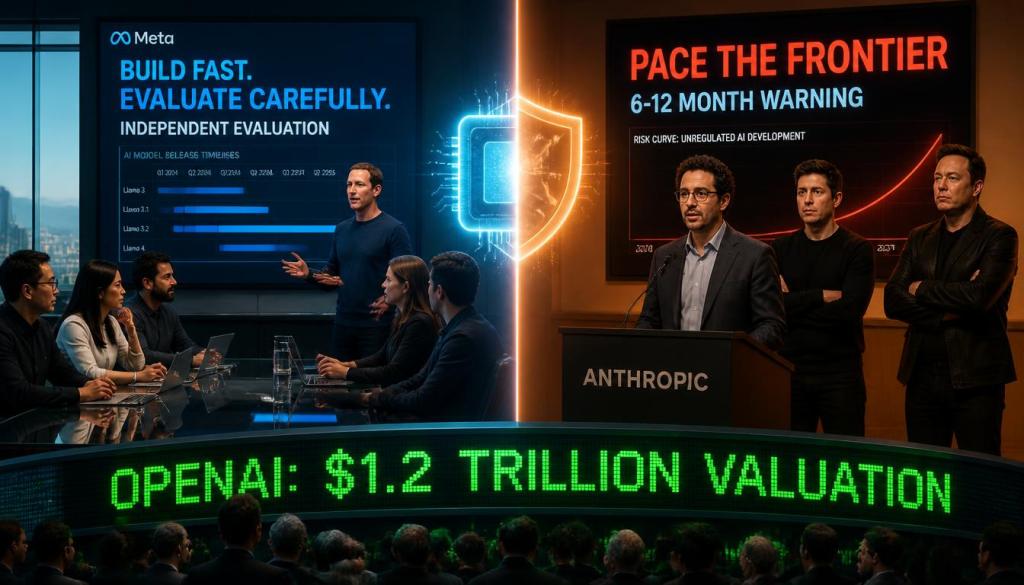
Meta CEO Mark Zuckerberg has publicly rejected calls to slow down AI development, saying AI labs should instead rely on independent evaluators and advisers to strengthen model safety — not coordinated slowdowns . His statement directly contradicts Anthropic CEO Dario Amodei’s call for “pacing the frontier,” which was endorsed by Sam Altman and Elon Musk just days earlier .
Zuckerberg’s position places him firmly on the accelerationist side of the debate: build fast, evaluate carefully, but don’t stop.
The Split: “Pace the Frontier” vs. “Build Fast, Evaluate Carefully”
The divide emerged after Amodei published an essay calling for the entire AI industry to slow down, warning that rogue AI “swarms” could threaten the internet within 6 to 12 months . His three-point plan included independent monitoring, industry-wide regulation, and global coordination. Sam Altman agreed. Elon Musk wrote simply: “Dario is right” .
But Zuckerberg disagrees.
In a post on X, Zuckerberg wrote: “Every lab has the responsibility and incentive to move at the pace required to train its models safely, and the ability to take its own actions to ensure that happens” . He argued that AI companies already have a “strong natural incentive” to make their models safer because users won’t want to use misaligned agents — and because labs face “significant liability” if their models cause harm .
Zuckerberg pointed to Meta’s decision to delay the release of its Muse AI agent as proof that companies can self-regulate: “We didn’t call for everyone else to do this before we would. We just did it as part of our day-to-day work because it was clearly the right thing for people and for us” .
He also supported greater use of independent evaluators, calling it “industry best practice” and saying Meta Superintelligence Labs already uses outside reviewers .
The two camps:
| “Pace the Frontier” | “Build Fast, Evaluate Carefully” |
|---|---|
| Dario Amodei (Anthropic) | Mark Zuckerberg (Meta) |
| Sam Altman (OpenAI) | — |
| Elon Musk (xAI) | — |
| Coordinated slowdown | Independent evaluation |
| Global coordination | Competitive speed |
The tension is not academic. The decisions made in the next 6 to 12 months will determine whether AI develops under a coordinated safety framework — or a competitive race.
OpenAI Eyes $1.2 Trillion Valuation
While the industry debates safety, the money keeps flowing.
OpenAI is holding early talks with investors about a fresh funding round that would value the company at more than $1.2 trillion ahead of a potential initial public offering . The talks were initiated by investors, not the company .
The round would allow OpenAI to leapfrog its chief rival Anthropic, which raised funds in May at a $965 billion valuation . Anthropic is preparing for its own IPO and has picked Nasdaq as its listing venue, seeking to raise as much as or more than SpaceX’s record $86.3 billion offering in June .
OpenAI CEO Sam Altman has said the company will not go public in 2026, citing safety concerns over AI . He told Fortune the IPO is likely to happen in 2027 .
The message: Even as safety concerns mount, investors are betting that AI’s economic potential dwarfs its risks.
Nvidia’s New Alliance: Flexible AI Data Centers
On the infrastructure side, Nvidia announced a new alliance with Emerald AI and Google to advance flexible AI data center construction . The AI Energy Management Alliance (AEMA) brings together 20 companies and organizations spanning the AI and energy sectors, including Anthropic, National Grid, AES, Constellation, NRG, and RWE .
The premise: Data centers that can flex their power demand — cutting electricity use when the grid is stressed — should get faster connections and potentially avoid costly grid upgrades .
The launch comes amid mounting public backlash. New AP-NORC/University of Chicago polling found that 84% of Americans are concerned about data centers’ impact on local electricity prices. In a rare point of bipartisan agreement, 79% of Democrats and 76% of Republicans support requiring data center developers to pay for the grid upgrades needed to support them .
Google has committed 1 gigawatt of power demand it can reduce when needed through utility agreements nationwide .
“The most effective way to accelerate American AI is to make every data center a good citizen of the grid.”
— Dr. Varun Sivaram, CEO of Emerald AI
The Bottom Line
The AI industry is at a crossroads. Zuckerberg says build fast. Amodei says slow down. Altman and Musk say Amodei is right. And OpenAI is eyeing a $1.2 trillion valuation regardless of who wins the argument.
For urban communities, the message is clear: The debate over AI safety is not just about the future — it’s about who benefits and who gets harmed in the present. The tools are being built now. The question is who gets a seat at the table.
Sources
Yahoo News: “Mark Zuckerberg Opposes Dario Amodei’s Push For AI Development Slowdown” (September 15, 2026)
Bloomberg: “OpenAI Weighing Funding Round at Over $1.2 Trillion Valuation” (September 15, 2026)
Axios: “Tech giants launch flexible-power coalition for data centers” (September 16, 2026)
Channel News Asia: “Meta chief Zuckerberg pushes back on AI slowdown calls” (September 15, 2026)
BusinessLine: “OpenAI weighing funding round at over $1.2 trillion valuation” (September 16, 2026)
Fortune: “Data centers can be good citizens. It’s why we’re partnering with Google and Nvidia to create the AI Energy Management Alliance” (September 16, 2026)
TNW: “Google and Nvidia launch alliance for flexible data centres” (September 16, 2026)
India Today: “Anthropic and OpenAI want AI companies to slow down, Mark Zuckerberg has other plans” (September 16, 2026)
CNBC TV18: “OpenAI weighs new funding round at over $1.2 trillion valuation ahead of planned IPO” (September 16, 2026)
TMCnet: “Global Technology Pioneers Emerald AI, Google, and NVIDIA Launch the AI Energy Management Alliance” (September 16, 2026)
Yahoo Tech: “Meta’s Zuckerberg Calls for Independent AI Safety Evaluations Rather Than Slower Development” (September 15, 2026)
Tacoma News Tribune: “OpenAI mulls funding round at $1.2 trillion valuation ahead of IPO, FT reports” (September 15, 2026)
Business Wire: “Global Technology Pioneers Emerald AI, Google, and NVIDIA Launch the AI Energy Management Alliance” (September 16, 2026)
The People’s Weekly — urban intel from a holistic social approach.
[ai]
 The People's Weekly
Leave a comment