Business & Entrepreneurship | Listen Free 🎧 | Contact 📧
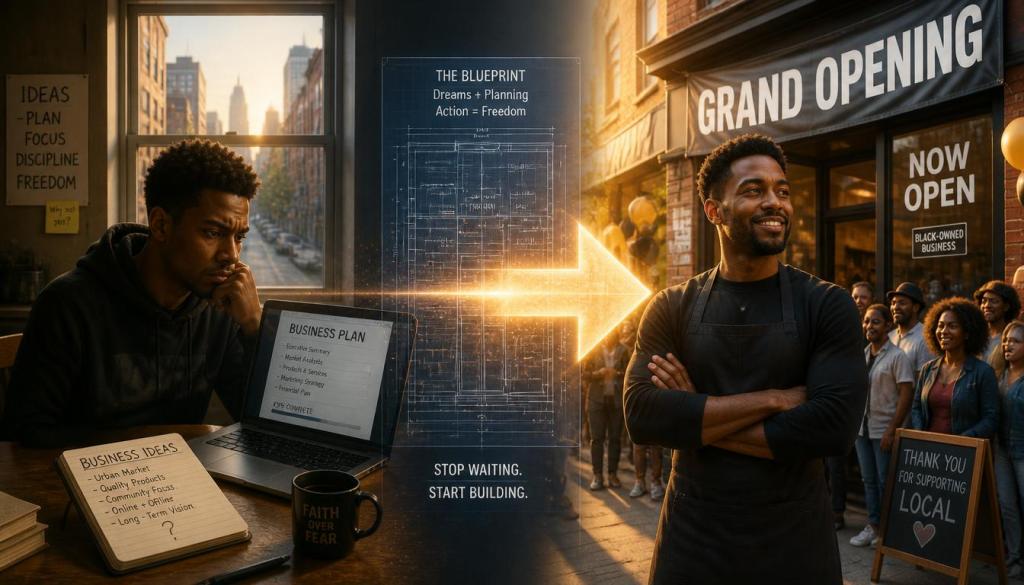
You’ve been thinking about it. Maybe for months. Maybe for years. That business idea. That side hustle. That leap from employee to entrepreneur.
But something keeps holding you back. Fear. Uncertainty. The voice that says, “I don’t have enough experience” or “I don’t know where to start” or “What if I fail?”
Here’s the truth: most people regret the risks they didn’t take, not the ones they did.
The Data Doesn’t Lie
In research studies, when people were asked to describe their significant regrets, more than 8 out of 10 focused on actions they did not take — rather than actions they took and failed at. The weight of “what if” sits heavier than the sting of “I tried.”
The regrets aren’t about failure. They’re about not trying.
History proves that the “experts” are often wrong:
- “The horse is here to stay but the automobile is only a novelty – a fad.” — President of Michigan Savings Bank, advising Henry Ford’s lawyer not to invest in Ford in 1903
- “We don’t like their sound, and the guitar is on the way out. The Beatles have no future in show business.” — Decca Recording Company, 1962
- “There’s no chance that the iPhone is going to get any significant market share. No chance.” — Microsoft CEO Steve Ballmer, 2007
The people who built the future didn’t wait for permission. They didn’t wait for the “right time.” They started — with imperfect knowledge, limited resources, and a willingness to figure it out as they went.
The Blueprint Framework: From Employee to Entrepreneur
According to Kevin Barnicle, a seasoned entrepreneur who started with no prior experience and grew his company into one of the fastest-growing in the U.S., the path to successful entrepreneurship follows a 7-phase framework:
- Preparation — Aligning your mindset and focus with your endeavor
- Research and validation — Ensuring your idea solves a real problem
- Legal and financial foundation — Setting up your business structure correctly
- Product/service development — Building something people actually want
- Brand and customer-first culture — Creating a business that stands out
- Marketing on a shoestring budget — Tactics that work even when capital is limited
- Scaling and exit strategy — Building for long-term success
The key insight: You don’t need a business degree, prior experience, or a million-dollar budget to start. You need a plan, a willingness to learn, and the courage to take the first step.
What Successful Founders Actually Do
The blueprint approach isn’t about waiting for the perfect moment. It’s about action — informed, strategic action.
- You don’t need to know everything before you start. You need to know enough to take the next step.
- You don’t need a perfect product. You need a product that solves a real problem for real people.
- You don’t need unlimited funding. You need creativity, persistence, and the willingness to start small and scale.
Immigrant entrepreneurs represent 25% of startup founders and 55% of billion-dollar “unicorn” companies. First-generation Americans aren’t waiting for permission. They’re building. And so can you.
The Regret Test
Here’s a simple exercise: Ask yourself what you’ll regret in five years.
Will you regret taking a shot at building something of your own? Even if it doesn’t work out, will you be proud that you tried?
Or will you regret never finding out what could have been?
The Bottom Line
The 8 out of 10 people who regret the risks they didn’t take aren’t looking back on failure. They’re looking back on inaction. They’re looking back on the opportunities they let pass because they were waiting for the “right time.”
The right time doesn’t exist. The right moment is now. Stop waiting for permission. Stop waiting for certainty. Start building.
As the Entrepreneur’s Blueprint reminds us: “There are ALWAYS people who say it cannot be done.” The people who achieve success are the ones who don’t listen to them.
Sources
Forbes: “Why We Regret Inaction More Than Action” (December 5, 2021)
Harvard Business Review: “Why People Regret Not Taking Risks” (March 2018)
Entrepreneur: “The 7-Phase Blueprint for Starting a Business with No Experience” (2026)
National Bureau of Economic Research: “Immigrant Entrepreneurs and Innovation in the U.S.” (2025)
The People’s Weekly — urban intel from a holistic social approach.
[ai]
 The People's Weekly
Leave a comment