Politics & Policy — Listen Free 🎧 | Contact 📧
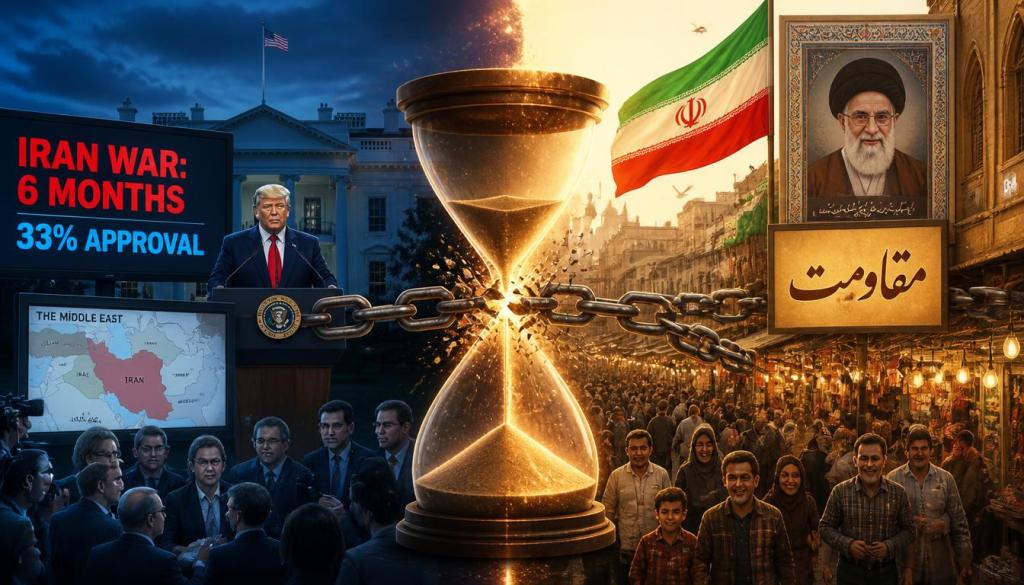
Today marks the six-month anniversary of joint U.S.-Israeli attacks on Iran. At the time, President Trump called the strikes a “little excursion” lasting a matter of weeks. Instead, the war has stretched into a deeply unpopular stalemate that threatens to derail his presidency and Republican control of Congress .
Trump has reached an awkward moment in his second term. A conflict that has already cost the United States more than $37.5 billion and damaged his popularity ahead of critical November elections for his party. Despite his repeated assurances that the war would be brief, the fighting continues — and Iran’s new leaders are defying the might of the United States.
Trump’s Shifting Strategies: From Victory to Siege
What was supposed to be a short military campaign has instead evolved through several different strategies, from outright victory to a negotiated peace deal to, most recently, an economic siege aimed at squeezing Tehran into submission .
The Original Mission (March 2):
Trump laid out sweeping objectives: destroying Iran’s missile capabilities, annihilating their navy, ensuring Iran can never obtain a nuclear weapon, and preventing the regime from arming terrorist armies outside its borders .
The Peace Deal (April-June):
By April, Trump was already framing the military campaign as a success, while setting reopening the Strait of Hormuz as his condition for ending hostilities. On June 17, Trump declared victory on the diplomatic front as well, announcing an agreement with Iran. That same day, the U.S. and Iran signed a memorandum of understanding calling for an immediate halt to hostilities and 60 days of follow-up negotiations toward a permanent nuclear agreement .
The Collapse (July):
The deal didn’t hold. By early July, Trump signaled he was walking away from diplomacy entirely. “I don’t want to deal with them anymore,” he said on July 8. With the settlement collapsed, Trump lost the exit strategy he had spent months building toward .
The Economic Siege (August):
By mid-August, Trump had fully pivoted to economic warfare. Treasury Secretary Scott Bessent described the new measures as “the single greatest financial offensive ever marshalled against an adversary.” The administration is now threatening to punish any country or entity that continues to conduct business with Tehran .
Trump’s current stance: “We don’t want to speak to them. We’re not looking to meet or anything,” Trump told reporters Thursday. He stressed that he’s “not in a hurry” to get Iran back to the negotiating table .
Iran’s New Leaders: Defiant and Unified
Six months of war have had the opposite effect of what Trump intended. Instead of toppling the Islamic Republic, Iran’s leadership has coalesced around a hard core of military generals and clerics who are ready for a potentially long confrontation with the U.S. .
Ayatollah Mojtaba Khamenei, the new supreme leader, has surrounded himself with hard-line allies, appointing Mohsen Rezaei as secretary of Iran’s Supreme National Security Council and Hossein Taeb as head of the Basij — the Revolutionary Guard’s volunteer street force that played a major role in crushing protests .
Rezaei has threatened to escalate the war if the economic pressure continues: “If the economic war continues, not a single drop of oil will be exported from the Persian Gulf” .
Iran’s miscalculation risk: Analysts warn that escalation is not inevitable. Iran could find it difficult to “escalate enough to restore deterrence without triggering retaliation that leaves it worse off,” said Homayoun Falakshahi, a top oil analyst for Kpler .
The Political Cost: Trump’s Approval in Freefall
Trump’s approval rating has collapsed to some of the lowest levels of his second term, driven by war fatigue, surging fuel prices, and eroding support even among his own base .
The numbers:
- Trump’s approval rating has fallen to 33%, according to Reuters/Ipsos polling — down from 40% before the war began and 52% at the start of his second term .
- Only 31% of Americans support the war — the lowest level since the conflict began .
- Gas prices soared past $4 by the end of March, up more than 30% since the war began, driven by a collapse in tanker traffic through the Strait of Hormuz, which normally carries roughly a fifth of the world’s oil supply .
The midterm implications: Voter anger over high prices poses a problem for Trump’s Republican Party before November’s midterm elections, when it must defend narrow majorities in both chambers of Congress. The conflict has also widened a rift between more isolationist Republicans and those who believe Trump should keep military pressure on Tehran .
The Bottom Line
Six months into a war that was supposed to last weeks, the U.S. finds itself in a prolonged conflict with no clear end in sight. Trump’s shifting strategies — from military victory to peace deal to economic siege — have failed to break Iran’s resolve. Instead, Iran’s leadership has unified, its economy remains fragile but defiant, and the U.S. faces a political reckoning at the ballot box in November.
For working families, the cost is already being felt: gas prices remain elevated, the war has cost the U.S. more than $37.5 billion, and Trump’s approval rating is stuck at record lows. As one analyst put it, the war has become a “political millstone” for a president who promised to end wars and not plunge the U.S. into new foreign conflicts.
The join the effort to build better communities and a better America starts with you. Visit Fight for the People PAC and Democrats.org today and sign up, to give or do what you can to make America better for all.
Sources
Times Now: “Iran War Hits 6 Months: How Trump’s ‘Quick Victory’ Turned Into Economic Warfare” (August 28, 2026)
Eagle-Tribune / AP: “6 months on, Iran’s leaders are defying the US and signaling no tolerance for dissent” (August 28, 2026)
Times Now: “From 52% to Negative 26: The 6-Month Freefall Of Trump’s Approval Ratings Amid Iran War” (August 27, 2026)
AP News: “The Latest: Iran war reaches its six-month mark as Trump tries increasing economic pressure” (August 27, 2026)
Hindustan Times: “Six months into Iran war, Donald Trump says he’s in no hurry to end it” (August 28, 2026)
Ahram Online: “The US and Israel tried to topple Iran’s government. Six months on, new leaders are defying them” (August 29, 2026)
Yerepouni Daily News / Reuters: “Six consequences of six months of war in Iran” (August 26, 2026)
Toronto Star / AP: “The US and Israel tried to topple Iran’s government. Six months on, new leaders are defying them” (August 28, 2026)
Al-Quds: “Six Months of the Iran War: How the US-Israeli ‘Decisive War’ Turned Into a Stalemate” (August 28, 2026)
The People’s Weekly — urban intel from a holistic social approach.
[ai]
 The People's Weekly
Leave a comment