Urban News & Lifestyle — Listen Free 🎧 | Contact 📧
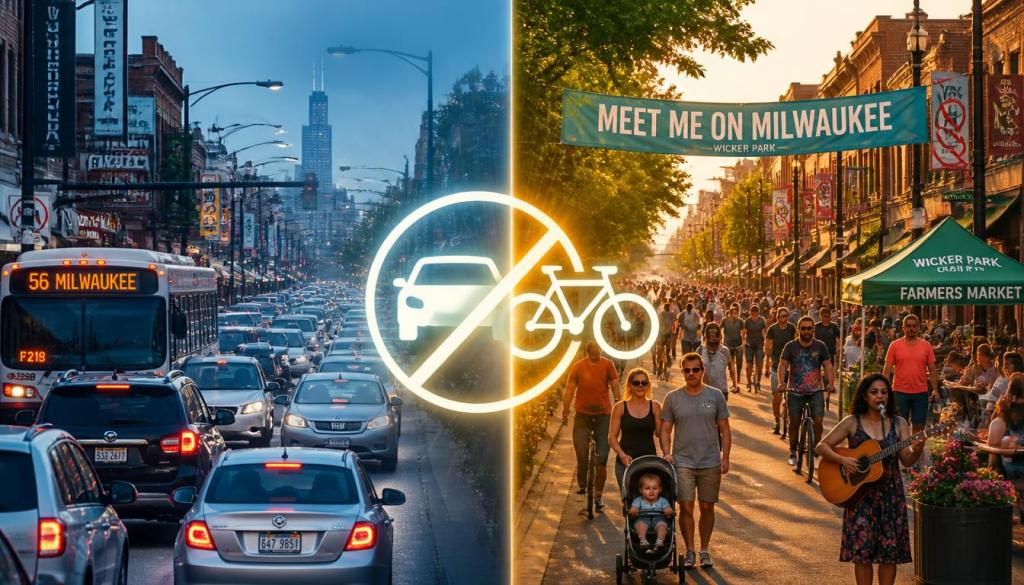
On Sunday, August 30, one of Chicago’s busiest commercial corridors will look very different. Milwaukee Avenue between the North/Damen intersection and Ashland Avenue will close to cars and buses for the return of Meet Me On Milwaukee — a pedestrian-focused event that replaces normal traffic with walking, biking, sidewalk shopping, outdoor dining, live music, exercise classes, and neighborhood pop-ups.
The street will go car-free again on the last Sunday of September and October, giving Chicago three opportunities this fall to experience one of Wicker Park’s main commercial corridors without normal vehicle traffic.
What Is Meet Me On Milwaukee?
Meet Me On Milwaukee is officially described as a pedestrianization pilot — not a conventional street festival. There are no giant festival gates or admission fees. Instead, existing neighborhood businesses spill activity into the street and sidewalks while residents and visitors are encouraged to walk or bike through a section of Milwaukee Avenue normally dominated by moving cars, buses, and parking.
What visitors can expect:
- Sidewalk sales
- Live acoustic music
- Outdoor dining
- Exercise and wellness activities
- Local business pop-ups
- Space for walking and biking
2026 Schedule:
- August 30: 10 a.m. to 6 p.m.
- September 27: 10 a.m. to 6 p.m.
- October 25: 10 a.m. to 4 p.m.
The main closure extends along Milwaukee Avenue from the North/Damen intersection southeast to Ashland Avenue, creating a continuous pedestrian zone through one of the busiest parts of Wicker Park, including the stretch surrounding the Damen Blue Line station.
Why Chicago Is Bringing It Back
The first Meet Me On Milwaukee series launched in 2025 as a collaboration between Ald. Daniel La Spata’s 1st Ward office, the Wicker Park Bucktown Chamber of Commerce, and the Chicago Department of Transportation. The idea was straightforward: temporarily remove vehicles and see what happens when Milwaukee Avenue functions primarily as a place for people and neighborhood businesses.
The early results got attention. Location-data analysis found that foot traffic during the August 2025 event was roughly three times the level recorded on the comparable Sunday a year earlier. September and October activations reportedly drew roughly double the normal foot traffic.
That matters for a corridor where independent restaurants, bookstores, vintage shops, coffee shops, and other businesses depend heavily on people walking through the neighborhood.
“Lots more business excitement, because last time in August they had no idea what to expect it to be, and now there’s a lot more upfront excitement.”
— Ald. Daniel La Spata
The Bigger Picture: Cities Reimagining Public Space
Chicago is not alone. Across the country, cities are reimagining how public space can be used to build community, support local businesses, and reduce pollution.
Burnaby, Canada: The city is celebrating Car-Free Day on August 30, shutting down streets to cars for a day of community celebration.
Strong Towns Movement: The Strong Towns Chicago network has highlighted the Wicker Park initiative as a model for creating people-centered streets. The organization’s mission is to build “stronger, more resilient communities” by rethinking how cities allocate space.
National Trends:
- Cities from New York to Los Angeles are experimenting with open streets programs
- Car-free Sundays and pedestrian zones are gaining traction in neighborhoods across the country
- Urban residents are demanding more public space for people — not just cars
- Local businesses are discovering that foot traffic drives sales more than vehicle traffic
The Wicker Park Farmers Market
For those looking to make a full day of it, the Wicker Park Farmers Market is also happening today. Now in its 26th season, the market runs from 8 a.m. to 2 p.m. every Sunday through October 25 at 1425 N. Damen Ave.
Visitors can combine a trip to the farmers market with the pedestrianized Milwaukee Avenue experience — shopping for fresh produce, locally-made goods, and supporting neighborhood businesses in a car-free environment.
What This Means for Urban Communities
Car-free streets are more than a novelty — they’re a statement about what cities can be. They create spaces where:
- Families can walk safely without the noise and danger of traffic
- Local businesses can thrive with increased foot traffic
- Neighbors can connect in public space
- Pollution is reduced by eliminating vehicle emissions
- Pedestrians and cyclists are prioritized over cars
“Streets full of people, sidewalks full of commerce.”
— Ald. Daniel La Spata
The Bottom Line
Chicago’s Wicker Park is going car-free again — and cities across North America are watching. The “Meet Me On Milwaukee” pedestrianization pilot has demonstrated that removing cars from a commercial corridor doesn’t hurt businesses — it brings more people, more foot traffic, and more energy to the neighborhood.
For urban communities, the message is clear: public space belongs to people, not just cars. And when we reclaim it, everyone benefits.
Sources
Block Club Chicago: “Wicker Park’s Car-Free ‘Meet Me On Milwaukee’ Events Return In August” (July 14, 2026)
Option Premier: “Milwaukee Avenue Goes Car-Free Again for 3 Sundays in Wicker Park” (August 28, 2026)
Choose Chicago: “Meet Me on Milwaukee (MMoM)” (August 4, 2026)
Hoodline: “Meet Me On Milwaukee Returns To Wicker Park” (July 17, 2026)
Strong Towns Chicago: “Meet Me On Milwaukee”
Choose Chicago: “Wicker Park Farmers Market” (April 23, 2026)
CBS News: “Wicker Park Farmers Market opens for the season” (May 3, 2026)
US Message Board: “Car-free Sundays and ‘opei}n streets’ initiatives are growing in the USA” (April 14, 2026)
The People’s Blog — urban political intelligence with a holistic social approach.
[ai]
 The People's Weekly
Leave a comment