The People’s Weekly — Listen Free 🎧 | Contact 📧
For decades, commercial real estate investments have been the exclusive domain of wealthy, accredited investors. Office buildings, shopping centers, and industrial warehouses—the very assets that shape our neighborhoods—have been off-limits to the people who live in them .
But a new model is emerging: community equity. Across the country, innovative programs are cutting neighborhood residents into commercial real estate deals on the same terms as big institutional investors.
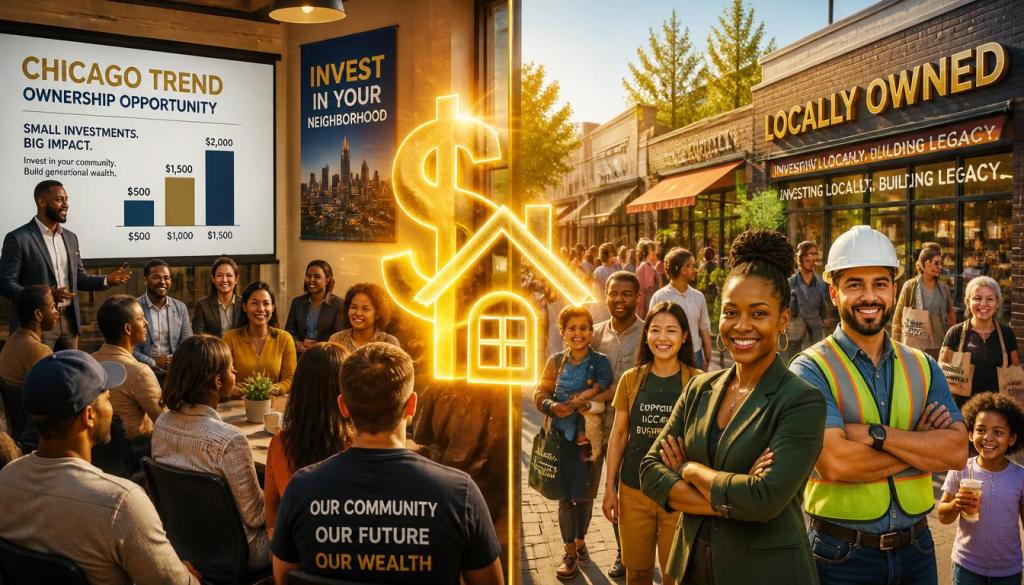
Chicago TREND: Buying Back the Block
In Chicago, Lyneir Richardson’s Chicago TREND is dismantling the barrier that has kept local residents from benefiting from neighborhood uplift. Neighborhood residents can invest—and earn real returns—in TREND’s local shopping centers on the same terms negotiated by institutional investors .
“Nobody ever invites the church member, the charter school parent, or the guy who used to do crime in the neighborhood that turned his life around, to have an ownership stake in making the neighborhood better.”
— Lyneir Richardson, Founder of Chicago TREND
The model: TREND has purchased seven neighborhood shopping centers, with an eighth deal close to completion. The strip malls house health services, food spots, grocery stores, and other essential businesses. The 460 low- and moderate-income neighborhood investors in Chicago, Baltimore, and other cities have invested an average of about $2,000—on the same terms as bigger investors .
Who’s investing: Most of the investors are people of color, and nearly half are women. Their capital represents as little as 5% and as much as 49% stake in each project. When TREND launches its next campaign, some residents will receive matching funds to amplify their investments .
The fundraising: The first commercial real estate fund is targeting a $15 million close, led by the Pritzker Traubert Foundation, alongside the MacArthur, McKnight, Kresge, and Surdna foundations .
“How do you democratize ownership? My belief is that you just gotta make it work for more people.”
— Lyneir Richardson
Pro Athletes Bet on Crowdfunded Urban Real Estate
A roster of professional athletes is skipping traditional private equity to democratize urban property ownership. NFL quarterback Jameis Winston and Adrian Muhammad, chairman of Kinexx Modular Construction, are leading an initiative backed by more than 20 professional athlete-investors .
The plan: The syndicate aims to build 25,000 homes nationwide on underused urban lots in overlooked communities—presenting a scalable blueprint for Black wealth creation. Decades of redlining and urban neglect have left nearly 250,000 vacant lots in post-industrial cities like Baltimore, Detroit, Chicago, Cleveland, Philadelphia, Columbus, St. Louis, and Nashville .
How it works: Kinexx uses factory-built modular construction to speed home completion by 30% to 50% compared with standard methods. The project allows retail investors to participate with investments starting at $500, removing the accredited-investor barrier .
“Our communities are in need, but they’re valuable, rich in people, rich in history, and rich in land.”
— Adrian Muhammad, Chairman of Kinexx Modular Construction
Target markets: Historically Black neighborhoods such as Chicago’s Bronzeville, where unused lots represent $100 million in untapped annual development value .
CDFI Lending: Capital for Entrepreneurs Who Can’t Access Traditional Banks
Community Development Financial Institutions (CDFIs) are filling the gap where traditional banks won’t lend. These mission-based lenders provide accessible, flexible financing for affordable housing, job growth, and small business development .
In Bloomington, Indiana: CDFI Friendly Bloomington has partnered with Allies for Community Business to offer loans from $500 to $500,000 for entrepreneurs within the city limits. A separate $2.25 million line of credit with three local banks is targeting affordable housing, child care, and small business projects across 13 Indiana counties .
“A4CB is excited to provide more loans to Indiana entrepreneurs by partnering with local organizations who know their neighborhoods best.”
— Brad McConnell, CEO of Allies for Community Business
In California: The California Community Reinvestment Corporation has completed a $114 million securitization of tax-exempt loans, marking the first time a CDFI has securitized affordable housing loans in the municipal market. The pool consists of 21 affordable housing properties comprising 1,573 units serving families, seniors, veterans, and formerly homeless households .
In Harlem: A former correctional facility is being transformed into a $98 million affordable homeownership development with 105 affordable cooperative units—the tallest 100% affordable homeownership building in New York City to meet Passive House certification .
Financial Literacy: Building the Knowledge to Build Wealth
Metro Detroit Financial Literacy Push: The Ballmer Group has invested $1.5 million to launch the Mi Money Matters Financial Empowerment Initiative—the largest financial literacy campaign ever undertaken in metro Detroit. The program targets five of Michigan’s most unbanked cities, where large numbers of residents do not use or have access to traditional financial services .
Atlanta’s City Accelerator: The City of Atlanta has joined a Citi Foundation and Living Cities program to support minority-owned businesses. A $100,000 grant will fund a program providing access to affordable real estate and technical assistance to economically underserved businesses in Southwest Atlanta, launching at Pittsburgh Yards—a 30-acre mixed-use site on the Atlanta Beltline .
Urban Financial Literacy at Penn: The University of Pennsylvania offers a course called Inequity and Empowerment: Urban Financial Literacy, providing students with a deep look at the historical and contemporary factors that have shaped America’s wealth gaps—including discriminatory housing, predatory lending, and unbanking .
The Blueprint: What Urban Communities Can Do
1. Invest in your own neighborhood. Chicago TREND and Kinexx Modular Construction are showing that small-dollar investments can build community wealth. Look for similar opportunities in your city .
2. Seek CDFI funding. Community Development Financial Institutions specialize in lending to underserved communities. They offer flexible terms and mission-driven lending that traditional banks won’t provide .
3. Build financial literacy. Free programs like Mi Money Matters in Detroit, the City of Atlanta’s Accelerator, and the University of Pennsylvania’s course are making financial education accessible. Take advantage of them .
4. Demand inclusion. The old model of commercial real estate investment kept communities out. The new model invites them in. Advocate for community equity programs in your city.
The Bottom Line
Urban communities are building wealth from the ground up—through community equity, crowdfunded real estate, CDFI lending, and financial literacy. The blueprint is being written in real time.
The question is: will you be part of it?
Sources
ImpactAlpha: “Cutting neighborhood residents into commercial real estate investments” (March 18, 2026)
ImpactAlpha: “Locals get the same terms as big investors in Chicago TREND’s neighborhood shopping centers” (March 18, 2026)
Black Enterprise: “Pro Athlete Syndicate Bets Big On Crowdfunded Real Estate To Combat Urban Housing Crisis” (June 5, 2026)
CDFI Friendly Bloomington: “CDFI Friendly Bloomington Announces New Lending Partnerships for 2026” (January 28, 2026)
NASDAQ: “California Community Reinvestment Corporation Completes $114 Million Securitization” (July 26, 2026)
NYC Homes and Community Renewal: “Governor Hochul Announces Major Milestone in Transformation of Former Lincoln Correctional Facility” (May 17, 2026)
Detroit Regional Chamber: “Ballmer Group Invests $1.5M in State-Led Metro Detroit Financial Literacy Push” (March 16, 2026)
Invest Atlanta: “City of Atlanta Selected for City Accelerator Program” (June 23, 2026)
University of Pennsylvania: “Inequity and Empowerment: Urban Financial Literacy” (February 19, 2026)
The People’s Weekly — urban intel from a holistic social approach.
[ai]
 The People's Weekly
Leave a comment