Politics & Policy — Listen Free 🎧 | Contact 📧
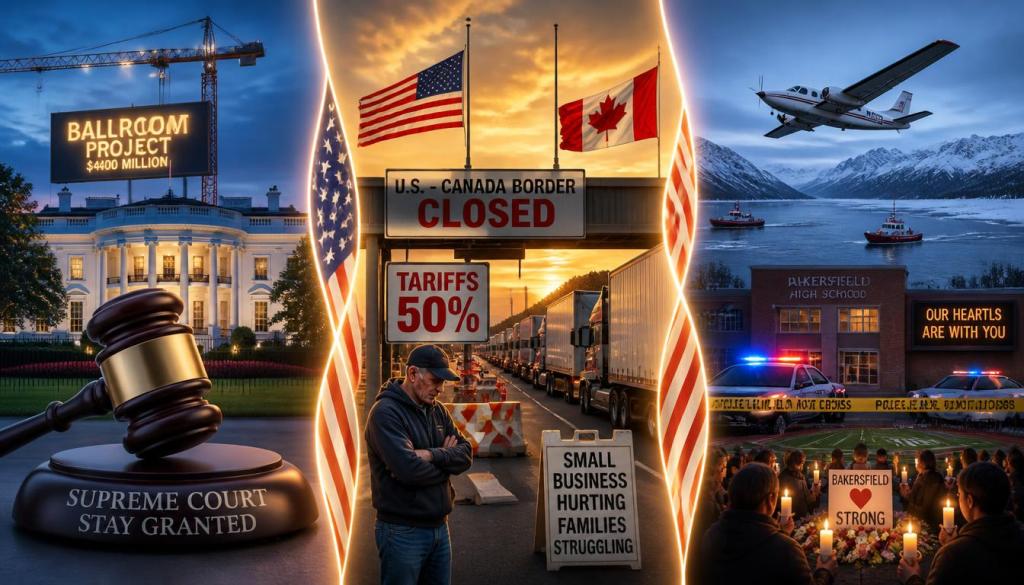
The U.S. Supreme Court on Friday temporarily allowed construction of President Donald Trump’s controversial White House ballroom to continue, freezing a lower court ruling that had ordered work to stop.
Chief Justice John Roberts issued a brief one-sentence administrative stay, which will remain in force until the Court reaches a decision on the underlying case. The order came after years of legal battles over the planned 90,000-square-foot ballroom, estimated to cost $400 million.
An appeals court had previously ruled that Trump was not permitted to build the ballroom without congressional authorization and that construction would have to be suspended until further notice. The president and his team insist the ballroom is necessary for national security, describing the structure as “bulletproof, drone-proof, missile-proof in many cases, and beautiful at the same time.”
The case highlights the ongoing tension between executive power and congressional oversight, as well as the broader debate over the use of historic federal property. The lower court’s injunction had been set to go into effect Saturday. The Supreme Court has not issued a final ruling on the underlying case — and the legal battle over the White House ballroom is far from over.
U.S.-Canada Trade Talks Collapse: Tariffs Take Effect
Trade negotiations between the United States and Canada fell apart on Friday night, shortly before a midnight deadline for 50% tariffs to take effect on $20 billion worth of Canadian products. The new tariffs kicked in at 12:01 a.m. ET Saturday.
Canadian Prime Minister Mark Carney said in a statement shared on social media late Friday that Canada will “match those tariffs dollar for dollar to protect our workers and businesses”. Carney said he has suspended trade negotiations with the U.S. and directed negotiators to return to Ottawa.
The prime minister blamed the U.S. for the collapse, stating that “last-minute changes in the U.S. proposed terms were unfair, uneconomic, and called into question the reliability of any deal”. U.S. Trade Representative Jamieson Greer responded that Canada had “declined to finalize the trade deal under the terms agreed earlier this week,” despite the U.S. offer to Canada to receive “the best treatment of any major exporter”.
“This will be a body blow to North American competitiveness in this self-defeating trade saga,” the Canadian Chamber of Commerce said of the new American levies.
Why It Matters: With the midterms less than 80 days away, the tariff war with America’s largest trading partner could raise prices on everything from lumber to electronics, hitting working families at a time when grocery and gas prices are already straining household budgets.
The Bottom Line
The Supreme Court’s temporary stay allows Trump’s $400 million White House ballroom project to continue — for now — while the legal battle over executive authority plays out. The collapse of U.S.-Canada trade talks has triggered 50% tariffs on $20 billion in Canadian goods, a move the Canadian Chamber of Commerce called a “body blow” to North American competitiveness.
The effort to build better communities and a better America starts with you. Visit Fight for the People PAC and Democrats.org today and sign up, to give or do what you can to make America better for all.
Sources
KCRG: “Supreme Court weighs legality of White House ballroom construction” (August 19, 2026)
Buffalo Toronto Public Media: “U.S.-Canada trade talks collapse just before deadline for tariffs” (August 22, 2026)
St. Catharines Standard: “Mark Carney suspends trade talks with U.S.” (August 22, 2026)
The People’s Weekly — urban intel from a holistic social approach.
[ai]
 The People's Weekly
Leave a comment