Finance & Investing — Listen Free 🎧 | Contact 📧
The Dow Jones Industrial Average is consolidating below 55,000 as U.S.-Canada tariff talks support sentiment while elevated Treasury yields and record AI investment collide.
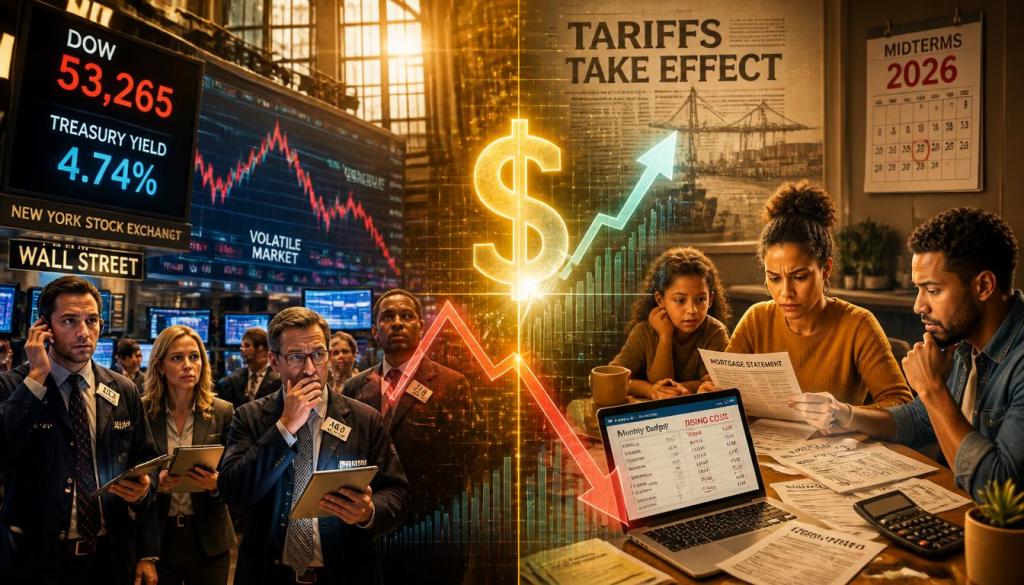
The Dow fell 0.84% to 53,265 on Thursday as the 10-year Treasury yield at 4.74% pressured valuations, before recovering Friday as U.S.-Canada tariff negotiations raised hopes for a trade deal. The S&P 500 dropped 1.43% and the Nasdaq 100 fell 2.52% on Thursday.
Record AI Investment Meets 4.74% Yields
Private investment in computers and peripheral equipment reached $790.61 billion in the first half of 2026, or 1.23% of nominal GDP, exceeding the Dotcom boom peak of about $210 billion in the second half of 2000.
Cloud capital expenditure is projected to grow about 29% in 2027, with spending projected to reach $1.4 trillion, according to Morgan Stanley. Goldman Sachs estimates global AI investment will reach approximately $1 trillion in 2026, including $581 billion in the U.S.
Tech giants are leading the charge: Amazon raised its 2026 capital expenditure forecast to about $220 billion, Alphabet to $195-205 billion, Meta to $130-145 billion, and Microsoft to $190 billion.
The 10-year Treasury yield closed at 4.74% while the 30-year yield stayed near 5.27% — levels that increase borrowing costs for households and businesses. The Treasury Department’s debt-buyback program, doubled from $2 billion to $4 billion per operation, provided only short-term relief.
The national debt surpassed $40 trillion, according to the U.S. Treasury. Maya MacGuineas, president of the Committee for a Responsible Federal Budget, stated that the $40 trillion debt is not confined to government ledgers but permeates the economy, ultimately affecting individuals’ finances.
U.S.-Canada Trade Talks Collapse: Tariffs Take Effect
Trade negotiations between the United States and Canada fell apart on Friday night, shortly before a midnight deadline for 50% tariffs to take effect on $20 billion worth of Canadian products. The new tariffs kicked in at 12:01 a.m. ET Saturday.
Canadian Prime Minister Mark Carney said in a statement shared on social media late Friday that Canada will “match those tariffs dollar for dollar to protect our workers and businesses.” Carney said he has suspended trade negotiations with the U.S. and directed negotiators to return to Ottawa.
The prime minister blamed the U.S. for the collapse, stating that “last-minute changes in the U.S. proposed terms were unfair, uneconomic, and called into question the reliability of any deal.”
U.S. Trade Representative Jamieson Greer responded that Canada had “declined to finalize the trade deal under the terms agreed earlier this week,” despite the U.S. offer to Canada to receive “the best treatment of any major exporter.”
“This will be a body blow to North American competitiveness in this self-defeating trade saga,” the Canadian Chamber of Commerce said of the new American levies.
What This Means for Urban Communities and Working Families
Higher borrowing costs: Elevated Treasury yields translate directly into higher mortgage rates, auto loans, and credit card costs for working families. The 10-year yield at 4.74% means a typical mortgage is now significantly more expensive than it was just a year ago.
Higher prices at the pump: Oil prices remain elevated due to the ongoing Iran conflict and disruption of the Strait of Hormuz. Gasoline prices are up 24.6% year-over-year, and fuel oil is up 39.1%.
The hidden tariff tax: The collapse of U.S.-Canada trade talks means 50% tariffs on Canadian goods will raise prices on everything from lumber to electronics. The Canadian Chamber of Commerce warned that this will make costs go up for Americans and small businesses will disappear.
The Fed’s dilemma: Cooling core inflation (2.5% year-over-year) gives the Fed flexibility to remain on hold, but persistent energy-driven headline inflation keeps rate hike risk elevated. The Federal Reserve held rates at 3.50%-3.75% at its July meeting, but three voting members favored a 25bps hike.
The Bottom Line
The Dow’s path depends on whether the 52,400 support holds and whether a break above 55,000 opens the way toward 60,000. A confirmed U.S.-Canada trade deal could ease input costs for industrial companies, but high borrowing costs and uncertain AI returns remain the primary risks.
As one analyst put it: “A trade deal with Canada would reduce cost pressures, while the AI investment boom supports economic growth — provided financing costs and returns hold up.”
For working families, the stakes couldn’t be higher. Higher Treasury yields mean higher borrowing costs for mortgages, auto loans, and credit cards. And with the midterms less than 80 days away, the economy remains the number one issue on voters’ minds.
The People’s Blog — urban intel from a holistic social approach.
Sources
YahooFinance: “The surprising way that America’s $40 trillion debt costs you” (August 20, 2026)
Global News: “Carney says Canada ‘walking away from a bad deal’ as 50% tariffs hit” (August 22, 2026)
[ai]
 The People's Weekly
Leave a comment