Politics & Policy — Listen Free 🎧 | Contact 📧
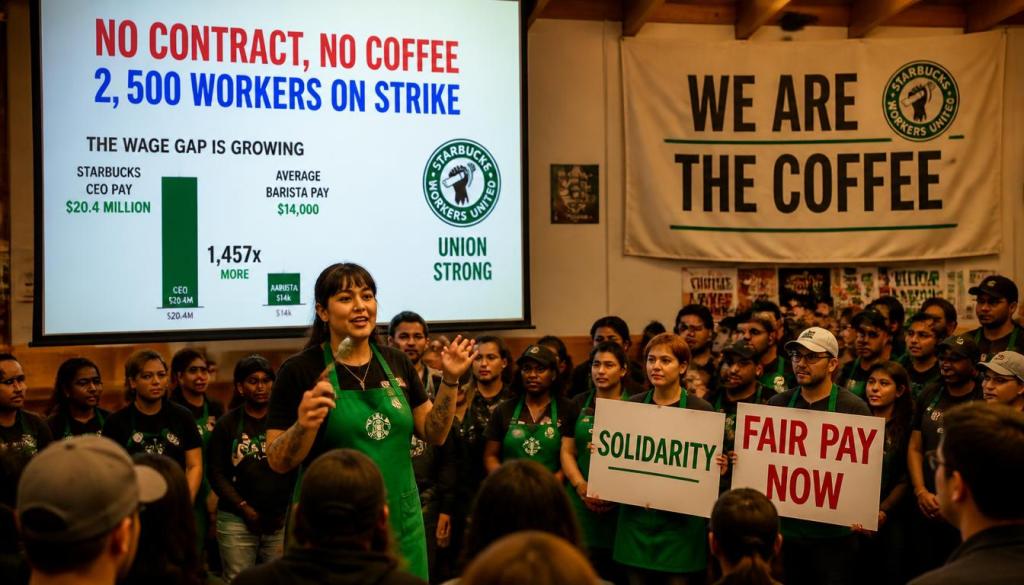
More than 2,500 Starbucks baristas across the United States are now on strike as the union representing coffee shop workers escalates its four-year fight for a first contract. The strike, which began on Red Cup Day in July, has expanded to include 95 stores in 65 cities, including Cleveland, Memphis, Springfield (Missouri), Albany, and dozens more .
Workers are demanding higher pay, better hours, and an end to what they describe as unlawful labor practices — and they’re calling on customers to delete the Starbucks app as part of a “No Contract, No Coffee” campaign.
The State of the Strike
The strike started on July 16, targeting Starbucks’ annual Red Cup Day — typically one of the busiest days of the year for the coffee giant . What began as a one-day work stoppage has become an open-ended strike, with the union vowing to continue until Starbucks returns to the bargaining table in good faith .
The union has grown from a single store in Buffalo, New York, in 2021 to represent approximately 550 stores and nearly 10,000 baristas across the country . Yet despite four years of organizing, a first contract has never been reached.
Starbucks has pushed back hard against the strike’s impact. The company told CNBC that the walkout has had “minimal disruption” to its operations. Starbucks also noted that this year’s Red Cup Day was “the strongest in the company’s history in terms of sales and store traffic” .
What Workers Want
The union’s demands include:
Higher wages. The union is requesting a minimum wage of $17 per hour, along with 4% annual raises . Workers point to the massive pay disparity between baristas and executives. Starbucks CEO Brian Niccol, who joined in September, could make more than $100 million in his first year. One striking worker noted that Starbucks also spent $81 million in June on a conference in Las Vegas for 14,000 store managers .
Better hours and staffing. Baristas say they struggle to get more than 19 hours per week, falling short of the 20-hour threshold required to qualify for Starbucks benefits like health insurance . Dachi Spoltore, a barista from Pittsburgh who makes $16 per hour, said: “I want Starbucks to succeed. My livelihood depends on it. We’re proud of our work, but we’re tired of being treated like we’re disposable” .
Resolution of unfair labor practice charges. The union has filed hundreds of charges with the National Labor Relations Board, alleging that Starbucks has fired baristas in retaliation for unionizing, refused to bargain in good faith, and attempted to walk back agreements already reached in negotiations .
The Company’s Position
Starbucks says it offers “the best job in retail,” with an average pay package worth $30 per hour, including healthcare, 18 weeks of paid family leave, and 100% tuition coverage for a four-year college degree .
The company has accused the union of walking away from the bargaining table and making “financially unsustainable” proposals . In a recent statement, Starbucks spokesperson Jaci Anderson said: “We’ve been very clear — when the union is ready to come back, we’re ready to talk” .
Starbucks has also noted that it has been expanding its compensation packages. The company recently announced a new incentive rewards program for hourly workers, including potential $300 quarterly bonuses . However, those changes are subject to collective bargaining at unionized stores.
The Politics Behind the Fight
The Starbucks strike is part of a broader wave of labor activism in the service sector. Workers United, the union representing the baristas, is pushing for what it calls a “foundational framework” on key issues like wages, scheduling, and healthcare access .
For urban communities, the strike hits close to home. Service sector jobs are a major source of employment, and the outcome of the Starbucks union battle could have ripple effects across the industry. In cities like New York, Philadelphia, Chicago, and Seattle, the strike has drawn attention to the challenges facing workers who are essential to the urban economy — but who often struggle to make ends meet.
Why It Matters to the People
This strike is not just about coffee. It is a test of whether the labor movement can succeed in the modern service economy. Since the first store unionized in Buffalo in 2021, the movement has grown to include stores across the country — but it has yet to secure a single contract .
The union’s “No Contract, No Coffee” campaign, which urges customers to delete the Starbucks app in solidarity, is a direct challenge to corporate power . It raises a fundamental question: In an economy where CEO pay has skyrocketed and workers are struggling to afford basic necessities, what is a fair share of the profits?
The Bottom Line
The Starbucks strike is now the largest in the company’s history. Workers are demanding a $17 minimum wage, better hours, and a resolution to hundreds of unfair labor practice charges.
Starbucks says it is ready to talk — but the union says the company has walked away from agreements already made.
For urban communities, the outcome matters. Service sector workers are the backbone of the city economy, and their fight for fair wages, stable hours, and dignity on the job is a fight that affects us all.
The effort to build better communities and a better America starts with you. Visit Fight for the People PAC and Democrats.org today and sign up, to give or do what you can to make America better for all.
Sources
KRGV: “Starbucks workers kick off 65-store US strike on company’s busy Red Cup Day” (July 16, 2026)
Bloomberg: “Starbucks Union Says It’s Working With Company to Revive Contract Talks” (March 12, 2026)
Barchart: “Starbucks union says 30 more US stores are joining week-old strike” (August 8, 2026)
Insurance Journal: “Starbucks May Be Neglecting Labor Dispute Risks, Shareholder Proxy Firms Warn” (March 16, 2026)
WBRZ: “Starbucks strike expands, closes nearly 60 US stores” (July 5, 2026)
OnLabor: “Starbucks union revives talks with company” (March 16, 2026)
TribLIVE: “Starbucks union strikes stores in Pittsburgh area on Red Cup Day” (August 5, 2026)
The Seattle Times: “Starbucks workers at Pike Place store seek to unionize” (April 19, 2026)
New Age: “Starbucks baristas launch strike on chain’s ‘Red Cup Day’” (May 6, 2026)
MarketScreener: “Starbucks Union Proposes New Contract Terms, Looks to Reopen Negotiations” (March 12, 2026)
Prachatai: “Starbucks union calls for app boycott” (April 2026)
The Seattle Times: “Pike Place Starbucks workers won’t vote to join a union as planned” (May 4, 2026)
The People’s Weekly — urban intel from a holistic social approach.
[ai]
 The People's Weekly
Leave a comment