Urban News & Lifestyle — Listen Free 🎧 | Contact 📧
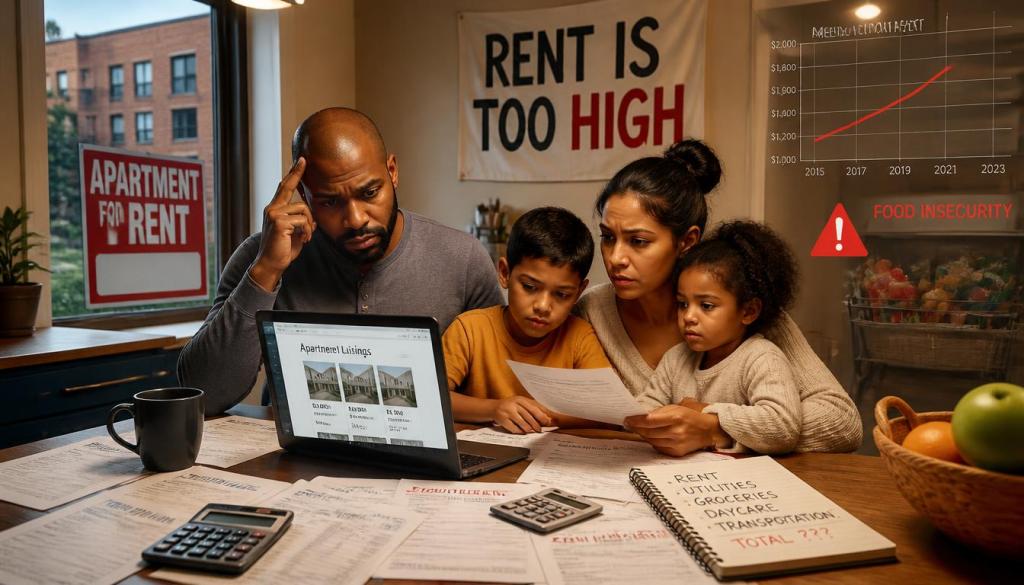
Nearly half of all U.S. renters are now “cost-burdened,” meaning they spend more than 30% of their income on housing. According to Harvard University’s 2026 State of the Nation’s Housing report, nearly 22.7 million renter households—almost half of all renters in the U.S.—are spending more than 30% of their income on rent. More than 12 million of those households are paying more than half their income on housing alone .
The U.S. faces a housing shortfall of 4.7 million homes—the result of two decades of underbuilding that began after the 2008 financial crisis . The squeeze is being felt from New York to Oklahoma City—and it’s reshaping urban life as we know it.
The Numbers: What “Cost-Burdened” Actually Means
The national picture:
- Nearly 50% of all renters are cost-burdened—a figure that has persisted in recent years
- 56.2% of Black households face higher housing costs compared to the overall population
- 53.2% of Hispanic households face higher housing costs compared to the overall population
Oklahoma City: 52.2% of renting families are cost-burdened—roughly one in two families are stretched thin.
The root cause: The U.S. faces a housing shortfall of 4.7 million homes—the result of two decades of underbuilding that began after the 2008 financial crisis . As Zillow senior economist Kara Ng put it: “The more than 300,000 lots currently listed for sale represent the lowest-hanging fruit in addressing a housing shortage that’s two decades in the making” .
The Ripple Effects: How Rent Burdens Impact Urban Communities
When families spend more than 30% of their income on housing, something has to give. That something is often groceries, healthcare, childcare, or savings.
The food insecurity connection: Over 4.7 million Americans have lost food assistance benefits since the Trump administration’s tax and spending legislation took effect in July 2025—the largest drop in nearly 30 years . The new law cuts approximately $187 billion in SNAP funding over 10 years while expanding work requirements .
In Arizona, the hardest-hit state, SNAP recipients dropped by nearly half—more than 457,000 people, including nearly 196,000 children . The cuts have driven a record number of people to food banks, with about 843,000 Arizonans seeking support from a food pantry in April 2026 alone .
The transit crisis: When bus routes are cut, families lose access to jobs, healthcare, and grocery stores. In Memphis, riders report waiting two to three hours for buses that don’t show up . MATA’s on-time performance for fixed-route buses stands at just 60% .
One Memphis rider, Zen’Yari Winters, who has relied on public transit for more than a decade, said she has walked as long as two and a half hours to get home when no bus arrived and no ride was available .
“Other people are stranded at these stops that may not have someone they can call. That is a public safety crisis that we are dealing with right now.”
— Kelsey Huse, Memphis public transit advocate
In Kansas City, the transit authority was set to eliminate nine bus routes—affecting more than 4,300 weekday riders—until the city stepped in with $8.3 million in last-minute funding .
The housing assistance gap: In Cleveland, 55 low-income households have gone without federal housing assistance since August because of a HUD funding delay—and they could face eviction if the money doesn’t come through by October .
Cleveland has since learned it will receive $28 million through several HUD programs, but the money was not available in time for the city to renew its contract with the nonprofit that administers housing subsidies .
“They know they’re at risk of losing their house, their roof over their head, for something they did not do.”
— Willie Thomas, Cleveland landlord, who has two tenants in the program
What This Means for Urban Families
The housing crisis is not just about rent—it’s about the entire infrastructure of urban life. When housing costs consume more than 30% of income, families make impossible choices:
- Food vs. rent: The SNAP cuts hitting communities are a direct consequence of the same federal policies driving the housing crisis
- Transportation vs. work: In cities like Memphis, unreliable buses make it harder to hold down a job
- Eviction vs. survival: In Cleveland, families face eviction through no fault of their own—a delayed contract between the city and HUD
The Path Forward: What Needs to Change
Experts point to a single solution: build more housing. The U.S. is short 4.7 million homes, and the gap is not closing fast enough .
Congress recently passed the 21st Century ROAD to Housing Act, the most sweeping federal housing bill in a generation. The legislation:
- Prohibits institutional investors from purchasing single-family homes
- Streamlines permitting for housing projects
- Reforms the Community Development Block Grant program to encourage greater housing production
- Improves veterans’ access to home loans
The bill passed the House by a 396-13 vote and has been sent to the Senate for approval .
Local leaders are trying—in Kansas City, the city council unanimously approved $8.3 million in emergency funding to prevent bus cuts . In Memphis, advocates continue to fight for reliable bus service .
But the problem is larger than any one city. And with the midterms less than 80 days away, voters are watching.
The Bottom Line
Half of American renters are cost-burdened. Families are choosing between rent and groceries. Bus routes are being cut. And federal funding delays are leaving families facing eviction.
The housing crisis is not just about housing—it’s about the entire infrastructure of urban life.
Sources
Enterprise Community Partners: “Half of American renters are cost-burdened” (2026)
National Association of REALTORS®: “NAR President Testifies Before Senate on Housing Affordability Crisis” (June 22, 2026)
Infobae: “Más de cuatro millones perdieron la ayuda alimentaria SNAP en EE. UU.” (August 3, 2026)
U.S. House Financial Services Committee: “21st Century ROAD to Housing Act Passes House” (May 20, 2026)
Bullard Center: “Nearly half of US renters spend more than 30% of their income on housing costs” (2023)
Nasdaq: “More than 300,000 empty lots for sale could close America’s housing shortage by 6%” (July 20, 2026)
U.S. News & World Report: “Millions Lose Food Stamps Under Trump Cuts. Arizona Is Hardest Hit” (June 24, 2026)
Senator John Hoeven: “Hoeven Statement on Passage of 21st Century ROAD to Housing Act” (March 12, 2026)
Action News 5: “MATA riders say Memphis bus service remains unreliable” (July 31, 2026)
Representative Sharice Davids: “$13.3M in federal funds to replace, rehabilitate Kansas City buses” (March 9, 2026)
Cleveland.com: “Delayed HUD funding leaves Cleveland landlords unpaid, tenants facing possible eviction” (August 13, 2026)
The People’s Weekly — urban intel from a holistic social approach.
[ai]
 The People's Weekly
Leave a comment