Health & Personal Awareness |
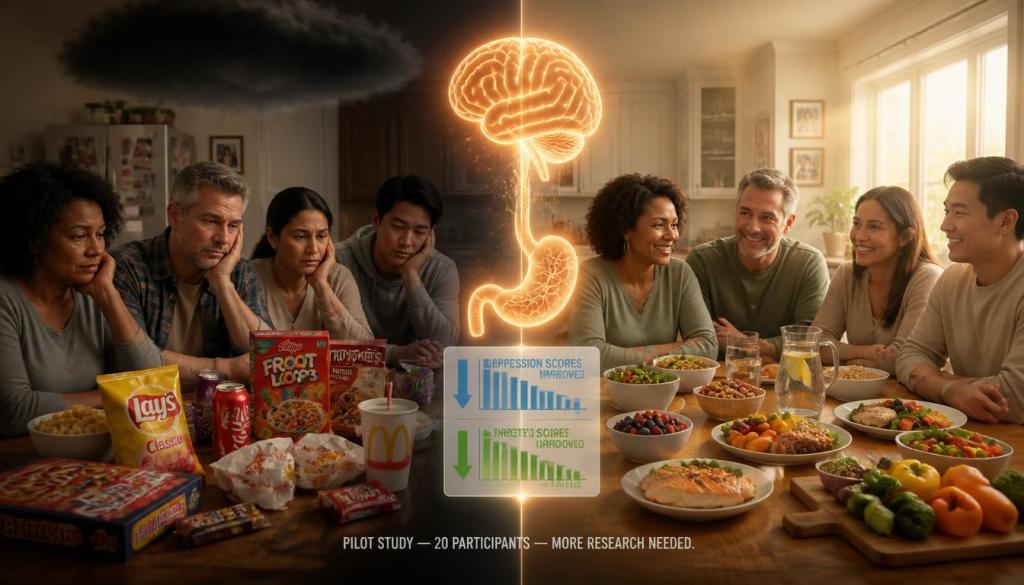
A preliminary study led by researchers at the University of California, San Francisco, adds to a growing body of evidence that reducing ultraprocessed food may improve symptoms of depression. The study, published September 23 in JAMA Psychiatry and funded by the National Institutes of Health, is believed to be the first to compare symptoms in people with depression before and after they switched from their regular ultraprocessed diet to healthier food.
The findings offer a glimmer of hope for the millions of Americans living with depression—and raise urgent questions about what we’re eating and how it affects our minds.
The Study: What They Did
The pilot trial involved 20 people with depression and a high intake of ultraprocessed foods. The average age of participants was 44, and 70% were female. In addition to depression, 14 participants had anxiety, and all had a high BMI and at least one metabolic disorder—such as hypertension, diabetes, or elevated LDL cholesterol.
Participants were divided into two groups. One group continued with their regular diet for four weeks, while the other shifted to a low-ultraprocessed diet. They shopped for and purchased their own food with guidance from researchers. After four weeks, the two groups swapped diets.
Throughout the study, other factors—medication, therapy, exercise, and sleep—were kept unchanged, allowing researchers to isolate the impact of diet changes.
The Results: “Moderate to Large” Improvements
Participants reduced their ultraprocessed food intake by more than 85%. The results were striking:
- Depression scores showed moderate to large improvements across three separate measures.
- Anxiety scores also improved, though more modestly.
- The intervention was well received by participants, though they noted that reducing ultraprocessed food intake to such a significant extent was not easy.
“Although the pilot study comprised just 20 people, it ‘successfully established the viability of carrying out this research in a larger-scale trial.’”
— Andrew Krystal, MD, senior author and professor at UCSF
The Science: How Food Affects Mood
The link between ultraprocessed food and depression may be explained by what researcher Nyasha Chagwedera calls a “leaky, out-of-balance gut.”
“This gut damage can create low-grade, chronic inflammation throughout the body that either directly causes depression or makes people more vulnerable to it. In other words, junky processing may harm your gut in ways that ripple up to your brain.”
— Nyasha Chagwedera, MD, PhD, corresponding author and assistant professor at UCSF
Ultraprocessed foods include packaged snacks, fast food, sugary beverages, and other industrially manufactured items that may contain preservatives, artificial coloring, flavor enhancers, and emulsifiers. These foods trigger dopamine—the pleasure hormone—which promotes craving. As Chagwedera explained: “Food companies work with scientists to find just the right amount of sugar, salt, and fat that make you want to eat more and more”.
The Important Caveats
The study’s authors and independent experts are clear: this is a small pilot study, and the results should be interpreted with caution.
Key limitations:
- Small sample size: Only 20 people participated, and the age diversity and selected characteristics limit how broadly the findings apply.
- Secondary analysis: The primary goal of the study was to assess whether the intervention was feasible—not to prove it improved depression. The improvements in symptoms were secondary findings.
- Cannot isolate the cause: The study does not allow researchers to determine whether the benefits came specifically from reducing ultraprocessed foods or from other associated dietary changes, such as alterations in calorie, fat, or sugar intake.
- Care bias possible: Participants’ symptoms might have improved simply because they felt cared for and listened to during the study.
“These results are interesting because they suggest that diet may play a complementary role in the management of depression. However, they should be interpreted with caution.”
— Maira Bes-Rastrollo, professor at the University of Navarra
“This is a reasonably well-designed pilot study to assess whether reducing ultraprocessed foods is feasible, but it is insufficient to demonstrate that such a reduction improves depression.”
— José M. Ordovás, professor at Tufts University
What This Means for Everyday Americans
For the average person struggling with depression or anxiety, this study does not offer a cure. It does not suggest that diet alone can replace therapy, medication, or professional care.
But it does add to a growing body of research linking diet quality to mental health—and it suggests that reducing ultraprocessed foods may be a complementary strategy worth discussing with a healthcare provider.
What you can do:
- Talk to your doctor or a registered dietitian before making significant dietary changes, especially if you are managing depression or anxiety.
- Start small. You don’t have to eliminate all ultraprocessed foods overnight. Reducing intake gradually may be more sustainable.
- Focus on whole foods. Minimally processed foods—fruits, vegetables, whole grains, lean proteins—are the foundation of a healthy diet.
- Be aware of the gut-brain connection. What you eat affects not just your body, but your mind.
- Don’t blame yourself. Ultraprocessed foods are designed to be highly palatable, cheap, and convenient. Reducing them is challenging in a food environment that makes them hard to avoid.
The Bottom Line
A small pilot study suggests that reducing ultraprocessed foods may improve depression and anxiety symptoms. The findings are promising but preliminary—the study was too small to draw firm conclusions, and more research is needed.
What is clear is that diet and mental health are connected. For Americans of all backgrounds, the food we eat is not just fuel for the body—it is fuel for the mind. And as researchers continue to explore the gut-brain connection, the question of what we put on our plates may become as important as what we put in our minds.
The effort to build better communities and a better America starts with you. Contact your state representatives and political party’s state, city or county office today and sign up, to give or do what you can to make America better for all.
Sources
UC San Francisco via EurekAlert!: “Could quitting ultra-processed food boost your mental health?” (September 22, 2026)
JAMA Psychiatry: “Reducing Ultraprocessed Foods From the Diets of Patients With Depression” (September 22, 2026)
MedPage Today: “AI Hacks Health Network; White House Drops NIH Plan; RFK Jr. Makes Millions off MAHA” (September 23, 2026)
Science Media Centre España: “A small pilot study examines the reduction in the consumption of ultra-processed foods among patients with depression” (September 22, 2026)
CuídatePlus: “Reducir los ultraprocesados podría mejorar los síntomas de la depresión, según un nuevo estudio” (September 23, 2026)
The People’s Weekly — urban intel with a holistic social approach.
[ai]


Leave a comment