Finance & Investing | Listen Free 🎧 | Contact 📧
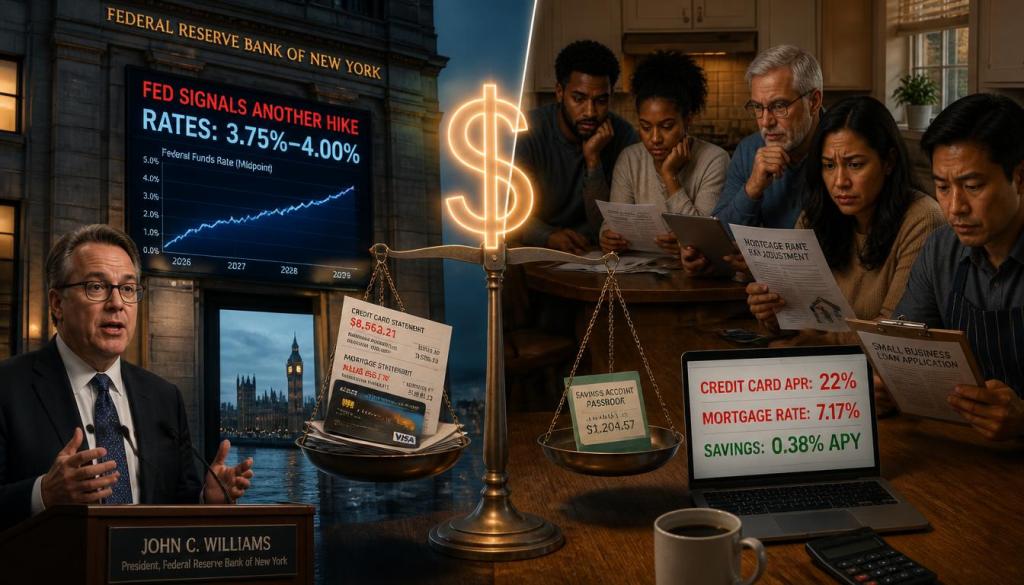
New York Federal Reserve President John Williams said Thursday it would be “reasonable” for the Fed to raise interest rates again before the end of the year, as inflation remains stubbornly above the central bank’s 2% target and markets raised their bets on another hike.
“It’s likely that another rate hike may be appropriate by the end of the year,” Williams said at the London Macro Policy Forum. “That seems to me a reasonable way of thinking about it. But we have to see. We’re going to collect the data and do what we did between July and September”.
The remarks came just over a week after the Fed raised its benchmark rate by 25 basis points to a range of 3.75% to 4% — the first increase since 2023 . And they signal that the tightening cycle may not be over.
The Market’s Reaction: Odds Jump Sharply
Traders responded immediately. CME Group’s FedWatch tool showed a 77.5% probability of a rate hike in October on Thursday, up from about 53% a day earlier . The odds of further tightening in December also climbed .
The shift reflects a simple reality: inflation is not cooling as quickly as the Fed had hoped. Williams acknowledged that “inflation’s been above target for five years” and that “we still have a lot of work to do” .
The Fed’s own projections support that view. According to the FOMC’s September Summary of Economic Projections, the median participant expects core PCE inflation to remain at 3.4% in 2026 — well above the 2% target — with a return to 2% not expected until 2029 .
What Another Rate Hike Would Mean for You
Credit Cards
Credit card APRs are already above 20% on average, and another hike would push them higher. Mark Zandi, chief economist at Moody’s, warned that card rates “will rise once the Fed moves to raise rates, likely to record highs” .
Americans collectively carry about $1.26 trillion in credit card debt, with roughly 60% of cardholders revolving balances month to month . A 25-basis-point increase would cost card borrowers an additional $2 billion in interest charges over the next 12 months, according to WalletHub analysis .
Mortgages
The picture is more complicated. Mortgage rates track the 10-year Treasury yield, not the Fed funds rate directly. The 10-year yield crossed 5% for the first time since 2023 on September 14, and the average 30-year fixed mortgage rate now sits at 7.17% .
Fannie Mae, which previously predicted rates would fall as low as 5.70% in 2026, now forecasts rates will continue rising for the rest of the year .
For homeowners with fixed-rate mortgages, nothing changes — roughly 19.5% of mortgages still carry pandemic-era rates of 3% or below . But for new buyers and those with adjustable-rate mortgages or home equity lines of credit, costs will climb.
Auto Loans
Existing auto loans are fixed and unaffected. But new car loans will get more expensive. WalletHub projects the average APR on a 48-month new car loan will rise by roughly 12 basis points after a 25-basis-point hike — a modest move layered onto payments car buyers are already straining to meet .
Savings
Here is the one silver lining: deposit rates tend to rise with the Fed funds rate. High-yield savings accounts and certificates of deposit will offer slightly better returns . The national average savings account pays just 0.38% APY, while top accounts pay over 10 times that amount .
If you have cash sitting in a low-yield account, now is the time to shop around.
The Two-Speed Economy: Who Gets Hurt, Who Gets Helped
The Fed’s rate hikes are not affecting all Americans equally.
Those who benefit:
- Savers with high-yield accounts and CDs earn more on their deposits .
- Older, wealthier households with fixed-rate mortgages locked in during the pandemic are largely insulated from rising rates .
- AI companies and their investors continue to attract capital despite higher borrowing costs, as the AI investment boom remains the strongest source of demand in the economy .
Those who are harmed:
- Younger and lower-income households who rely on credit cards and variable-rate debt feel the squeeze first .
- Homebuyers face mortgage rates above 7% and diminishing affordability .
- Small businesses face substantially higher financing costs than they did several years ago .
- Retirees reliant on borrowing face higher costs on credit cards and loans .
As former White House Council of Economic Advisers chair Tomas Philipson put it: “Higher rates naturally hit younger borrowers who have lower income… and help older savers who have higher income” .
The Bottom Line
Another Fed rate hike is looking increasingly likely by year-end. For savers, that means slightly better returns. For borrowers — especially those carrying credit card balances or shopping for a home — it means higher costs.
The Fed’s own projections show inflation not returning to 2% until 2029. That means the era of higher-for-longer is not ending anytime soon. And for working families already stretched thin, the squeeze is only tightening.
The effort to build better communities and a better America starts with you. Contact your state representatives and political party’s state, city or county office today and sign up, to give or do what you can to make America better for all.
Sources
CNBC TV18: “New York Fed chief says another rate hike may be appropriate by year-end, markets raise bets” (September 24, 2026)
American Banker: “Fed’s Williams says more work needed to lower inflation” (September 24, 2026)
CNBC: “Higher interest rates squeeze younger and lower-income households” (September 23, 2026)
The Wall Street Journal: “Mortgage Rates Today, September 24, 2026: 30-Year Rates Rise to 7.17%” (September 24, 2026)
MarketScreener: “US consumers and businesses are now facing a future of more expensive borrowing” (September 23, 2026)
The Motley Fool: “The Fed Is Raising Rates for the First Time Since 2023. Here’s What It Means for Your Savings” (September 15, 2026)
Nasdaq: “Will a 2026 Fed Interest Rate Increase Help or Hurt Retirees?” (June 15, 2026)
The People’s Weekly — urban intel with a holistic social approach.
[ai]


Leave a comment