Politics & Policy | Listen Free 🎧 | Contact 📧
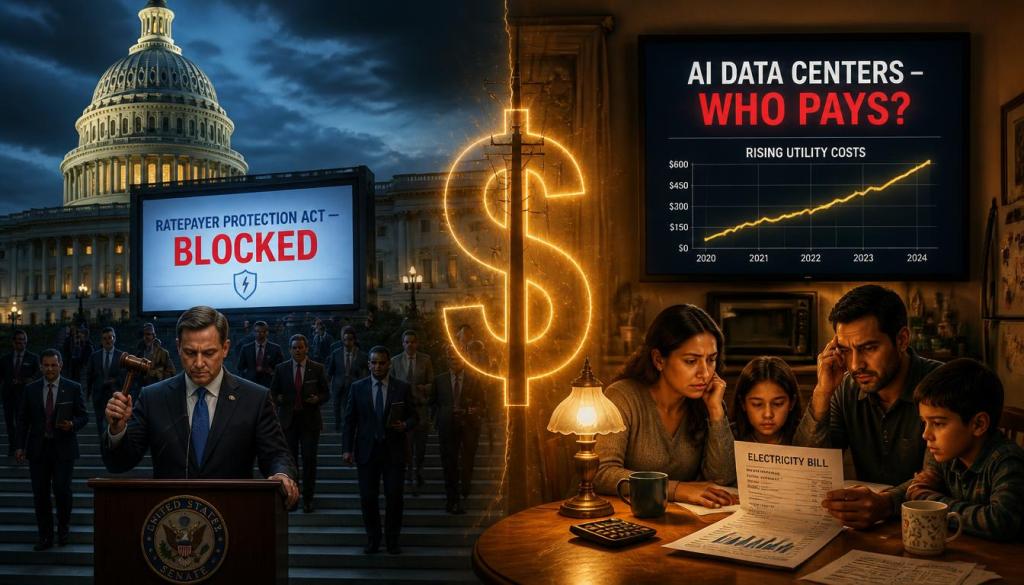
A bipartisan bill aimed at protecting American households from the soaring electricity costs tied to the AI data center boom was blocked in the Senate on Thursday, less than 48 hours after it passed the House by a nearly unanimous margin. The failure exposes a deepening national divide over who should pay for the infrastructure powering the artificial intelligence revolution — and whether Congress will act before the November midterms.
The Bill That Almost Passed
The Ratepayer Protection Act, introduced by Senator Jon Husted (R-OH), passed the House on September 16 by a vote of 417-3 — a rare display of bipartisan consensus. The bill would have required state regulators to consider whether AI data centers consuming 100 megawatts or more of electricity should fully cover the cost of new power generation, transmission lines, and grid upgrades, rather than passing those costs on to ordinary households.
On Thursday, Husted sought to fast-track the bill through the Senate using a unanimous consent procedure, which allows bills to pass without a formal roll-call vote if no senator objects.
Senator Martin Heinrich (D-NM) objected .
The Two Sides
Those who support the bill argue that the AI boom is placing an unfair burden on working families. Data centers are projected to consume a rapidly growing share of U.S. electricity, and utilities have warned that grid upgrades will cost billions. Without legislation, those costs would be spread across all ratepayers — including families who never use AI services.
Husted’s bill would not have mandated that data centers pay. It would only have required state regulators to consider whether they should. Supporters viewed it as a modest, first-step compromise that could pass a divided Congress.
Those who oppose the bill — including Heinrich — argue that the language is too weak to meaningfully protect consumers. Heinrich called it insufficient and introduced his own alternative, the GRID Savings Act, which would direct the Federal Energy Regulatory Commission (FERC) to require users consuming 150 megawatts or more to pay for grid upgrades. That approach would be binding, not voluntary .
“Congress should pass a real law with teeth,” Heinrich argued, rather than one that merely asks states to think about it .
Why It Matters — For Everyone
The debate over who pays for AI infrastructure is not abstract. It affects every American household, regardless of political affiliation, income level, or geography.
For working families and renters: Electricity bill increases hit hardest in low-income communities where energy costs already consume a disproportionate share of household budgets. The same families least likely to benefit directly from AI are the ones most likely to subsidize its infrastructure.
For homeowners and small businesses: Grid upgrade costs get passed through to ratepayers over years or decades. A modest monthly increase compounds into a significant burden.
For AI companies and their investors: Requiring data centers to pay their own way could slow the pace of AI development by raising costs. This is the core tension in the debate — and it is why the industry has a direct stake in whether these bills pass.
For state regulators: The bill’s fate leaves states with the primary responsibility for deciding how to handle data center costs. Some states have already begun imposing their own requirements. Others are waiting for federal guidance that may not come before the election.
For Congress: The vote exposes the limits of bipartisan cooperation in a narrowly divided Senate. A bill that passed the House 417-3 died in the Senate in under 48 hours — a reminder that unanimous consent is a fragile tool, and that one senator can block legislation with national implications.
The Midterm Connection
The AI data center fight is unfolding against the backdrop of a closely contested midterm election. Senator Chuck Schumer recently said Democrats have “multiple paths for the majority,” and Democrats have been organizing aggressively on affordability issues.
But the politics of AI regulation are complicated. Politico reported that Democratic strategists have advised candidates in key battleground districts to avoid emphasizing AI regulation — not because they disagree with it, but because the AI industry’s super PACs have shown a willingness to spend heavily against candidates who criticize the industry. One group, Leading the Future, spent over $25 million in primaries and launched a $2 million ad campaign supporting Republican Senate candidates .
This means the same issue that unites Americans in their electricity bills — who should pay for data center infrastructure — divides them on the campaign trail. Candidates are being advised to tread carefully, even as the costs mount for their constituents.
What Happens Next
The Senate is scheduled to recess on October 2. The permitting reform deal that negotiators have been working on — which could include data center provisions — remains unresolved, with Environment and Public Works Chair Shelley Moore Capito saying it “has to pop out of here in the next 48 hours” .
If no deal comes together, the Ratepayer Protection Act is effectively dead until after the election. The House has already passed its version. The Senate has blocked it. And American households will continue paying for the grid upgrades needed to power the AI boom — unless states act on their own.
The effort to build better communities and a better America starts with you. Contact your state representatives and political party’s state, city or county office today and sign up, to give or do what you can to make America better for all.
Sources
Semafor: “Senate permitting talks reach a turning point” (September 17, 2026)
SBS News: “US Democrats Wary of AI Industry’s ‘Money Bomb,’ Urge Candidates to Watch Their Words” (September 17, 2026)
The People’s Weekly — urban intel with a holistic social approach.
[ai]
 The People's Weekly
Leave a comment