Business & Entrepreneurship | Listen Free 🎧 | Contact 📧
For entrepreneurs across America — Black, Latino, Asian, Indigenous, immigrant, and working-class founders of every background — the past decade brought a wave of corporate and nonprofit grant programs designed to widen access to capital. But as diversity-focused funding initiatives shrink or disappear altogether, founders are facing a hard truth: grants are a starting point, not a strategy.
The question now is what comes next — and who gets left behind when the money stops flowing.
The State of Funding for Underrepresented Founders in 2026
Entrepreneurs of color remain significantly underrepresented in venture capital and traditional lending. Black-owned businesses make up roughly 3% of all U.S. employer firms and receive a fraction of a percent of venture capital funding. Latino-owned businesses face similar gaps — receiving only about 1-2% of venture capital exits despite representing a growing share of new business formation. Asian-owned businesses, while better represented in some sectors, still face barriers in access to mainstream financing. Indigenous and rural entrepreneurs often operate in markets that banks simply don’t serve.
In response, grant programs and accelerators emerged to fill the gap — but the landscape is shifting.
Programs that are active or reopening:
- Amber Grant (WomensNet): Three $10,000 grants awarded monthly, plus a $50,000 year-end prize. Open to women-owned businesses of all backgrounds (50%+ ownership). $15 application fee, with fee waivers available .
- Camelback Ventures Fellowship: $50,000 in capital for founders in education, health, workforce, economic inclusion, and policy. Cohort 18 applications close September 18, 2026 .
- Comcast RISE: $5,000 monetary grants plus technology makeovers, creative production, media schedules, and business coaching. Awarded in cycles by region .
- NAACP Powershift Entrepreneur Grant: $25,000 grants for rising and established Black entrepreneurs, tied to Black Entrepreneurs Day. Typically opens in October .
- Intuit IDEAS Program: $5,000 cash grant, $1,000 technology grant, plus $10,000+ in software and training for small businesses in operation at least one year .
Programs that have closed or paused:
- Fearless Fund Strivers Grant: Permanently terminated under a settlement announced September 11, 2024 .
- Black Ambition: Running no 2026 Prize Competition, listed as “paused” .
- Tarte’s Shape Your Future Awards: No 2025 or 2026 cycle found .
- digitalundivided BREAKTHROUGH: Closed for the cycle .
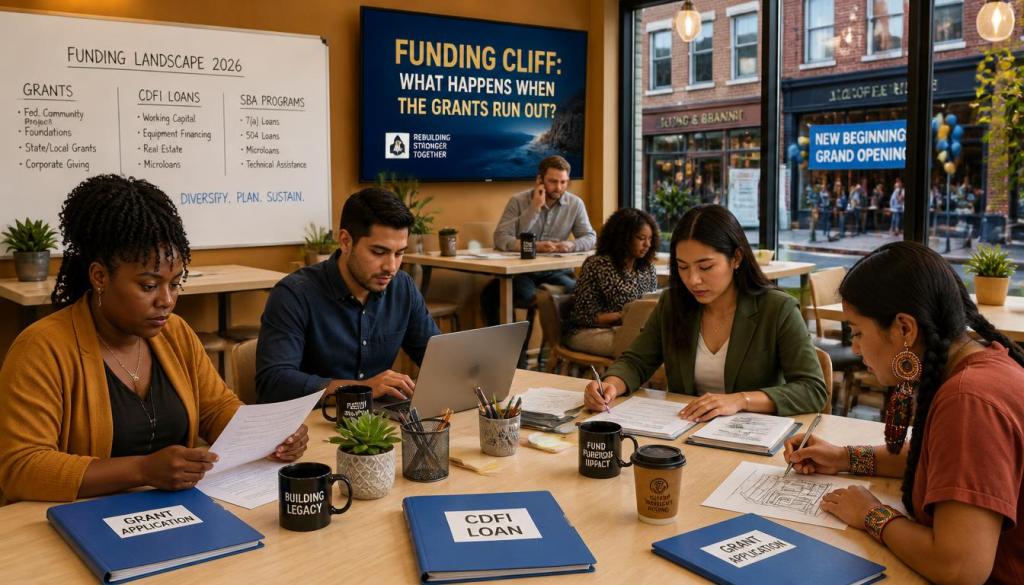
The pattern is clear: some doors are closing while others remain open. For entrepreneurs of every background, the challenge is the same — how to navigate a funding landscape that is contracting even as the need grows.
The Case for CDFIs: Lending Beyond the Grant
Community Development Financial Institutions (CDFIs) are Treasury-certified lenders mandated to serve underserved communities — urban and rural, Black and Brown, immigrant and working-class, across every demographic that mainstream banks have historically overlooked.
Unlike grants, CDFIs offer loans — but they are designed for entrepreneurs who cannot access traditional bank financing .
How CDFIs differ from grants:
| Feature | Grants | CDFI Loans |
|---|---|---|
| Repayment | Not required | Required |
| Amounts | Typically $5K–$50K | Up to $250K+ |
| Timeline | One-time injection | Ongoing relationship |
| Purpose | Seed capital or project funding | Working capital, equipment, expansion |
Examples:
- HOPE Credit Union lends up to $250,000 on a rolling basis to businesses in Alabama, Arkansas, Louisiana, Mississippi, and Tennessee — a region that includes some of the poorest communities in America, Black and white alike .
- Florida Black Business Loan Program lends up to $250,000 through state-certified administrators, moving in annual appropriation cycles .
The key distinction: grants are a long shot; CDFI loans are a plan. As one analysis put it, “Line up a CDFI in parallel. Grants are a long shot. A CDFI loan is a plan” .
The SBA’s Role: Technical Assistance, Not Direct Grants
The U.S. Small Business Administration does not provide federal grants to start or grow a business. That’s the official position from USA.gov .
What the SBA does offer:
- Loan guarantees (7(a), Microloan programs)
- Technical assistance through resource partners
- Program for Investment in Microentrepreneurs (PRIME): Grants awarded to nonprofit organizations that then provide training and technical assistance to disadvantaged entrepreneurs. FY2026 awards ranged from $75,000 to $400,000, with a 50% matching requirement .
What this means for entrepreneurs of all backgrounds: The SBA is a resource for training, counseling, and loan access — not direct cash grants. Confusing SBA programs with grants is a common mistake that leads entrepreneurs to waste time on applications that don’t exist .
The Corporate Pullback: What It Means for Every Community
Several factors are driving the contraction in funding for underrepresented founders:
- DEI backlash: Following the 2020 racial justice movement, corporate commitments to diversity surged. Many have since been scaled back or eliminated — affecting programs that served Black, Latino, Asian, Indigenous, and women entrepreneurs alike.
- Legal challenges: The Fearless Fund settlement signaled that race-exclusive grant programs face legal risk. Other programs have responded by broadening eligibility to include all underrepresented founders, regardless of race.
- Economic pressure: Companies are tightening budgets across the board, and philanthropy is often the first line item cut.
The U.S. Black Chambers, Inc. launched the USBC 360° Accelerator in response — a 12-week program for growth-stage Black founders in consumer packaged goods, offering up to $100,000 in grant funding plus mentorship and strategic support . The program targets founders with annual revenue between $100,000 and $2,000,000 — businesses that have traction but need help scaling .
Similar programs exist for Latino founders through the Latino Business Action Network (LBAN) , for Asian entrepreneurs through Chinatown-based small business associations , and for Indigenous entrepreneurs through Native CDFIs — each serving their own communities with the same goal: capital access for those who have been left out.
“USBC 360° represents a strategic investment in the growth and sustainability of Black entrepreneurship. By equipping founders with the tools, resources, and access to capital needed to expand across multiple channels, we are not only strengthening Black-owned businesses but also positioning them for long-term success.”
— Ron Busby Sr., President and CEO, U.S. Black Chambers, Inc.
The Blueprint: What Entrepreneurs of Every Background Should Do Now
1. Apply to rolling grants immediately. Programs like the NAACP Powershift and HOPE Credit Union lend on a rolling basis. Don’t wait for a deadline that doesn’t exist .
2. Calendar the dated ones. Camelback Ventures closes September 18. Intuit IDEAS has a priority deadline of September 12. The Amber Grant closes the last day of every month .
3. Build a relationship with a CDFI. Grants are competitive and small. A CDFI loan is a scalable plan. Start the conversation before you need the money .
4. Write one strong story you can reuse. Most grant applications ask the same things: what your business does, the impact of the money, and your community connection. Draft it once .
5. Confirm eligibility on the official page. Grant amounts, rules, and deadlines change by cycle. The table is a starting point, not a substitute for the program’s own site .
6. Know your local resources. Every community — Black, Latino, Asian, Indigenous, rural, urban, immigrant — has organizations dedicated to supporting entrepreneurs. Find them, connect with them, and use them.
The Bottom Line
The funding landscape for underrepresented entrepreneurs is shifting. Some grant programs are closing. Others are opening. The constant is that capital access remains the single greatest barrier for founders who have been historically excluded — regardless of race, ethnicity, or background. Grants can help. CDFI loans can scale. But the blueprint requires a strategy that doesn’t depend on any single source of funding.
The effort to build better communities and a better America starts with you. Contact your state representatives and political party’s state, city or county office today and sign up, to give or do what you can to make America better for all.
Sources
GrantCompass: “Black-Owned Business Grants Open Now (August 2026): 17 Programs, 1 Open Deadline” (August 23, 2026)
SupplierDiversity.com: “Grants for Black-Owned Businesses 2026: 7 Real Programs Open Now, With Amounts and Deadlines” (July 25, 2026)
Camelback Ventures: “Apply” (2024)
Comcast Corporation: “Comcast Supports American Small Business Growth, Awarding 500 Grant Packages to Entrepreneurs in Five Regions” (August 19, 2025)
NAACP: “Powershift Entrepreneur Grant” (October 23, 2025)
Los Angeles Regional VBOC: “Boost Your Business with the 2026 Intuit IDEAS Program: Grants, Coaching, and Free Software” (August 30, 2026)
Black Enterprise: “As Funding Tightens For Black Businesses, USBC Launches New Accelerator Program” (May 6, 2026)
USA.gov: “How to start and fund your own business” (August 17, 2026)
Congress.gov: “The Small Business Administration’s Program for Investment in Microentrepreneurs” (October 15, 2024)
WomensNet: “Amber Grant Rules” (July 8, 2025)
The People’s Weekly — urban intel from a holistic social approach.
[ai]
 The People's Weekly
Leave a comment