Technology & Innovation | Listen Free 🎧 | Contact 📧
The AI boom is minting billionaires at a record pace. But for Black Americans—as founders, investors, and everyday users—the barriers to participating in that wealth creation are as steep as ever. From venture funding to corporate ownership to the biases embedded in the tools themselves, the data paints a clear picture: AI is widening the gap, not closing it.
Ownership: Who Really Owns the AI Revolution?
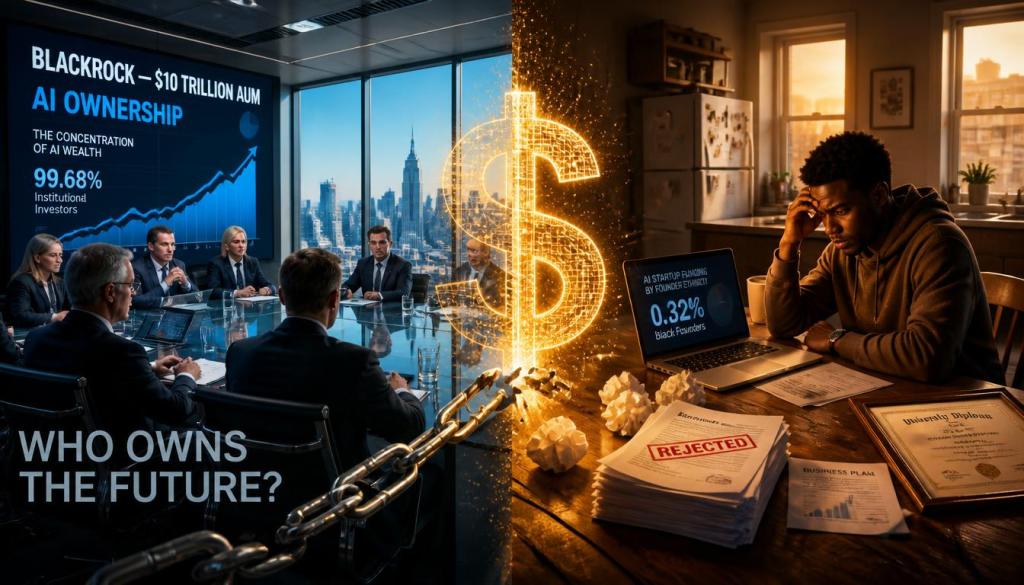
When you ask who owns the major tech companies powering the AI boom, the answer is unambiguous: institutional investors, predominantly white-led asset managers.
The ownership structure:
- IBM: Approximately 64% owned by Vanguard, BlackRock, and State Street
- Intel: Vanguard holds 8.8%, BlackRock holds 6%
- C3.ai: BlackRock holds 8.39%
BlackRock—the world’s largest asset manager with over $10 trillion under management—has positioned itself at the center of the AI economy. Its Technology and Private Equity Term Trust lists Anthropic (6.2%), PsiQuantum (6.0%), and Nvidia (3.8%) among its top holdings . The fund allows regular investors to participate in private AI companies—but the vast majority of Americans, and Black Americans in particular, have no meaningful stake in these vehicles.
The result: The wealth generated by AI flows overwhelmingly to a small, predominantly white investor class.
Investment: The Funding Gap Persists
In 2025, Black founders raised approximately $942 million—just 0.32% of the $290 billion invested across the U.S. venture market .
The 2026 rebound is misleading. In Q1 2026, Black founders raised $643 million—the highest quarterly total since 2022 . But that surge was driven almost entirely by a single deal: SambaNova, an AI hardware company co-founded by Kunle Olukotun, which raised $350 million .
As Gené Teare, Head of Research at Crunchbase, told TechCrunch: factors limiting funding for Black founders include limited access to networks, relationship-building opportunities, and early introductions .
Access: The Awareness and Usage Gap
According to Pew Research Center’s 2026 survey of 5,119 U.S. adults, Asian adults stand out significantly for both awareness and usage of AI chatbots.
| Metric | White | Hispanic | Black | Asian |
|---|---|---|---|---|
| Net Uses AI Chatbots | 46% | 49% | 49% | 70% |
| Daily Use | 20% | 26% | 24% | 47% |
*Source: Pew Research Center, “Americans and AI 2026” *
The “Decision Divide”: As one advocate put it, the real AI divide isn’t just access to tools—it’s access to knowledge, networks, and opportunities to build with them .
The Bias Problem: AI Isn’t Neutral
A study published in the Journal of Financial Planning tested seven major AI platforms on identical personal finance prompts. When researchers changed only the race and gender of the hypothetical user, ChatGPT, Copilot, and DeepSeek recommended higher emergency savings for women and African American users than for white male counterparts .
The researchers noted that AI models combine vast datasets on human behavior to make assumptions—such as expecting minority male users to face longer job searches—leading tools to prescribe larger financial cushions without explaining the reasoning . DeepSeek recommended a 75% bond allocation for an African American male household, compared with 30% for white households .
Workplace bias: Research from Harvard Kennedy School finds that Black women entering workplaces with a higher percentage of white colleagues face lower promotion rates and higher attrition . AI-generated stereotypes—including videos depicting Black women as irresponsible mothers—exacerbate these perceptions in digital spaces .
The Wealth Gap: The Foundation of the Ownership Gap
A Federal Reserve Bank of Boston study of Massachusetts families reveals the starkest picture of racial wealth disparity available:
| Demographic | Median Net Worth | Zero/Negative Net Worth |
|---|---|---|
| White | $549,200 | — |
| Asian/Hawaiian/Pacific Islander | $305,000 | — |
| Black | $7,800 | 31% |
| Hispanic | $1,200 | 41% |
*Source: Federal Reserve Bank of Boston, 2026 *
Key Takeaway: Black and Hispanic families in Massachusetts have 1% or less of the wealth of White families. These gaps translate directly into ownership capacity—the ability to invest, own equity, or build generational wealth.
The Human Cost: Automation and Job Displacement
Brookings Institution analysis identifies 6.1 million U.S. workers who face both high AI exposure and low adaptive capacity—meaning they are most at risk of displacement without the resources to recover.
| Factor | Data |
|---|---|
| Workers at High Risk | 6.1 million |
| Gender of At-Risk Workers | 86% are women |
| Occupations Most At Risk | Administrative, clerical, secretarial, receptionist |
*Source: Brookings Institution, NBER *
Bureau of Labor Statistics data shows Black workers hold nearly 20% of clerical and administrative support roles despite being just 13% of the workforce—meaning they are overrepresented in the exact job categories AI is replacing .
More than 300,000 Black women left the workforce in recent data—a trend that threatens to deepen existing disparities .
The Blueprint: What’s Being Done
Workforce training: At City of Refuge in Atlanta, NPursuit Career Partners runs a 32-week cybersecurity program where Black students make up the overwhelming majority. The program achieved a 97% certification rate on the CompTIA Network+ exam—nearly double the national average .
Financial tools: GenBlkWealth is an AI-powered money app built specifically for Black families, offering zero-based budgeting, automatic bank syncing, and an AI coach that understands the cultural context behind money decisions .
AI literacy: National Black AI Literacy Week (June 8–12, 2026) was created to close the AI divide—ensuring Black communities have access to AI education, participation, representation, entrepreneurship, and leadership .
The Bottom Line
The AI revolution is creating unprecedented wealth—but Black Americans are largely locked out of ownership, underrepresented in investment, and underserved in access. The tools themselves carry biases that can actively harm Black users. And the jobs most vulnerable to automation are disproportionately held by Black workers.
The blueprint for change requires more than access. It requires ownership, investment, and decision-making power. As one advocate put it: “The people building the future should reflect all the people who will live in it” .
For urban communities, the message is clear: AI is not neutral. It is shaped by who owns it, who builds it, and who benefits from it. The question is whether Black Americans will be participants—or casualties.
Sources
Pew Research Center: “Racial and ethnic differences in how adults use and view AI” (June 16, 2026)
Pew Research Center: “Asian Americans more likely to use chatbots for a variety of tasks” (June 16, 2026)
Crunchbase News: “‘This System Wasn’t Built For Me’: Black Founders Became Investors To Change Venture Capital” (June 16, 2026)
KuCoin: “Black founders in the U.S. raised $643 million in Q1 2026” (May 30, 2026)
Data & Society: “‘AI Can’t Do Nothing With Us!’: Inside One Atlanta Workforce Training Program” (January 28, 2026)
Data & Society: “From Plantations to Platforms” (February 17, 2026)
MSMU: “RSWG 2026 Closer Look: AI’s Impact on Black Women” (May 17, 2026)
Yahoo Finance: “Here’s Who Really Owns All Of The Major Tech Brands” (April 29, 2026)
Quartz: “AI tools are giving inconsistent financial advice — and some may show racial and gender bias” (July 6, 2026)
LinkedIn: “Black founders left out of AI boom despite being early adopters” (June 6, 2026)
LinkedIn: “National Black AI Literacy Week 2026: Closing the AI Divide” (June 4, 2026)
Product Hunt: “GenBlkWealth, Build Generational Wealth” (June 25, 2026)
The People’s Weekly — urban intel from a holistic social approach.
[AI]
 The People's Weekly
Leave a comment