HipHop Culture — Listen Free 🎧 | Contact 📧
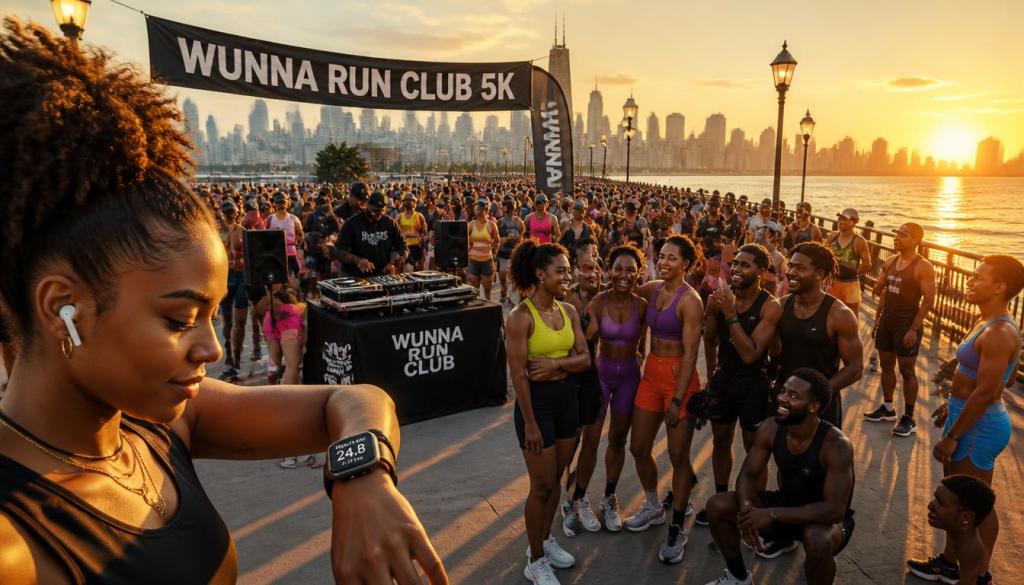
Apple’s new “Health Age” feature — which estimates whether your body is aging faster or slower than your birth certificate — arrives at the exact moment hip-hop culture is experiencing a fitness renaissance. Run clubs led by artists like Gunna and community organizers across the country are transforming how Black communities approach health. Together, they tell a bigger story: a cultural shift from neglecting the body to actively managing it.
The Run Club Explosion: From 12 People to 2,000
When Gunna’s Wunna Run Club 5K took over New York’s Pier 63, the rain didn’t stop anyone. Approximately 2,000 runners showed up — the vast majority young and Black.
Akhibi Hererra, founder of the Peak and Pace run club, which partnered with Gunna, put it plainly:
“It’s not just about running. We started with 12 people 15 months ago. Now we’re bringing 2,000 people together with the biggest star in the world. But one person didn’t do that. It took a community coming together around a shared mission. That’s how a run club becomes a movement.”
This isn’t an isolated phenomenon.
WeRun313 in Detroit is the largest run club in Michigan and the tri-state area, drawing 350 to 500 people every Tuesday. Founder Joe Robinson has described it as more than physical fitness — it’s about “spiritual growth and mental health.”
ZFT Run Club in Houston held its 9th annual Juneteenth weekend 5K, with support from Nike and Hibbett. 6run5 in Nashville draws over 100 people weekly and has become a hub for Black wellness in the city.
The common thread: these communities aren’t waiting for permission to define what health looks like. They’re building it themselves.
What Apple’s Health Age Actually Does
Apple’s new Longevity tab and Health Age feature combine data from your heart, sleep, mental health, physical activity, metabolism, hearing, and nutrition. It analyzes:
- VO₂ max — a key measure of cardiorespiratory fitness
- Resting heart rate
- Heart rate variability
- Sleep patterns
- Blood markers you can manually add, like LDL cholesterol and glycated hemoglobin
The Apple Watch Series 12 also introduces a readiness score, rated 0 to 10, that combines sleep, recent activity, and physiological data to answer a simple question: Is your body ready to push, or does it need recovery?
Important caveat: Apple explicitly labels these as “wellness features,” not medical devices. They are not FDA-approved. They are reference tools — not diagnoses.
Where the Two Movements Intersect
The run club movement is, at its core, a body sovereignty movement. Historically, Black communities have been systematically underserved by the healthcare system, with worse outcomes across nearly every major health indicator.
Run clubs are saying: We will define strength, endurance, and health on our own terms.
Apple’s Health Age can serve as a personal dashboard within that framework:
| The Run Club Provides | Health Age Provides |
|---|---|
| Community, accountability, energy | Personal data, trends, feedback |
| “Someone to run with” | “What your body is telling you” |
| Cultural belonging | Quantified self-awareness |
Gunna himself said he trained six days a week after his release from jail, replacing unhealthy habits with purpose. His run club attracts 2,000 people not because he teaches a secret training method — but because he is living proof that change is possible.
Apple’s Health Age says the same thing in data language: your body can get younger. You just have to pay attention to it.
A Necessary Warning
Apple’s Health Age is not FDA-approved. It is not a diagnostic tool. It cannot replace a doctor. Run clubs cannot replace professional medical care either.
Real health is a three-part equation: community support + personal discipline + professional care. Apple’s tools can track trends. Run clubs can keep you motivated. But the real change happens when you decide — today — to move.
The Bottom Line
Apple’s Health Age launched at the same moment Black run clubs are exploding across America. They may seem unrelated, but they point in the same direction: from passively accepting health outcomes to actively managing your body as capital.
Gunna’s run club had 2,000 people. WeRun313 has 500 every week. ZFT has been running for nine years. These people aren’t staring at a watch waiting for a number to tell them they’re old. They’re using their feet to redefine what “young” means.
Apple can give you a number. But only you and your community can make that number smaller.
Sources
Yahoo Tech: “Apple’s revamped Health app will calculate your ‘health age’ and readiness score” (September 8, 2026)
TechRepublic: “Apple Health Redesign Turns Wearable Data Into Daily Advice” (September 9, 2026)
The Mac Observer: “Wellness Feature or Medical Device? How Apple Labels Every New Health Feature for 2026” (September 9, 2026)
Atlanta Journal-Constitution: “Atlanta rapper Gunna hosts another 5K run. For him, the journey is personal.” (September 10, 2026)
BroadwayWorld: “Gunna Brings WUNNA RUN 5K to Atlanta on September 13” (September 9, 2026)
The Detroit News: “WeRun313 is putting Detroit on a healthier path, one mile at a time” (August 21, 2026)
Click2Houston: “ZFT Run Club celebrates 9th annual Run, Walk, Crawl 5K during Juneteenth weekend in Houston” (June 16, 2026)
Hibbett: “Run With Us – Nike x Hibbett Partner with Houston’s ZFT Run Club” (March 24, 2026)
The Tennessean: “Why Nashville’s Black run club and wellness hubs draw big crowds” (February 16, 2026)
The People’s Weekly — urban intel from a holistic social approach.
[ai]
 The People's Weekly
Leave a comment