Finance & Investing — Listen Free 🎧 | Contact 📧
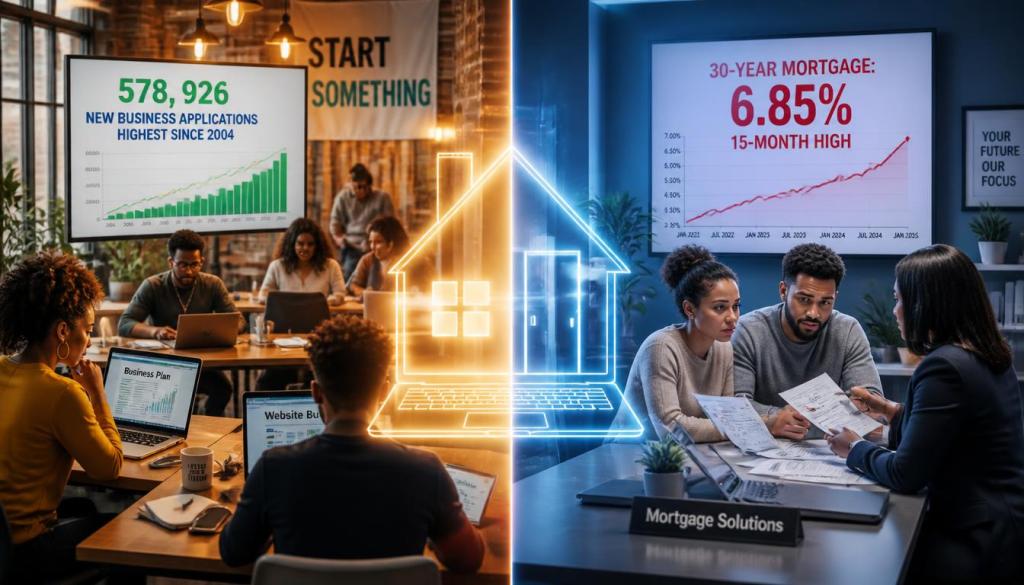
Two economic stories are telling very different tales this week. On one hand, new business applications have surged to their highest level in more than two decades — a sign of entrepreneurial energy that could reshape urban economies. On the other, mortgage rates have climbed to a 15-month high, squeezing home buyers and refinancers. For working families and urban entrepreneurs, the message is complex: opportunity is rising, but so is the cost of capital.
The Start-Up Surge: 578,926 Applications in July
Treasury Secretary Scott Bessent recently expressed frustration that the media isn’t paying enough attention to what he called America’s “hidden start-up growth” .
The data backs him up. In July, Americans submitted 578,926 new business applications — an 8.1% increase from June and a 23.4% rise compared to last year. This represents the highest monthly total recorded in the Census Bureau’s seasonally adjusted data since July 2004, surpassing even the pandemic-era surge of July 2020 by 5.9% .
And it’s not a one-month anomaly. Applications have been rising since April, with the three-month average reaching a record 547,848 — up 9.8% from the prior three months. So far this year, total unadjusted applications stand at 3.87 million, a 13.8% increase from the same period last year and a 79.4% jump since 2019 .
What’s driving the surge?
- AI is lowering barriers to entry. Tasks that once required specialized personnel can now be handled by founders using affordable software. A Gusto survey of 1,051 founders who started businesses in 2025 found that 60% used AI in their launch process, with half saying it made the process significantly quicker or less costly .
- Deregulation is reducing compliance costs. A Trump administration directive requiring agencies to identify regulations for repeal when introducing new ones has created a more favorable environment for entrepreneurs .
- Tax incentives are encouraging investment. The One Big Beautiful Bill made 100% bonus depreciation for qualifying investments permanent, allowing businesses to deduct the full cost of eligible equipment in the year it’s placed into service .
The sectors leading the charge:
- Professional, scientific, and technical services: +27.5%
- Information sector: +34.2%
- Accommodation and food services: +14.2%
- Construction: +9.5%
The surge in applications isn’t just about solo entrepreneurs. Gusto’s findings reveal that 49% of businesses incorporating AI planned to hire more staff, compared to only 41% of those not using the technology. Overall hiring intentions reached a three-year high .
The Mortgage Squeeze: 30-Year Rate Hits 6.85%
While entrepreneurs are launching new ventures, homebuyers are facing the highest borrowing costs in over a year.
According to the Mortgage Bankers Association, the average rate on a 30-year fixed mortgage climbed to 6.85% last week — the highest since June 2025 and 36 basis points higher than a year ago .
“Mortgage rates moved higher last week, driven by ongoing investor concerns over inflation and the federal budget deficit.”
— Joel Kan, MBA’s Vice President and Deputy Chief Economist
The impact was immediate. Mortgage applications fell 2.7% on a seasonally adjusted basis, with refinance applications dropping 6% to their slowest weekly pace since May 2025 .
The rate picture across loan types:
| Loan Type | Rate |
|---|---|
| 30-Year Fixed | 6.85% |
| 15-Year Fixed | 6.17% |
| FHA 30-Year | 6.53% |
| Jumbo 30-Year | 6.74% |
Freddie Mac’s Primary Mortgage Market Survey, released September 3, showed the 30-year fixed-rate mortgage averaging 6.71% — up from 6.66% the previous week and 6.50% a year ago .
What this means for buyers: Borrowers are responding by turning to adjustable-rate mortgages. The ARM share rose to 8.5% of applications — its highest level since June . But ARMs carry their own risks if rates continue to climb.
Credit Card Debt: The Silent Burden
For families already carrying balances, credit card costs remain elevated. According to WalletHub, the average interest rate for new credit card offers stands at 22.19%, while existing accounts average 20.94% .
Rates by credit tier:
| Credit Level | Average APR |
|---|---|
| Excellent Credit | 17.11% |
| Good Credit | 23.29% |
| Fair Credit | 26.95% |
| Store Cards | 33.14% |
For urban families managing debt, these rates represent a significant burden — particularly for those with fair or poor credit, who face rates approaching 27% or higher .
The Labor Market: Stable but Uncertain
Amid the start-up surge and mortgage squeeze, the labor market remains relatively stable. Initial jobless claims edged down to 206,000 for the week ending September 5, below the 259,000 recorded a year earlier .
But the August jobs report showed a stronger-than-expected 162,000 jobs added, with the unemployment rate holding at 4.1% . That strength, however, has raised the odds of a Federal Reserve rate hike at its September 16 meeting — from 51% to 60%, according to CME Group’s FedWatch .
Why This Matters for Urban Communities
The start-up boom is encouraging, but it comes with a caveat: new business applications don’t always become employer businesses. Many are solo ventures or side hustles. The real test will be whether these applications translate into sustainable businesses that create jobs and build wealth in urban communities.
Meanwhile, the mortgage squeeze and elevated credit card rates mean that the cost of capital remains high for families trying to buy homes or manage debt. For Black and Brown entrepreneurs, who already face systemic barriers to financing, these conditions make it harder to access the capital needed to grow.
The opportunity is real. The challenge is equally real.
The Bottom Line
America is experiencing a genuine surge in entrepreneurial activity — the highest business application volume since 2004. AI, deregulation, and tax incentives are making it easier than ever to start something. But with mortgage rates at 6.85%, credit card rates above 20%, and the Fed potentially raising rates again, the cost of building wealth remains steep.
For urban entrepreneurs, the message is clear: the tools are more accessible than ever, but the capital is more expensive. The blueprint for success will require not just a great idea, but a strategy for navigating a high-cost environment.
Sources
Total News: “Bessent Discusses America’s Hidden Start-Up Growth” (September 8, 2026)
CUToday: “Mortgage Applications Fall As 30-Year Rate Hits 15-Month High” (September 8, 2026)
WalletHub: “Current Credit Card Interest Rates – September 2026” (September 7, 2026)
Freddie Mac: “Mortgage Rates – Primary Mortgage Market Survey” (September 3, 2026)
Argaam: “US weekly jobless claims edge down” (September 10, 2026)
News18: “US weekly jobless claims decline to 206,000” (September 10, 2026)
Ambito: “El empleo en EEUU superó con creces las expectativas” (September 4, 2026)
The People’s Weekly — urban intel from a holistic social approach.
[ai]
 The People's Weekly
Leave a comment