Law & Justice — Listen Free 🎧 | Contact
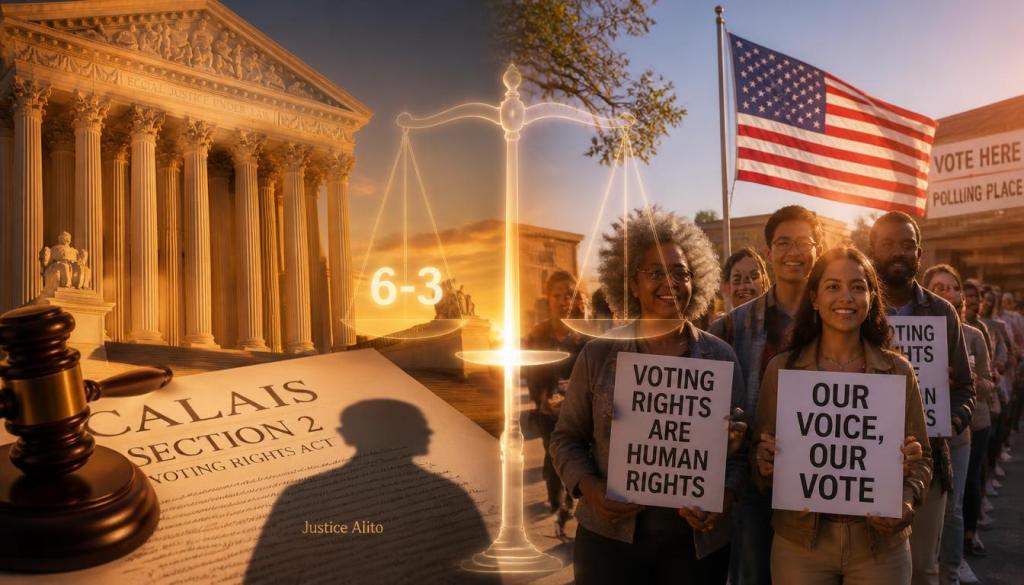
On April 29, 2026, the U.S. Supreme Court issued a 6-3 decision in Louisiana v. Callais that fundamentally altered the landscape of voting rights in America. The ruling struck down Louisiana’s congressional map — which had created a second majority-Black district — as an unconstitutional racial gerrymander. But the decision went far beyond Louisiana’s borders, effectively gutting Section 2 of the Voting Rights Act, the primary legal tool that communities of color have relied on for decades to challenge discriminatory voting maps.
For Black and Brown communities across the South, the ruling represents the final blow in a decade-long assault on the Voting Rights Act — an assault that began with Shelby County v. Holder in 2013 and has now reached its devastating conclusion.
The Callais Decision: What the Court Ruled
The case originated in Louisiana’s 2020 redistricting cycle. In 2022, a federal district judge ruled that the state’s congressional map likely violated Section 2 of the Voting Rights Act because it did not include an additional majority-Black district. Louisiana drew a new map, SB8, containing such a district. That map was then challenged as an unconstitutional racial gerrymander.
The Supreme Court, in an opinion authored by Justice Samuel Alito, held that the Voting Rights Act did not require Louisiana to create an additional majority-minority district. The majority concluded that compliance with Section 2 of the Voting Rights Act does not constitute a compelling interest to justify the state’s use of race in creating SB8, and that the map was an unconstitutional racial gerrymander.
The Majority’s Reasoning:
The Court started with the “general rule that the Constitution almost never permits the Federal Government or a State to discriminate on the basis of race”. The majority held that Section 2 imposes liability only where the circumstances give rise to a strong inference that intentional discrimination occurred — a significantly higher bar than the previous “results” test.
The Dissent:
Justice Elena Kagan, joined by Justices Sonia Sotomayor and Ketanji Brown Jackson, argued that the majority’s interpretation of Section 2 permits a state to “systematically dilute minority citizens’ voting power”. In a stinging dissent, Kagan wrote: “Bang, bang, bang. It is like shooting fish in a barrel” — a reference to the trilogy of cases that have systematically dismantled the Voting Rights Act.
What the Ruling Actually Does
The Callais decision has far-reaching consequences for voting rights across the country:
1. It makes it harder to challenge discriminatory maps. By requiring proof of discriminatory intent — and rejecting evidence of discriminatory effect — the ruling shatters longstanding enforcement of Section 2 of the Voting Rights Act. Voters challenging racially discriminatory maps and voting laws will face higher legal barriers and fewer statutory protections.
2. It opens the door for states to eliminate majority-minority districts. Mapmakers saw majority-minority districts as a legal way to bolster the likelihood of electing lawmakers of color in states where Black voters were disproportionately underrepresented. After Callais, that legal basis has been severely limited. The decision makes it easier to dismantle existing majority-minority districts, where racial minorities make up most of the voting-age population.
3. It limits how America can respond to demographic change. The ruling effectively tells mapmakers that using race to draw districts, even to correct discrimination, is off-limits. As the nation becomes more diverse, Section 2 has been one of the few remaining tools for ensuring that congressional and state legislative maps evolve along with its people.
4. It threatens to reverse diversity gains in Congress. The number of non-white representatives in Congress has risen with the expansion in majority-minority districts — a trend that may be reversed after the Callais decision. The ruling will have significant effects on diversity in the House, making a legislative body that is already less diverse than the public even less representative.
The Three-Part Assault on the Voting Rights Act
The Callais decision is the third in a trilogy of Supreme Court rulings that have systematically dismantled the Voting Rights Act:
1. Shelby County v. Holder (2013): The Court struck down Section 5 of the VRA, which required jurisdictions with histories of voting discrimination to obtain federal approval (“preclearance”) before making changes to their voting laws. Chief Justice John Roberts wrote that “our country has changed” — but dissenting Justice Ruth Bader Ginsburg warned that the decision was like “throwing away your umbrella in a rainstorm because you are not getting wet”.
2. Brnovich v. Democratic National Committee (2021): The Court limited another provision of Section 2, making it difficult to challenge discriminatory voting laws.
3. Louisiana v. Callais (2026): The Court reinterpreted Section 2 of the Voting Rights Act, severely limiting its scope and effectively gutting the last remaining meaningful safeguard against racially discriminatory gerrymandering. As legal experts and civil rights organizations have noted, the ruling “renders the Voting Rights Act all but a dead letter”.
Together, these three cases limit minority representation at both the voter and representative level. As one analysis put it: “Section 2 of the Voting Rights Act now stands at a paradoxical crossroads. Though it remains the statute’s central protection against racial vote dilution after Shelby County v. Holder, it is increasingly undermined by a constitutional framework that treats race-conscious remedies as suspect rather than necessary”.
The Human Cost: What This Means for Black and Brown Communities
The consequences of the Callais ruling are not abstract. They are being felt in real time across the South.
In Louisiana: The state’s second majority-Black district — which had been created to comply with the Voting Rights Act — is now at risk of being eliminated. Black voters who finally gained a second seat at the table could lose that representation entirely.
In Alabama: The state has already moved to use maps that dilute Black voting power. Plaintiffs in Allen v. Milligan, who sought to add a second congressional Black district in Alabama, have warned that the progress they fought for is now threatened.
Across the South: The racial turnout gap — the disparity in voter participation between white voters and voters of color — has grown since Shelby County gutted Section 5. With Section 2 now severely weakened, that gap is likely to widen further.
As Tafeni English-Relf, state director of Alabama for the Southern Poverty Law Center, put it: “For generations, Black people were denied full participation in our democracy. And it was the passage of the Voting Rights Act that allowed those barriers to be broken down”.
But those barriers are being rebuilt.
The Path Forward: State-Level Protections and Federal Action
In the wake of the Callais ruling, voting rights advocates are pursuing a two-track strategy:
State-Level Voting Rights Acts: Delaware recently became the first state to pass a state-level Voting Rights Act in the wake of Callais, enshrining protections into state law. Other states are watching closely — and may follow Delaware’s lead.
Federal Legislation: Democrats have pledged to pass the John R. Lewis Voting Rights Advancement Act if they regain control of Congress. The bill would update and restore critical safeguards of the original Voting Rights Act, extending the attorney general’s powers over elections and requiring states to seek federal clearance for redistricting, cleaning voting rolls, and strengthening voter ID requirements.
As NAACP President and CEO Derrick Johnson said: “This Supreme Court made a decision that flies in the face of logic, legal reason, and nonpartisanship. It is an activist court. It will probably go down in the history books as one of the worst Supreme Court decisions in the history of this nation”.
The Bottom Line
The Louisiana v. Callais decision represents a fundamental shift in how courts evaluate claims of racial discrimination in voting. By severely limiting Section 2 of the Voting Rights Act — and requiring proof of discriminatory intent rather than discriminatory effect — the Supreme Court has weakened one of the last meaningful safeguards against racially discriminatory gerrymandering, stripping away critical protections that have served communities of color for more than 60 years.
The ruling is the culmination of a decade-long assault on the Voting Rights Act that began with Shelby County v. Holder and has now reached its devastating conclusion. For Black and Brown communities across the South — and across the country — the fight for fair representation has become significantly harder.
As NAACP General Counsel Kristen Clarke put it: “Without question, this ruling strikes at one of the last remaining core provisions of the law, rendering the Voting Rights Act all but a dead letter”.
Sources
ACLU: “Supreme Court Strikes Down Louisiana Map and Destroys Key Voting Rights Act Provision” (April 29, 2026)
Brookings: “Callais decision threatens to stall diversity gains in House” (May 6, 2026)
Dorsey: “The Supreme Court Update – April 29, 2026” (April 29, 2026)
LSE USAPP: “The Supreme Court’s Louisiana v. Callais decision is the end of multiracial democracy in the South” (May 8, 2026)
NAACP: “NAACP Emergency Town Hall Unpacks Supreme Court Voting Rights Decision” (May 1, 2026)
The Lens: “Louisiana and Alabama map battles renew voting rights fight after 61 years” (August 14, 2026)
Supreme Court: “Louisiana v. Callais, 608 U.S. ___ (2026)” (April 29, 2026)
Washington and Lee University: “Section 2 of the Voting Rights Act at a Crossroads” (July 2026)
The People’s Weekly — urban intel from a holistic social approach.
[ai]
 The People's Weekly
Leave a comment