Business & Entrepreneurship — Listen Free 🎧 | Contact
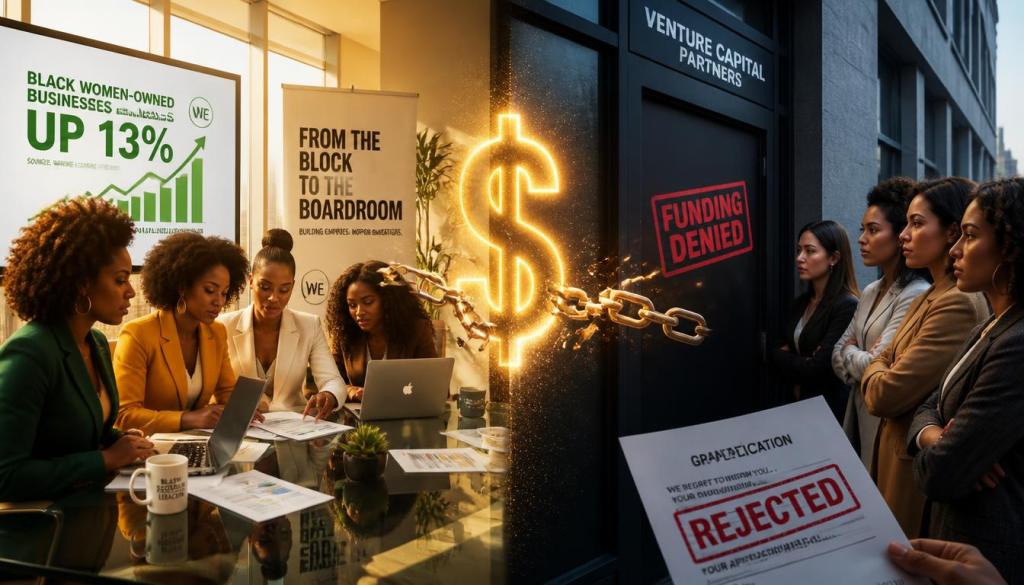
Black women are the fastest-growing group of entrepreneurs in America. Between 2024 and 2025, Black women-owned employer businesses grew by 13% — more than triple the 4.4% growth rate for women-owned businesses overall. Their revenue increased by nearly 6%, and Black women-owned businesses without employees saw revenue surge by 8%. Between 2022 and 2025, Black women-owned employer firms grew 18.3% in count and 23.1% in employment — both well ahead of the 8.0% and 11.1% rates for women-owned employers overall.
Today, there are over 2 million Black women-owned businesses in the U.S., representing 14% of all women-owned businesses and 48.8% of all Black-owned businesses. Collectively, they employ more than 647,000 people and generate over $118 billion in annual revenue.
But behind these impressive numbers lies a sobering reality: Black women entrepreneurs receive less than 1% of venture capital funding. They are rejected for funding at three times the rate of white business owners. And despite their rapid growth, only 3% of Black women-owned businesses mature and survive beyond five years.
This is the story of Black women entrepreneurs — building the future, brick by brick, despite a system that continues to stack the odds against them.
The Growth Story: A Movement, Not a Moment
Black women are not just starting businesses — they are driving the entire entrepreneurial ecosystem. In 2025, women started 69% of new Black-owned businesses. The number of Black women-owned businesses increased by roughly 13% in the last year alone, reaching over 2 million businesses nationwide and representing about 14% of all women-owned businesses in the U.S..
These businesses generated over $118 billion in annual revenue in 2025, despite receiving only 0.3% of total venture capital funding.
The growth is not an accident. It is a response to a labor market that has systematically undervalued Black women’s contributions. As one report noted, Black women are leaving traditional jobs and building businesses despite barriers. They are creating their own opportunities because the traditional economy has failed to create them.
The Funding Gap: A System Designed to Exclude
The growth of Black women-owned businesses is happening in spite of the system — not because of it.
Black women business owners who apply for funding are rejected at three times the rate of white business owners. Only 0.1% — one-tenth of one percent — of venture capital funds went to Black and Latina women founders in 2025. The share of venture-capital funding going to Black-owned businesses in 2025 was 0.3%, the lowest share in a decade.
61% of Black women self-fund everything. 80% are scraping together their own savings to fund their businesses, with only 17% able to secure bank loans. More than 60% of for-profit businesses have self-funded their organizations up to $100,000.
The result: Fewer than 1% of Black women-owned businesses ever cross $1 million in revenue. Black women-owned employer firms average just $650,000 in revenue — the lowest of any group.
Why does this gap persist? Research reveals that race and gender create a “double jeopardy” for Black women entrepreneurs, amplifying obstacles like limited access to capital, exclusion from networks, and undervalued credentials. The same right-wing activist who successfully challenged affirmative action in college admissions has sued to end grant programs for Black women entrepreneurs. Wealthy extremists are attacking funding for Black women entrepreneurs in a desperate attempt to preserve systemic inequality.
As the National Urban League has documented, the disparity is often framed as a lack of willingness to take risks — but the data tells a different story. Black women are starting businesses at record rates, generating billions in revenue, and creating jobs in their communities. The problem is not a lack of ambition or capability. The problem is a funding system that systematically excludes them.
The Success Stories: Building Despite the Odds
Despite the barriers, Black women entrepreneurs are building, scaling, and succeeding.
Etosha Cave is a standout example. As co-founder and Chief Science Officer of Twelve, a carbon transformation company, she has helped raise over $645 million in funding. She is among the top Black women founders in the “First 200” index — a list of the first 200 U.S.-based Black women founders to raise $1 million in VC funding.
From the Ground Up:
- Mali Montgomery and Ayanna Carver built Vine & Olive into a four-store success in Atlanta, proving passion and flavor can win in a crowded market.
- Shontay Lunday founded Black Girl Sunscreen, a Los Angeles-based company with 25 employees, mostly women of color. The sunscreen is available in 20 locations.
- April Showers created Afro Unicorn, a brand that has become a cultural phenomenon.
- Terrell Patterson and Jasmine Hill, a mother-daughter duo from Jonesboro, opened Ebony X Beauty Supply in 2023 with a goal of supplying hair products for all hair types.
- Judy Koloko made history when The Steam Bar became the first Black British-owned company accepted into Sephora’s Accelerate program.
The She Did That. Movement:
In August 2026, She Did That. celebrated Black Business Month with a NYC marketplace showcasing 13 Black women-owned businesses in beauty, fashion, jewelry, home, wellness, and specialty food. Participating brands included Anima Iris, Brooklyn Tea, OUI the People, and others.
Trailblazers:
- Shellye Archambeau became the first Black woman CEO in Silicon Valley and has served on Fortune 500 boards.
- Morgan DeBaun started Blavity Inc. in 2014, building a culturally relevant digital media empire for Black millennials.
- Monica Cornitcher rebuilt MEDASE Cocktails after a hiatus following her co-founder’s death from breast cancer, with a full rollout planned for fall 2026.
The Path Forward: What Needs to Change
The barriers facing Black women entrepreneurs are not insurmountable — but they require intentional action.
Policy Solutions:
- The SPARK Act would create grant funding for community organizations that support small business accelerators and incubators, and provide grants and low-cost loans directly to underserved small businesses.
- Black Girl Ventures continues to provide pitch competitions for Black and Brown women founders, offering $5,000 guaranteed matches per cohort member.
- Programs like Venture Miami Opportunity Program are working to close the inclusion gap among BIPOC female business leaders.
What You Can Do:
- Support Black women-owned businesses in your community — every dollar spent is a vote for economic justice.
- Advocate for equitable funding — demand that venture capital firms invest in diverse founders.
- Amplify their stories — visibility matters. When Black women entrepreneurs succeed, it inspires the next generation.
- Mentor and invest — if you have capital or expertise, share it with the next generation of founders.
The Bottom Line
Black women are the fastest-growing group of entrepreneurs in America. They are starting businesses at record rates, generating billions in revenue, and creating jobs in their communities. But they are doing so with one hand tied behind their backs — receiving less than 1% of venture capital funding, rejected at three times the rate of white business owners, and systematically excluded from the networks and resources that fuel success.
The question is not whether Black women entrepreneurs can succeed. They are already succeeding — despite the odds.
The question is whether the system will finally catch up to their ambition, their talent, and their vision. The question is whether venture capital will finally recognize that Black women are not a risk — they are an opportunity.
Sources
NNPA: “‘Lift as you rise’: Black women founders mentor the next wave of leaders” (2026)
SwagHer Magazine: “The Real Challenges Faced by Black Women in Business” (June 17, 2026)
Crunchbase via Black Enterprise: “Black Women Entrepreneurs Face Tough Funding Climate” (March 19, 2026)
Brock University: “Brock provides research assistance for new report on Black women entrepreneurs” (April 1, 2026)
TipRanks: “Twelve Leadership, Clients & Company Overview” (July 15, 2026)
Black Enterprise: “Black Women Are The Fastest Group of Entrepreneurs” (March 19, 2026)
Senator Hirono: “SPARK Act to Supercharge Minority Entrepreneurship” (February 25, 2026)
Harvard Business Review / Essence: “The Real Challenges Faced by Black Women in Business” (2025-2026)
The People’s Weekly — urban intel from a holistic social approach.
[ai]
 The People's Weekly
Leave a comment