Health & Awareness — Listen Free 🎧 | Contact 📧
Mental health is the silent crisis of urban America. From the Bronx to Los Angeles, communities are grappling with the weight of anxiety, trauma, substance use, and the emotional toll of economic insecurity. But across the country, a new wave of community-driven solutions is emerging — blending traditional practices, public art, and accessible care to meet people where they are.
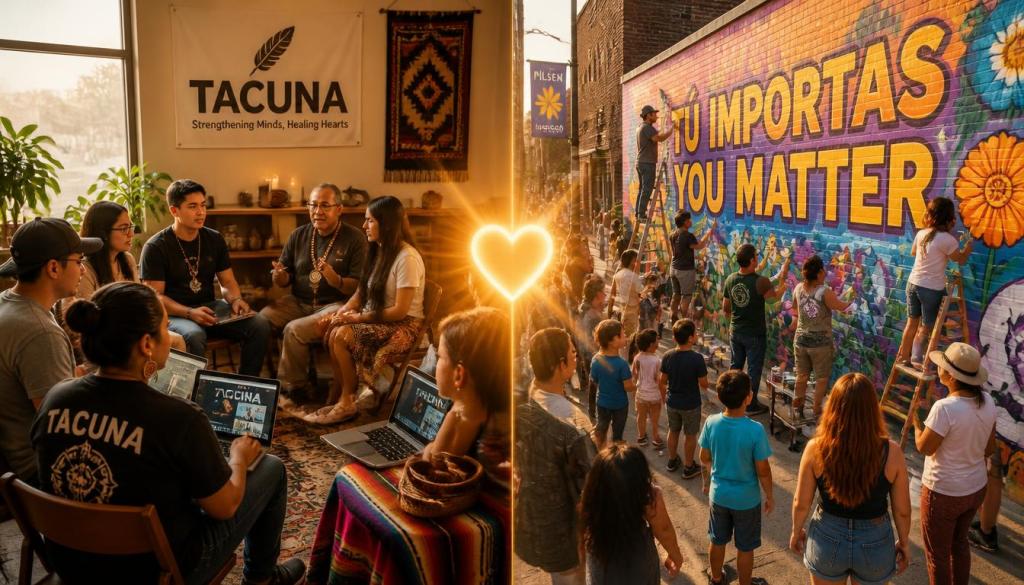
TACUNA: A Virtual Lifeline for Urban Native Americans
For American Indian and Alaska Native young adults living in urban areas, cultural connection is often a casualty of displacement. A new NIH-funded study offers a powerful solution: a virtual program that blends evidence-based practices with traditional Indigenous healing.
The program, called Traditions and Connections for Urban Native Americans (TACUNA), was tested in a clinical trial involving 541 emerging adults aged 18 to 25. Participants who completed the program reported reduced cannabis and alcohol use, less time around peers using drugs, and lower anxiety symptoms compared to a control group.
“Supportive social environments and community engagement are an important component of substance use prevention. Yet few interventions have been designed specifically for American Indian and Alaska Native people living in urban areas who may feel disconnected from their tribal communities.”
— Nora Volkow, M.D., Director of NIH’s National Institute on Drug Abuse
Why It Matters to Urban Communities:
TACUNA is delivered virtually, making it accessible to Indigenous young adults who may not have in-person resources in their cities. The program combines motivational interviewing with traditional activities — cooking, storytelling, prayer — woven into discussions about healthy choices and relationships.
The significance: American Indian and Alaska Native individuals face higher rates of drug overdose death, cannabis use, and psychological distress than other groups. This research demonstrates that culturally grounded interventions can be both effective and scalable — and that virtual delivery can extend their reach.
Chicago’s Pilsen Neighborhood Gets a Message of Hope: “Tú Importas”
On August 22, a new mural will rise in Chicago’s Pilsen neighborhood — a powerful public art installation affirming that mental health matters, especially for immigrant families navigating fear, discrimination, and the pressures of the back‑to‑school season.
The Tú Importas (You Matter) Healing Mural is the work of Contigo Wellness, a community-centered nonprofit, in collaboration with Chicago-based artist Fab RP. It will become the sixth Tú Importas mural across three states, bringing culturally responsive messages of belonging, visibility, and care directly into historically marginalized neighborhoods.
“Too often, mental health support is something people are expected to seek behind closed doors after they are already struggling. Tú Importas brings healing into public space. A young person walking to school, a parent heading to work or an immigrant family moving through their neighborhood can encounter a message reminding them that they are seen, valued and worthy of care.”
— Diana Anzaldúa, LCSW-S, Founder and Executive Director of Contigo Wellness
Why It Matters to Urban Communities:
The timing is intentional. As families prepare for the new school year, many immigrant communities are carrying heightened fear related to discrimination, family separation, community violence, and uncertainty about their safety and belonging. For students, returning to school can bring excitement — but also anxiety, grief, financial stress, bullying, and the weight of community or racial violence.
The location: Pilsen has been shaped by generations of Mexican, Latino, immigrant, and working-class families. The neighborhood has a long tradition of using murals and public art to preserve culture, tell community stories, and make social issues visible.
What’s next: The mural reveal event is free and open to the public, bringing together students, families, educators, artists, mental health advocates, immigrant-serving organizations, and community partners.
New York Invests $21 Million to Expand Mental Health Crisis Services
New York State is making a significant investment in mental health crisis care. Governor Kathy Hochul announced that $21 million in capital and start-up funding has been awarded to establish three new Comprehensive Psychiatric Emergency Programs (CPEPs) and improve four others across the state.
What CPEPs Do:
CPEPs provide 24/7 emergency services for individuals experiencing a mental health crisis, including those with mental health disorders, co-occurring substance use disorders, intellectual and developmental disabilities, and medical conditions. They can care for patients for up to 72 hours if extended observation is needed.
The Impact:
State-funded CPEPs received more than 110,000 visits between February 2025 and January 2026, admitting more than 18,000 patients to extended observation beds.
Where the Money Is Going:
- NYC Health + Hospitals/Lincoln in the Bronx: $6 million to establish a new CPEP serving the Bronx, including six extended observation beds for adults.
- Westchester Medical Center Health Network: $6 million to establish a new CPEP serving Dutchess and Ulster counties, including youth/adolescent and adult observation beds.
- Champlain Valley Physicians Hospital: $6 million to establish a new CPEP serving Clinton, Essex, and Franklin counties.
- Four other hospitals received about $3.1 million to improve existing CPEPs.
Why It Matters to Urban Communities:
Mental health crises don’t wait for business hours. For urban residents — particularly in communities with limited access to care — CPEPs provide a critical safety net. The expansion in the Bronx, where mental health needs are acute, is especially significant.
What These Stories Tell Us
Across the country, the message is the same: mental health care cannot be confined to clinics and hospitals. It must reach people where they live, in the languages they speak, through the cultural practices they value, and in the public spaces where they gather.
- In urban Native communities, virtual programs like TACUNA are bridging the gap between cultural connection and clinical care.
- In Chicago’s immigrant neighborhoods, a mural becomes a healing space — a visible affirmation that mental health matters, especially for those who are often overlooked.
- In New York, a $21 million investment in psychiatric emergency programs is a recognition that crisis care is a fundamental part of public health infrastructure.
The work is far from inished. But these efforts point to a way forward: culturally responsive, community-rooted, and accessible mental health care for all.
Sources
NIH: “Virtual intervention reduces substance use in American Indians and Alaska Natives” (August 11, 2026)
National Law Review: “Contigo Wellness to Unveil Tú Importas Mural in Pilsen” (August 10, 2026)
NYC Health + Hospitals: “Governor Hochul Announces $21 Million to Expand Emergency Programs” (August 10, 2026)
The People’s Weekly — urban Intel from a holistic social approach.
[ai]
 The People's Weekly
Leave a comment