Urban Lifestyle — Listen Free 🎧 | Contact 📧
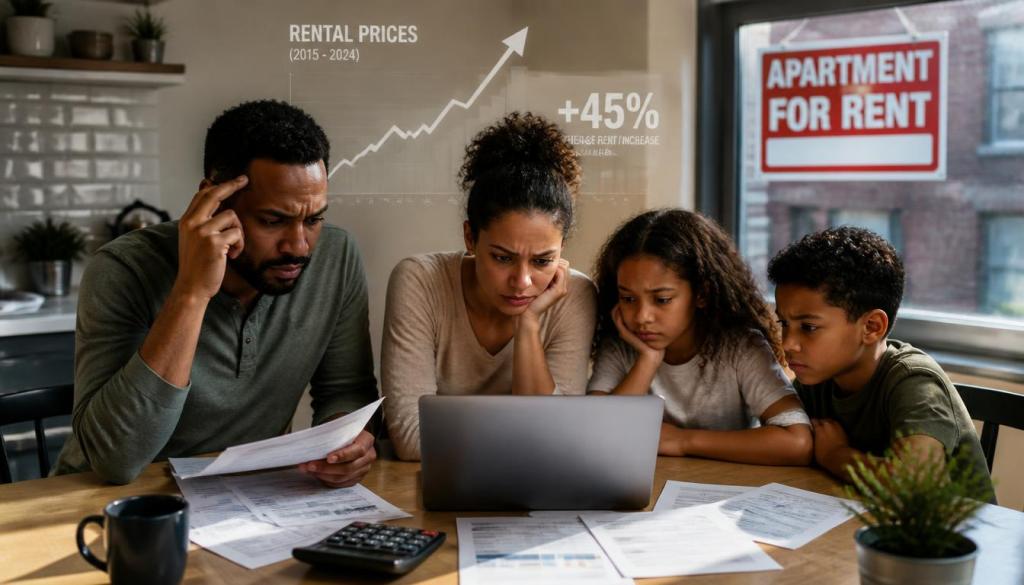
American cities are becoming increasingly unaffordable for working-class families. Since 2019, rent in the 50 largest U.S. cities has climbed an average of 41 percent, or $457 a month, to $1,578 for a one-bedroom apartment . Two-bedroom rents have surged an average of 37 percent, or $505, to roughly $1,858 per month over the same period . The classic budgeting rule — 30 percent of income on housing — is no longer realistic for most urban renters.
The Numbers: Where Rents Have Risen Most
According to a LendingTree study using U.S. Department of Housing and Urban Development data, New York tops the list with the largest dollar increase since 2019: up $852 a month, or 53 percent . In New York City, the average rent for a one-bedroom apartment now sits at $4,039. San Diego follows closely with a 41 percent increase, or $658 a month . Miami ($737), Phoenix ($731), Seattle ($712), Sacramento ($698), and Atlanta ($677) round out the top cities with the largest increases .
Nationally, rents have risen 1.5 times faster than wages on average since 2019 . As Matt Schulz, chief consumer finance analyst at LendingTree, put it: “If your income is rising at the same time your rent is, maybe that extra expense is no big deal. However, so many Americans’ financial wiggle room is tiny, even in the best of times, so having to carve out hundreds of extra dollars to pay rent each month can be a big deal” .
The Rent Burden: What 30 Percent Actually Means in 2026
Housing analysts call a household “rent burdened” when housing costs eat more than 30 percent of gross income, and “severely rent burdened” when they eat more than 50 percent. The U.S. Department of Housing and Urban Development uses the 30 percent line to set its Fair Market Rents (FMR) — the dollar figures that drive Section 8 vouchers and other affordability programs.
For Fiscal Year 2026, NYC’s Fair Market Rent for a one-bedroom is set at $2,511 . But that’s not what landlords actually charge. The median asking rent in Manhattan is $4,700; in Brooklyn, $3,750; in Queens, $3,150. The gap between HUD’s “reasonable rent” and the open market is the gap most working-class New Yorkers fall into.
Take a $60,000 annual salary. Your 30 percent rent ceiling is $1,500 per month — well below the HUD baseline and every borough median. A $100,000 salary gives you a ceiling of $2,500 — still under Manhattan’s median by $2,200. This is why so many urban residents either take roommates, move to outer boroughs, or accept being rent burdened.
The Hidden Housing Crisis: Who’s Living Where
The widely cited U.S. homeownership rate of roughly 65 percent does not measure how many adults actually own homes . A Federal Reserve Bank of Minneapolis study found that by counting people rather than housing units, the national homeownership rate is actually 53 percent . The gap is significant: 13.9 percent of American adults — more than one in eight — live in owner-occupied homes without owning them .
For young adults, the situation is even more stark. For households headed by adults under 35, the traditional homeownership rate was 37 percent in 2024. Measured by person, only 22 percent of adults under 35 owned their homes . The Urban Institute found that roughly 20 percent of Americans ages 25 to 34 live with their parents, nearly double the 11.8 percent share in 2005 . In high-cost metropolitan areas, median two-bedroom rent climbed 29 percent between 2005 and 2024 in inflation-adjusted terms, compared to 17 percent in low-cost metros .
The result? A generation stuck in what the Federal Reserve calls “shared living arrangements” — adult children with parents, older parents with adult children, friends, and roommates. Many of these adults pay some kind of rent but are excluded from standard renter counts .
The New Budget Reality: Adapting to High-Cost Cities
Standard budgeting advice often assumes housing costs around 30 percent of income. In high-cost cities like San Francisco, New York, Boston, or Seattle, housing alone can consume 40 to 50 percent of take-home pay, throwing conventional budgeting rules out the window.
The 50/30/20 rule (50 percent needs, 30 percent wants, 20 percent savings) may need to become 60/20/20 or even 65/15/20 in high-cost areas. This isn’t failure; it’s adapting to circumstances. The percentage that matters most is savings. Protecting your savings rate, even if it means aggressive cuts elsewhere, keeps you on track for long-term financial goals.
A family paying $1,800 per month in childcare on a $6,000 take-home has already consumed 30 percent of their income on a single essential line item. The 50 percent cap is gone before the car payment or the lease is counted.
Key strategies that work in expensive cities:
- House hacking: Roommates, renting out a room, or buying a multi-unit property and living in one unit can significantly reduce effective housing costs.
- Transportation trade-offs: Owning a car in Manhattan adds significant cost (parking, insurance, gas) while providing little benefit. In many high-cost urban areas, public transit and occasional rideshares cost far less than car ownership.
- Income focus: High-cost areas often offer higher salaries and more opportunities for income growth. Focusing on career advancement, skill development, and strategic job changes can increase the income side of the equation rather than just cutting expenses.
- Side income: Freelancing, consulting, and gig work have larger markets in major metros.
The Corporate Landlord Problem
President Trump has identified what he says is a clear culprit holding back the housing market: corporate investors buying up single-family homes and renting them out . “Homes are built for people, not for corporations,” Trump said .
But buried in Trump’s executive order that seeks to bar large investors from acquiring single-family homes is an exemption that allows them to build homes for renting out . These “build-to-rent” housing communities are a growing niche of the market involving some of the same Wall Street landlords that Trump has blamed for preventing average Americans from owning their own homes .
The numbers tell the story: Last year, some 66,000 homes in build-to-rent communities were completed. By comparison, just 11,000 such homes were constructed in 2021 . Large homebuilding companies like Lennar and DR Horton have gotten into the business, building single-family homes dedicated as rentals . DR Horton sold 3,546 single-family rental homes last year, compared with 83,622 that were mainly sold to ordinary buyers .
Wall Street-backed firms buying foreclosed homes helped stabilize the housing market in some regions because it took vacant homes off the market. But over time, the Wall Street landlords became a lightning rod for critics who said the deep-pocketed firms were crowding out first-time homebuyers .
What’s Being Done — And What’s Not
Some cities are experimenting with rent control and inclusionary zoning. States like California and New York are considering new housing mandates. But the problem is not being solved at scale.
In Boston, rents have defied economic gravity. While rents are falling in Los Angeles, San Diego, Washington D.C., and Denver, Boston’s rents have either risen modestly or remained flat. “People really want to live in Boston, and the Boston area has one of the largest housing shortages in the country,” said Adam Guren, an associate professor of economics at Boston University .
In Austin, Texas, the city added roughly 120,000 new units between 2015 and 2024, and rents there have been dropping steadily, down nearly 8 percent between 2023 and 2024 and 3.8 percent in the last year . The lesson: building more housing works.
The Bottom Line
The urban housing crisis is not going away. Without bold action — at the local, state, and federal levels — American cities will continue to become enclaves for the wealthy, pushing working-class families to the margins.
What you can do:
- Audit your budget. The old 50/30/20 rule may not work in your city. Adjust to 60/20/20 or 70/20/10, but protect your savings rate.
- Consider roommates or house hacking to reduce effective housing costs.
- Ditch the car if you’re in a transit-friendly city.
- Focus on income growth — high-cost cities offer higher salaries and more opportunities.
- Stay informed about housing policies and corporate landlord activity in your community.
Rents have outpaced wages by 1.5 times since 2019. One in eight adults live in owner-occupied homes without owning them. And the 50/30/20 rule is dead for most urban residents.
The question is whether policymakers will notice before it’s too late. To get involved sign up to give or do what you can at Fight for the People PAC and/or Democrats.org. Together we can build a better America.
Sources
AAOA: “These U.S. Cities Have Seen the Biggest Rent Increases Since 2020” (January 4, 2026)
NYC.gov: “NYC 15/15 Rental Assistance Program Rent Schedule” (2026)
The MortgagePoint: “Fed Study Challenges U.S. Homeownership Rate” (July 27, 2026)
Urban Institute: “High Housing Costs Are Keeping More Young Adults in Their Parents’ Homes” (July 14, 2026)
The White House: “Fact Sheet: President Donald J. Trump Stops Wall Street from Competing with Main Street Homebuyers” (January 20, 2026)
Boston University: “Global Housing Crisis Research on Tap” (February 28, 2024)
Multi-Housing News: “Austin’s Rent Realignment” (March 25, 2026)
Realty Times: “Rent Jumps 41% Since 2021 Across Largest Metros” (December 3, 2025)
Fortune: “The millennial generation has split, new Fed research shows” (July 22, 2026)
The New York Times: “Trump Decries a ‘Nation of Renters’ but His New Policy Promotes One” (February 11, 2026)
Realtor.com: “Austin Rents Are Going Down” (July 20, 2026)
The People’s Blog — urban intel with a holistic social approach.
[ai]
 The People's Weekly
Leave a comment