Politics & Policy — Listen Free 🎧 | Contact 📧
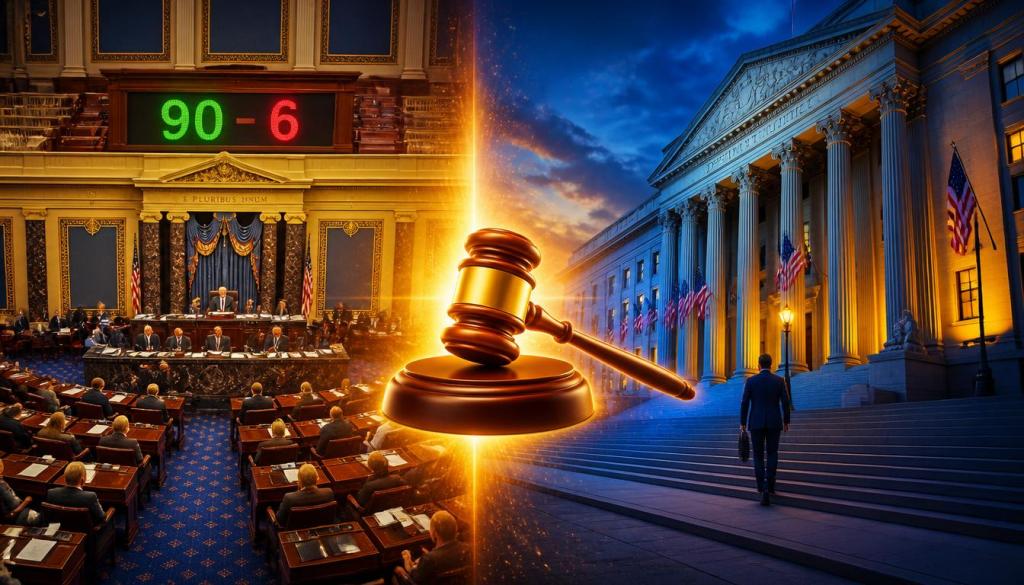
The U.S. Senate voted early Saturday to approve a short-term measure aimed at avoiding a federal government shutdown before the November midterm elections. The bill passed by a 90-6 vote and would fund the federal government at current levels through December 11, 2026.
The vote came after hours of negotiations that stretched into Saturday morning and just before senators left Washington for their summer break. The measure now heads to the House for consideration — but the two chambers will have to resolve their differences before President Trump can sign the bill before current funding expires on September 30.
What’s in the Bill:
- Funds most federal government operations at current levels through December 11
- Includes provisions to prevent fund reallocation to border security
- Protects social assistance programs
- Suspends a new White House budget office rule that would give political appointees control over large sums of grant money
Why It Matters:
A government shutdown would have halted federal services, delayed paychecks for federal workers, and disrupted programs that millions of Americans rely on. The temporary funding bill buys time — but it does not resolve the underlying budget battles. With the midterms less than 90 days away, the fight over spending is far from over.
Todd Blanche Confirmed as Attorney General — The 50-49 Vote That Could Reshape the Justice Department
In a separate development, the Senate confirmed President Trump’s former personal lawyer Todd Blanche as attorney general early Saturday in a razor-thin 50-49 vote.
Blanche, who has served as deputy attorney general since March 2025 and acting attorney general since April, won confirmation with Republican Senators Susan Collins of Maine and Lisa Murkowski of Alaska joining all Democrats in opposition.
The Path to Confirmation:
Blanche’s nomination had faced resistance from within the Republican Party over a controversial Justice Department proposal to establish a nearly $1.8 billion “anti-weaponization” fund for alleged victims of politically motivated prosecutions. Critics feared the fund could be used to compensate Trump supporters prosecuted for their involvement in the Jan. 6, 2021 attack on the U.S. Capitol.
Following an intense backlash from Republican senators, Blanche told a House appropriations subcommittee hearing in June that the Department of Justice abandoned the fund, saying: “We’re not moving forward with the fund”.
He also issued a written order scrapping the proposed fund and limited a Trump tax audit protection agreement to apply only retroactively to previous tax years, not future filings.
Why It Matters:
Blanche’s confirmation gives Trump formal command of the Department of Justice for the second time since he returned to the White House last year. Critics have raised concerns about the politicization of the Justice Department, with Senator Dick Durbin, the top Democrat on the Senate Judiciary Committee, saying: “Mr Blanche continues to operate as the president’s personal lawyer, treating the Justice Department like a law firm serving one client — the president”.
The Bottom Line:
Blanche’s narrow confirmation sets the stage for a Justice Department that could aggressively pursue Trump’s political agenda while facing ongoing scrutiny from Democrats who warn of a politicized agency.
Senators Head Home Without Meeting Trump’s Voting Bill Demands — What the Standoff Means for the Midterms
Senators headed for the exits in the predawn hours Saturday, ending for now a crushing standoff over President Donald Trump’s demands that they stay in session to pass a strict proof-of-citizenship voting bill before the summer recess.
Led by Sen. Mike Lee (R-Utah), a growing group of senators was refusing to adjourn for the summer break without passing Trump’s priority voting legislation. But the effort ultimately stalled, delaying the fight until September.
The SAVE America Act:
Trump has made the SAVE America Act his legislative priority in 2026, saying it would “guarantee the midterms” for Republicans. The bill would require strict proof of citizenship to register to vote and photo ID to cast a ballot.
But the full bill has virtually no chance of passing the Senate, as it lacks enough Republican support and the Democratic votes needed to overcome the 60-vote threshold for ending a filibuster. Republican leaders are working on a creative end-run around the Senate filibuster: using a budget bill — which can pass along party lines without Democrats — to incentivize states through grants to adopt parts of the legislation.
A Slimmer Effort Fails:
Sen. Jon Husted (R-Ohio) offered a measure in the middle of the night to require photo ID in elections. The bill failed, with no Democrats supporting it.
What Happens Next:
President Trump and Senate conservatives reached a deal Friday night to set aside action on much of the SAVE America Act until after the August recess. Instead, Republicans will try again to approve elements of the voting bill as part of a broader GOP budget package to fund the Iran war and replenish the Pentagon when they return in September.
Sen. Ron Johnson (R-Wis.), the GOP budget committee chairman, said the most the budget bill could spend on election integrity is $20 billion.
The Bottom Line:
The standoff has been delayed until September — but not resolved. With the midterms less than 90 days away, the fight over voting rights and election integrity is far from over. The Senate has now voted multiple times on the SAVE America Act without success, and the question of whether Trump can deliver on his signature voting legislation remains unanswered.
House Democrats Already Planning Trump Investigations If They Win the House
Meanwhile, House Democrats preparing for a possible return to power are developing a broad investigative strategy targeting companies and financial firms surrounding President Trump, according to four people familiar with the discussions.
The Approach:
Senior Democrats in the House and committee aides have discussed using hearings, subpoenas and document requests to obtain records from entities tied to Trump’s political and business orbit. The approach reflects both Democratic caution and a lesson many learned during Trump’s first term: impeachment proceedings can consume Congress while allowing Trump to cast himself as the victim of a partisan campaign.
“We’re not going into this to impeach,” said a senior Democratic aide, describing the thinking among party leaders and committee staff. “No one wants a failed vote on day one. The focus is on building a body of evidence through investigations that can hold Trump accountable”.
Potential Targets:
Three sources said Apple, Alphabet, Palantir, Blackstone, BlackRock and companies owned by Elon Musk have surfaced in discussions because of their contracts, regulatory exposure or administration dealings. Democrats are also expected to examine:
- Department of Homeland Security contracts
- Financing for Trump’s planned White House ballroom
- Corporate donors and alleged pay-to-play arrangements
- Trump-linked financial vehicles including 1789 Capital — a venture capital firm where his son Donald Trump Jr. is a partner
- Foreign sovereign wealth funds whose investments in Trump family-linked entities could raise questions about administration influence
Laying the Groundwork:
Democrats have already begun laying the groundwork for investigations. Party leaders are sending letters to companies, contractors and other organizations connected to potential investigations, seeking records and paving the way for subpoenas if Democrats win the House.
Rep. Robert Garcia (D-Calif.) and Rep. Jamie Raskin (D-Md.), the top Democrats on the House Oversight and Judiciary Committees, respectively, said existing investigations would expand if Democrats win the House.
The Bottom Line:
If Democrats win the House in November, they would gain subpoena power — and the ability to investigate the administration in ways they haven’t been able to since losing the majority. The investigations would likely target Trump’s business dealings, his use of the Justice Department, and potential conflicts of interest involving his family and associates. The political chessboard is set.
To get involved sign up to give or do what you can at Fight for the People PAC and or Democrats.org. Together we can build a better America.
Sources
Dap News: “US Senate passes temporary funding bill to avert government shutdown” (August 8, 2026)
Xinhua: “U.S. Senate confirms Todd Blanche as attorney general” (August 8, 2026)
The Business Standard: “Democrats plan Trump investigations over impeachment if they win House: Sources” (August 9, 2026)
ABC News: “Senators head for the exits without meeting Trump’s demands for voting bill” (August 8, 2026)
Devdiscourse: “Senate Passes Temporary Funding Bill to Prevent Government Shutdown” (August 8, 2026)
Anadolu Ajansı: “US Senate confirms Todd Blanche as attorney general” (August 8, 2026)
The Express Tribune: “Trump faces probes if Democrats win House” (August 9, 2026)
USA Today: “The Senate eked out a summer break. But bigger fights are coming.” (August 8, 2026)
ABP Live: “Trump’s Former Lawyer Todd Blanche Confirmed As US Attorney General In 50-49 Senate Vote” (August 8, 2026)
The Korea Herald: “Democrats plan Trump investigations over impeachment if they win House, sources say” (August 9, 2026)
Briefs Media: “Senate Passes Temporary Funding Bill Aimed at Avoiding Shutdown Through Election Day” (August 8, 2026)
The People’s Blog — urban intel with a holistic social approach.
[ai]
 The People's Weekly
Leave a comment