Economics & Investing — Listen Free 🎧 | Contact 📧
When the dollar weakens and gas prices spike, the pain isn’t felt evenly across America. Urban communities—particularly Black and Latino households—bear the heaviest burden. Here’s how the current economic turbulence is playing out where it matters most.
The Dollar’s “Hidden Tax” Hits Urban Households Hardest
The U.S. dollar has fallen roughly 10% against major global peers since early 2025 . This is not a neutral economic event. It acts as what economists call a “hidden tax”—a silent erosion of purchasing power .
Research from the National Bureau of Economic Research reveals something critical: import price inflation hits Black households nearly four times harder than rural households. The NBER estimates Black households experience approximately 10% import price inflation annually, compared to just 2.5% for rural households .
Why this disparity exists: Black and urban households have different consumption patterns. They spend more of their budget on imports and homogeneous goods, and research shows they experience “low dollar pass-through and high pass-through of foreign producer prices” . When the dollar weakens, urban residents feel it at the checkout counter more acutely. This means that the 2.1% rise in import prices over the past year is being absorbed unevenly—with urban communities shouldering a disproportionate share .
The Gas Pump: A Direct Line From the Strait of Hormuz to Urban Budgets
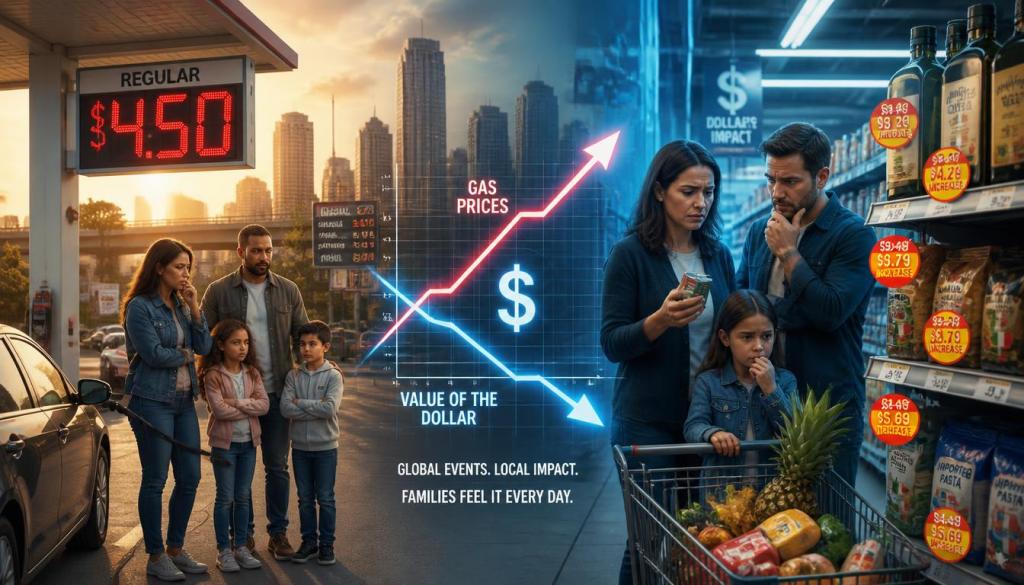
The conflict in the Strait of Hormuz—through which approximately 20% of global oil shipments pass—has pushed gas prices above $4.50 a gallon in many parts of the country .
44% of U.S. adults say high prices are making them drive less. Transit agencies in places like Cincinnati and Los Angeles have reported more riders, while Amtrak and used EV sales have seen increased interest .
For urban communities:
- $4.50+ per gallon means the typical worker filling up once a week is paying roughly $20 extra per week compared to pre-crisis prices
- 60% of Salt Lake City commuters (a metro area among the hardest hit) worry they won’t be able to afford gas if prices continue to rise
- In the Northeast, where fewer refineries exist, cities like Philadelphia are especially exposed—gas there hit $3.94 while South Jersey rose 6 cents in a single week
Delivery drivers, small business owners, and workers without transit alternatives are being squeezed. One Philadelphia driver told FOX29 he spent $107 to fill up his vehicle . A delivery driver in Rochester said he spends upward of $100 a week on gas .
The Bifurcated Economy: Urban Wage Growth vs. Urban Costs
The Federal Reserve’s March 2026 Beige Book describes a “bifurcated economy” where industrial hubs are growing while coastal regions—home to many urban centers—struggle with cooling tech demand and high living costs .
Key findings:
- “Shrinkflation” is surging in the New York District as firms try to recoup costs without alienating price-sensitive consumers
- Immigration enforcement has begun to “weigh on retail demand” and reduce the pool of community workforce program participants
- Tariffs on imports are forcing manufacturers to navigate volatile input costs, creating a ripple effect that makes pricing strategies increasingly difficult
This is playing out in a two-tier economy where lower-income Americans are “feeling under a lot of pressure right now,” as McDonald’s CEO put it, while higher-income consumers are still able to spend freely .
The urban poor are caught in the middle: higher gas prices, higher import prices, and rising credit card debt .
Commodity Prices: The Coming Wave
Harvard economist Kenneth Rogoff warns that commodity prices are likely to rise “no matter what the dollar’s at,” particularly with the impact of the Iran war on fuel prices . Morgan Stanley Research projects the dollar could lose another 10% by the end of 2026, driven by narrowing interest-rate differentials .
For urban communities, this means:
- Coffee prices are up nearly 19% in the past year, with a weaker dollar adding pressure on top of supply chain disruptions
- Fuel costs are driving up prices for everything from groceries to building materials
- Wealthier households are propping up the consumer economy while low- and middle-income families are being priced out
The Bottom Line
The combination of a weakening dollar, the Iran war, and tariffs is not an abstract economic story. It is a pocketbook story for urban communities.
Black households face import price inflation nearly four times higher than rural households. Gas prices are driving up commuting costs while wages stagnate. And the Federal Reserve’s Beige Book confirms a two-tier economy where urban centers are being squeezed.
For urban residents, the message is clear: the cost of living is rising faster than wages. And the policies driving the dollar down—tariffs, geopolitical risk, and trade disruption—are hitting urban communities hardest.
The question is whether policymakers will notice.
Sources
TheStreet: “U.S. dollar’s silent collapse is making everything cost more” (May 7, 2026)
Yahoo Finance: “Strait of Hormuz shutdown triggers oil ‘demand destruction’” (May 21, 2026)
ABC4 Utah: “Will Utahns find relief at the gas pump?” (April 7, 2026)
FOX29 Philadelphia: “Gas prices rise in Philadelphia region” (July 8, 2026)
WHAM Rochester: “Iran war drives up prices at gas pumps” (March 10, 2026)
BBC: “US inflation: Tariffs could widen divide between haves and have-nots” (September 14, 2025)
Wedbush Securities: “Bifurcated Economy: Analyzing the March 2026 Federal Reserve Beige Book” (March 5, 2026)
NBER: “Import Price Inflation and the Cost of Living of Different Demographic Groups” (2026)
The People’s Weekly | urban intelligence from a holistic approach.
[ai]
 The People's Weekly
Leave a comment