Politics and Policy — Listen Free 🎧 | Contact 📧
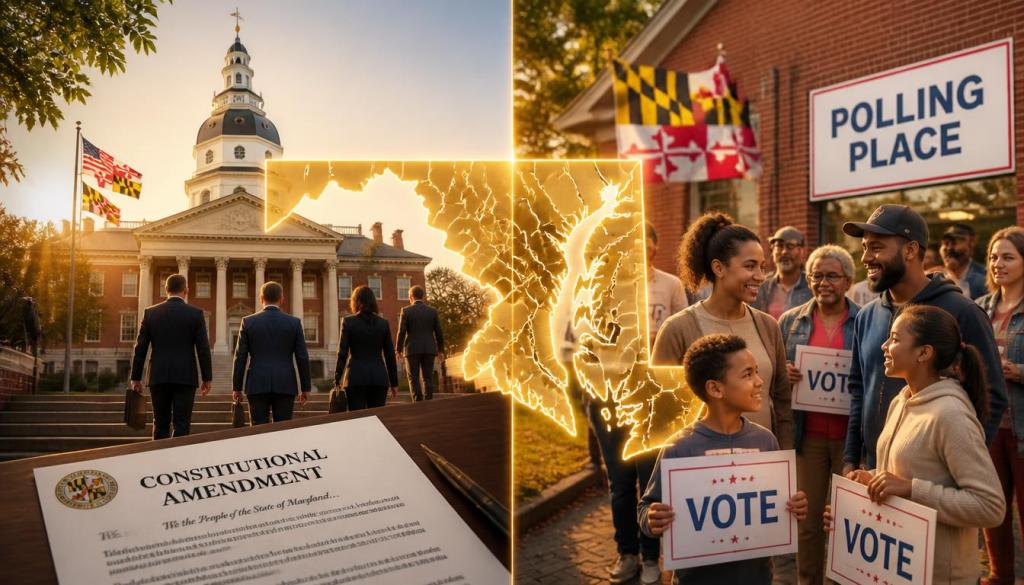
In a two-day special session that concluded Tuesday night, Maryland Democrats pushed through legislation that will put a constitutional amendment on the November ballot — one that could fundamentally change how the state draws its congressional maps and potentially give Democrats total control of Maryland’s U.S. House delegation.
The Maryland House voted 96-38 and the Senate voted 34-11 to approve the measure, sending it to Gov. Wes Moore’s desk for signature before it heads to voters in November.
What the Amendment Would Do
The amendment clarifies that certain redistricting parameters — including requirements that districts be compact, reasonably shaped, and drawn with consideration for existing geographic boundaries — apply only to state legislative districts, not congressional districts.
The measure also would allow the Maryland Supreme Court to have “original jurisdiction” to review congressional redistricting plans.
What it doesn’t do: The amendment does not draw any new congressional districts, change a single line on the map, or affect the upcoming 2026 midterm elections.
If voters approve the referendum in November, lawmakers could adopt new congressional maps ahead of the 2028 election.
The Political Context
Currently, Democrats hold seven of Maryland’s eight U.S. House seats. The lone Republican is Rep. Andy Harris, who represents the state’s 1st District on the Eastern Shore.
The amendment could give Democrats the latitude to eliminate that last Republican seat entirely.
Why now? Democrats argue the legislation is a response to other states redrawing their lines to give Republicans an advantage. Eight states — Alabama, Florida, Louisiana, Missouri, North Carolina, Ohio, Tennessee and Texas — have redrawn maps in recent years to help Republicans pick up as many as 16 seats in Congress.
“We saw states like Tennessee, Louisiana, and South Carolina act with haste to attempt to eliminate majority-minority congressional districts,” Senate President Bill Ferguson said. “These acts changed the calculus. And that’s why we’re here”.
Democrats also point to a 2022 court decision that struck down a proposed Democratic map, ruling that it violated state constitutional standards. The amendment would effectively nullify that ruling for future congressional redistricting.
The Republican Response
Republicans are calling the effort a blatant partisan power grab.
“This is the dimmest thing we ever did,” House Minority Leader Jason Buckel said.
Senate Minority Leader Steve Hershey was even more blunt: “They’re looking for a way to cheat. They’re going to ask the voters if they’ll vote in favor of a constitutional amendment so they can redraw the maps to eliminate the only Republican voice we have in the Congress”.
Republicans also argue that the special session is a distraction from the real issues facing Maryland families.
“We just came down here for two days and we’re told we’re not going to talk about any of that,” Buckel said, referring to affordability, energy costs, housing, and taxes.
The special session was not without procedural drama. Republicans attempted to filibuster and slow down the process. In the Senate, debate was limited to just 120 minutes total — 60 minutes for proponents and 60 minutes for opponents.
What the Speaker Said
House Speaker Joseline Peña-Melnyk defended the measure, emphasizing that it gives voters the final say.
“This legislation does not draw congressional districts. It does not change a single line on a map. And it does not affect the upcoming 2026 election,” she said.
“It simply clarifies Maryland law and gives voters the opportunity to decide whether our Constitution should provide the same legal framework available to other states as they confront the realities of congressional redistricting”.
What the Governor Said
Gov. Wes Moore praised the General Assembly’s action.
“By passing this constitutional amendment, the General Assembly has ensured that… the final decision will rest where it belongs: with the people of Maryland,” Moore said.
He added: “For over a year, I’ve warned that Donald Trump and Republicans across the country are working to rig the system and weaken voting rights. Today, the Maryland General Assembly took action to pass a constitutional amendment that, if ratified by voters in November, will ensure that Marylanders – and no one else – have the final say over their representation”.
House Minority Leader Hakeem Jeffries (D-N.Y.) thanked Moore and Maryland Democrats “for standing up to the MAGA power grab”.
What Happens Next
The bill now heads to Gov. Moore’s desk for signature. Once signed, the question will appear on the November ballot for Maryland voters to decide.
If voters approve the amendment, lawmakers could move forward with new congressional maps — possibly in time for the 2028 election.
Maryland’s constitution requires the General Assembly to reconvene for a second special session if voters approve the amendment, at which point lawmakers could take up a new map.
The Bottom Line
Maryland Democrats have used their supermajority to advance a constitutional amendment that could give them total control of the state’s congressional delegation. Republicans call it a power grab. Democrats call it a response to GOP redistricting efforts nationwide.
The final decision now rests with Maryland voters.
Sources
WMAR2: “MD Dems push through legislation to get easier redistricting rules on the ballot” (August 4, 2026)
NY Post: “Maryland Democrats pass redistricting amendment that could target lone Republican House seat — if voters approve” (August 4, 2026)
News & Observer: “Maryland House passes redistricting referendum, heads to Senate” (August 4, 2026)
The Hill: “Maryland lawmakers approve redistricting referendum” (August 5, 2026)
CBS Baltimore: “Maryland lawmakers approve redistricting amendment, sending congressional map changes to voters” (August 4, 2026)
CoastTV: “Maryland passes redistricting amendment in special session, now up to voters” (August 5, 2026)
AI
 The People's Weekly
Leave a comment