Urban Lifestyle — Listen Free 🎧 | Contact 📧
Dating has always been expensive, but in 2026, it’s becoming financially unsustainable for millions of Americans. The cost of romance is rising faster than inflation itself, forcing singles to rethink everything — from where they go on dates to whether they date at all.
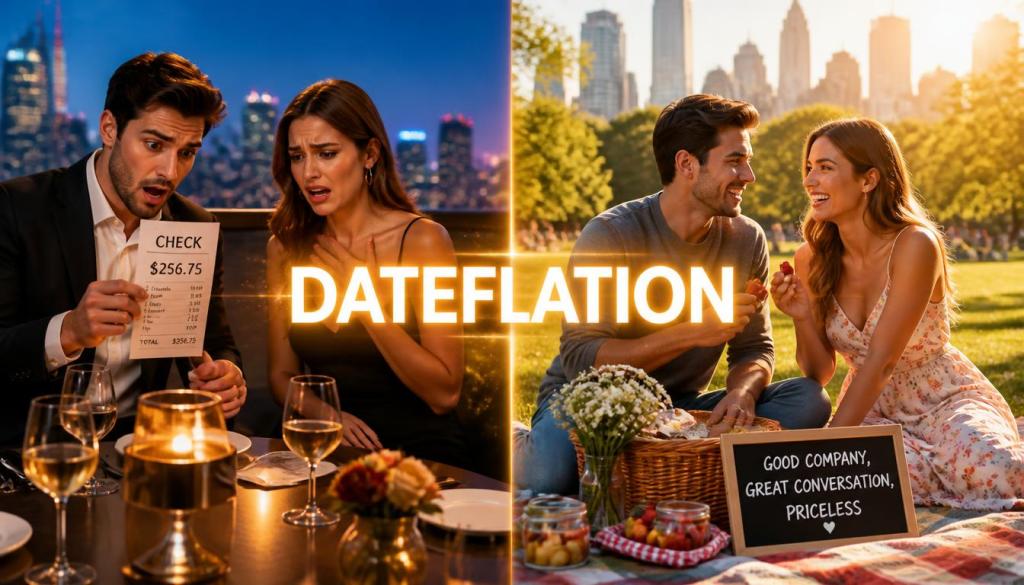
Welcome to the era of “dateflation.”
The Numbers Are Staggering
According to BMO’s 2026 Real Financial Progress Index, the average “all-in” cost of a date in America — including pre-date grooming, transportation, and the date itself — has climbed to $189, a 12.5% increase from $168 in 2025 . That growth rate is far outpacing the broader cost of living, which rose just 2.7% over the same period .
Those costs add up quickly. Americans spent an average of $2,323 on dates over the past year . And the number of dates is falling — the average American who dated went out about 12 times in the past year, down from around 14 in 2025 .
The generational breakdown is even more striking:
- Millennials: $252 per date, up 32% from $191 in 2025
- Gen Z: $205 per date, up from $194 in 2025
- Gen X: $173 per date, up from $172 in 2025
- Baby Boomers: $126 per date, down from $127 in 2025
The Human Cost: People Are Opting Out
The financial burden is changing behavior in profound ways.
Half of single Americans say they are going on fewer dates or choosing less expensive activities because of rising costs . More than four in 10 — 44% — have changed or adjusted date plans for financial reasons .
For singles, the toll is even heavier. Nearly half of singles (47%) say dating is simply not financially worth it . The BMO survey of 2,501 U.S. adults, conducted in late December through January, also found that 50% of Gen Z and 40% of Millennials say the cost of dating gets in the way of reaching their financial goals .
“We’re seeing that there is this increased cost of living, and it’s lowering our dating frequency and how we’re seeing or perceiving dating,” Sabrina Romanoff, a clinical psychologist, told CNBC. “We’re seeing people have fewer dinners out and there’s a lower tolerance for higher-risk meetups” .
The K-Shaped Dating Economy
The BMO report describes a “K-shaped dating economy” — two distinct approaches to coping with higher dating costs :
- One end: People are slashing dating expenses entirely — skipping date nights, swapping restaurants for home-cooked meals, and movie tickets for popcorn on the couch .
- The other end: Some are accepting that dating is expensive and continuing to spend. 14% say a typical date costs them $300 or more, up from 11% in 2025 .
Meanwhile, 14% of Americans say the average date costs them nothing — up from 12% a year ago .
A Generational Shift: Gen Z Is Sitting Out
Younger generations are particularly affected. According to Bank of America’s 2025 Better Money Habits study, 53% of Gen Z spend $0 per month on dating . The study of over 900 Gen Z adults found that 53% of men and 54% of women reported spending nothing on dating each month . Another 28% cap their monthly romance budget at under $100 .
“It’s no surprise they’re not spending on dating when many can barely afford rent,” HR consultant and generational expert Bryan Driscoll told Newsweek . “In their short lives, they’ve lived through economic collapse, inescapable student debt, and an impossible housing market” .
The impact extends beyond spending. A study from DatingNews.com and the Kinsey Institute found that 43% of young U.S. singles are going on fewer dates, 37% are cutting back on dating in general, and 33% blame the economy for their hesitation around romance . Additionally, 33% of U.S. adults say the economy makes them hesitant to commit to a serious relationship .
The Bigger Picture: Inflation’s Toll on Love
The dating crunch reflects something larger — an economy where the cost of living is outpacing wages, and where everyday experiences are becoming inaccessible to working-class Americans. According to a LendingTree survey, 65% of daters said inflation has affected their dating life .
For Gen Z, the math is brutal. The typical Gen Z American went on about nine dates in the prior year, putting their annual dating outlay at roughly $1,845 . For young workers, that represents a meaningful share of annual income .
The Response: “Infladating” and “Dateflation”
As dating becomes more expensive, singles are getting creative. Two viral terms have emerged to describe the shift: “infladating” and “dateflation” — the phenomenon of singles scaling back expensive dates and opting for budget-friendly activities amid financial pressures .
The concept is simple: instead of expensive dinners and cocktails, singles are opting for low- or no-cost activities — grabbing coffee, going for a walk, having a picnic, or hiking . More than 60% of single Americans say overspending to impress on a date is a red flag, and half say they prefer low-cost date ideas . Just 1 in 4 singles think spending up to $100 on a first date is reasonable, with the majority (57%) drawing the line at $75 or less .
“A lot of people are struggling in today’s economy and they’re opting out of dating completely because it’s too expensive,” says Amy Chan, a dating coach and author of Unsingle: How to Date Smarter and Create Love that Lasts. “If the antidote for that is infladating then I’m all for it!”
What This Means for Urban Communities
For urban residents, the impact is particularly acute. In major cities where the cost of living is already sky-high, dating has become a luxury many can’t afford. When a single date costs nearly $200 — and millennials are spending $252 — the math simply doesn’t work for young professionals trying to build wealth, save for a home, or pay down student debt.
50% of Gen Z and 40% of Millennials say the cost of dating gets in the way of reaching their financial goals . That’s not a minor inconvenience — it’s a structural barrier to connection.
The Bottom Line
Dating in 2026 is more expensive than ever. The average date costs $189. Nearly half of singles say dating isn’t financially worth it. More than half of Gen Z spends nothing on dating each month. And two-thirds say inflation has affected their dating lives.
But singles are adapting. They’re opting for walks over dinners, coffee over cocktails, and connection over consumption. The rise of “infladating” and “dateflation” isn’t just about cutting costs — it’s about reclaiming what romance should be about in the first place.
As Amy Chan put it: “If the antidote for that is infladating then I’m all for it!”
Sources
BMO Real Financial Progress Index: “Date-flation hits hard: Average date spend nears $200” (February 11, 2026)
CNBC: “Some young Americans scale back dating as costs and apps add pressure, survey shows” (April 25, 2026)
CNBC: “Millennials spend $252 on an average date, BMO finds — and social media is spiraling over ‘date-flation’” (May 23, 2026)
Bank of America: “Better Money Habits Report 2025” (2025)
Newsweek: “Most of Gen Z is not spending any money on dates” (August 4, 2025)
Vice: “Gen Z Stopped Spending Money on Dates—and They’re Fine With It” (September 2, 2025)
DatingNews.com & Kinsey Institute: “Young singles are giving up on dating for this startling reason, study says” (September 30, 2025)
LendingTree: “65% of Single Daters Say Inflation Has Impacted Their Dating Life” (2024)
USA Today: “People are going on cheap dates and calling it ‘infladating’” (August 2, 2026)
AI
 The People's Weekly
Leave a comment