Voting Rights and Democracy — Listen Free 🎧 | Contact 📧
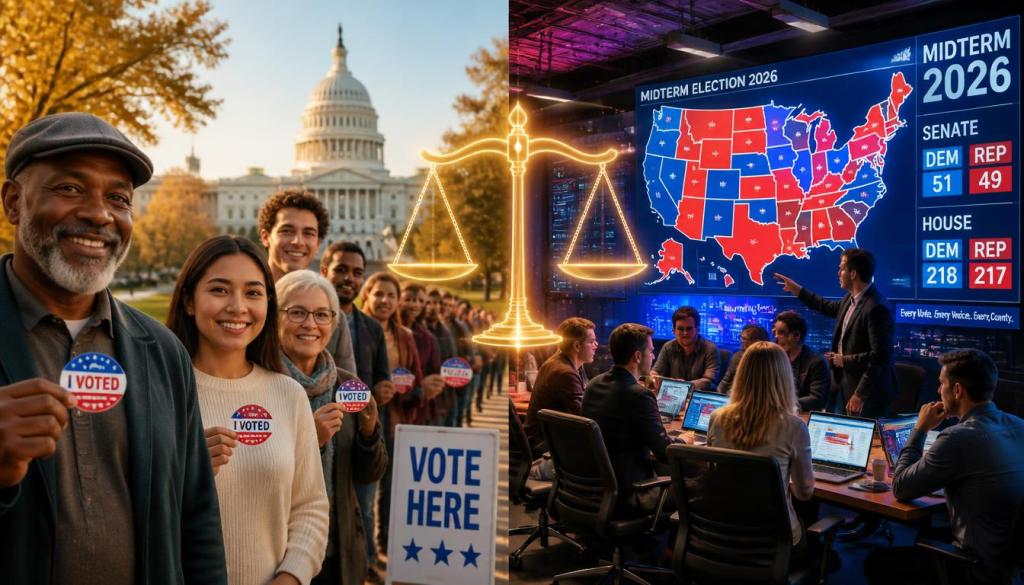
The 2026 midterm elections are shaping up to be among the most consequential in modern American history. With Republicans holding a razor-thin 218-212 House majority (with five vacancies) and a 53-47 Senate majority, the balance of power in Washington hangs by a thread.
The outcome will determine whether President Trump continues to govern with minimal legislative resistance — or whether Democrats gain the power to investigate, subpoena, and block his agenda.
Here’s what each scenario would mean for the country.
THE DEMOCRATIC SCENARIO: Checks, Balances, and Accountability
The Likely Outcome
Historical patterns, current polling, and the electoral map all point to a strong Democratic performance. The president’s party has lost House seats in 20 of the past 22 midterm elections dating back to 1938. Trump’s approval rating sits near a record low for his presidency, with his disapproval exceeding his approval by roughly 5 to 8 points in major polling averages.
The generic ballot currently shows Democrats with a 3.9-point advantage over Republicans — a swing of 6.5 points from the 2024 House elections, which would translate to a Democratic gain of roughly 12 to 19 House seats.
Most analysts expect a Democratic House and a Republican Senate, creating divided government.
What Democrats Could Do With the House
If Democrats regain control of the House, they would gain the power to:
1. Address Health Care Costs and Access in Red Districts
A Democratic House would likely prioritize legislation to reverse the Medicaid cuts and enhanced subsidy expirations enacted in the 2025 “One Big Beautiful Bill Act.” This would directly benefit the over 70% of Republican-held districts where residents face elevated rates of diabetes, high blood pressure, obesity, cardiovascular deaths, and uninsured rates exceeding the national average. In those districts, life expectancy now lags below the national average — a gap of over a decade behind Democratic-held districts.
Democratic proposals to restore Medicaid coverage and ACA subsidies would address the fact that 54% of House Republicans represent districts with above-average uninsured rates, compared to just 31% of Democrats. For the predominantly White, culturally conservative rural voters in these districts — who face physically demanding jobs, limited access to major medical centers, and higher exposure to health risks — restoring health care access would be a tangible benefit.
Battleground polling shows that 52% of voters in competitive districts identify health care and prescription drugs as a top priority for Congress to address. By acting on this priority, a Democratic House would deliver relief to the very communities most impacted by the GOP’s health care cuts — even if those communities have historically voted Republican.
2. Block Further Fiscal Legislation
Any additional Republican budget reconciliation bills — like the 2025 “One Big Beautiful Bill Act” — would die in the House. Democrats would likely oppose further corporate tax cuts, increased defense spending, or reductions in social programs.
3. Force Bipartisanship
To pass any legislation, Republicans would need Democratic votes. This would moderate policy outcomes and could force action on Democratic priorities — including ending the Iran war, addressing rising gas prices, and protecting Social Security and Medicare.
4. Protect the Debt Ceiling
With a Democratic House, debt ceiling negotiations would become more contentious. The current debt limit of $41.1 trillion is projected to be reached by 2027, and political posturing could create bond market volatility.
5. Restore Voting Rights Protections
Democrats would likely move to protect voting rights and push back against the restrictions and redistricting efforts that Republicans have advanced, including the SAVE America Act and the elimination of majority-minority districts.
What Democrats Could Not Do
Even with a House majority, Democrats could not advance their own legislative agenda without the Senate. A Republican-controlled Senate would block major Democratic initiatives. And President Trump’s veto power would remain.
As LGT Private Banking notes: “The election’s most important consequences are likely to be felt in fiscal policy and legislative priorities.”
The Bottom Line for the Democratic Scenario
A Democratic House would end the legislative phase of Trump’s presidency. The president would face real checks on his power for the first time in his second term. But gridlock would likely prevail, with only bipartisan legislation passing — and with it, the potential for more moderate, centrist policy outcomes.
THE REPUBLICAN SCENARIO: Unchecked Power and Continuing Transformation
The Likely Outcome
Republicans face significant headwinds. As Brookings concluded: “Barring unforeseeable game-changing events during the next 14 months, the probability that Republicans will lose control of the House is very high.”
However, Republicans have taken extraordinary steps to tilt the playing field:
1. Aggressive Redistricting
The mid-decade redistricting war has created 10 additional Republican-leaning House seats. Texas, North Carolina, Missouri, Ohio, Tennessee, Louisiana, and Alabama all redrew maps to eliminate Democratic-held or majority-minority districts. The Supreme Court’s decision in Louisiana v. Callais — which weakened the Voting Rights Act — made this possible.
According to an internal Republican assessment, Democrats must now defend 23 House seats that Trump won in 2024, up from 13 at the start of the cycle.
2. Voting Restrictions
The SAVE America Act would require documentary proof of citizenship to register to vote and photo ID to cast a ballot. While the legislation lacks the votes to overcome a Democratic filibuster, Trump has pressured Republicans to keep pushing — threatening not to sign any non-budgetary bills until it passes.
3. Justice Department Actions
The Justice Department has been demanding voter files from every state, suing at least 30 states and territories to compel compliance. While it has not won a single lawsuit, Democrats fear this data could be used to challenge, discredit, or spread disinformation about midterm results.
4. Weakened Election Security
The Trump administration has weakened the Cybersecurity and Infrastructure Security Agency, terminated an FBI task force combatting foreign influence in U.S. elections, and ended a program responsible for sharing threat intelligence with state and local officials.
5. Questioning Election Integrity
Trump continues to relitigate the 2020 election, using the White House to legitimize and seek evidence supporting debunked conspiracy theories. He has introduced a page on the White House website falsely accusing Democrats of promoting a “gaslighting narrative.”
What Republicans Could Do If They Hold Both Chambers
If Republicans retain control of both the House and Senate, they would continue to govern with virtually no legislative resistance. This would allow them to:
1. Pass Further Party-Line Legislation
Using the budget reconciliation process, Republicans could advance additional tax cuts, spending measures, and policy changes without Democratic votes.
2. Continue Reshaping the Federal Bureaucracy
By September 2025, approximately 154,000 federal employees had accepted buyout offers and left government service. A continued Republican Congress would support further downsizing and reshaping of the federal workforce.
3. Maintain Aggressive Trade and Immigration Policies
With legislative avenues open, the administration could continue its aggressive tariff and immigration policies, which present upside risks to inflation and could constrain the Federal Reserve’s ability to ease monetary policy.
4. Continue the Iran War and Expand Defense Spending
A Republican-controlled Congress would likely continue funding the conflict with Iran and approve increased defense spending, despite public opposition to the war. Only one in three Americans support the war, and 68 percent believe it is “not worth fighting.”
5. Further Restrict Voting
The SAVE America Act could become law, imposing new barriers to voting that would disproportionately impact communities of color, women who have changed their names, and lower-income Americans.
The Bottom Line for the Republican Scenario
A Republican-controlled Congress would mean continued consolidation of executive power. As the New York Times described it, Trump’s approach represents “arguably the closest the country has come during a time of general peace to the centralized authority of a monarch.” The legislative branch would remain subordinated to the executive, and the Trump administration’s transformation of American government would proceed without structural constraints.
The Electoral Math
House
- Current balance: 218 Republicans, 212 Democrats, 5 vacancies
- The baseline: Historical patterns suggest a Democratic gain of 12-19 seats
- The twist: Redistricting has created 10 additional Republican-leaning seats, making the math tighter
- The toss-ups: 18 House races are rated as “tossups” — 17 of them won by Trump in 2024
Senate
- Current balance: 53 Republicans, 47 Democrats
- The challenge: Democrats need a net gain of 4 seats to take the Senate
- The map: Republicans are defending 22 seats compared to just 13 for Democrats
- The caveat: Senate elections are increasingly nationalized. If Democrats win the House by a significant margin, they could also win the Senate — but the map makes it difficult.
The Bottom Line
The 2026 midterms represent a fundamental choice about the balance of power in American government.
If Democrats win the House: Trump’s legislative agenda would grind to a halt. Investigations would begin. The president would face real checks on his power for the first time in his second term. But gridlock would likely prevail, and little major legislation would pass.
If Republicans hold both chambers: Trump’s transformation of American government would continue without meaningful legislative resistance. Voting restrictions would tighten. The Iran war would continue. The executive branch would remain unchecked.
The historical winds are blowing toward Democrats. But Republicans have engineered structural advantages that could blunt the tide. The outcome is uncertain — and the stakes could not be higher.
To support the effort for a better America support Fight for the People PAC and Democrats.org. We’re fighting to save America, our Constitution, and our rights and freedoms.
Sources
Brookings: “Supreme Court decision alters 2026 midterm election outlook” (April 29, 2026)
Brookings: “What history tells us about the 2026 midterm elections” (August 28, 2025)
J.P. Morgan: “Mid-term elections: How does a change in Congress change U.S. policies?” (June 10, 2026)
The New York Times: “The Many Ways Trump Is Trying to Tip the Scales for the Midterms” (July 1, 2026)
BBC: “Republicans gained edge in redistricting battle, internal assessment finds” (June 9, 2026)
Advisor Perspectives: “Midterm Elections and Geopolitical Risk Will Drive the Market” (July 10, 2026)
LGT Private Banking: “US midterm elections 2026: what investors need to know” (June 1, 2026)
Rasmussen Reports: “It Don’t Mean a Thing if it Ain’t Got That Swing” (February 11, 2026)
Daily Herald: “Consider the possibilities for restoring good government” (August 1, 2026)
Cherry Bekaert: “2026 Midterms: Potential Outcomes and Implications” (2026)
The Hill: “Democrats’ health care push could pay off in red districts” (July 2026)
The Commonwealth Fund: “Health Care in Republican Districts: An Analysis” (2026)
The People’s Blog — urban political intelligence with a holistic social approach.
This article was writing with AI.
 The People's Weekly
Leave a comment