Finance & Investing | Listen Free 🎧 | Contact 📧
The Federal Reserve raised interest rates last week for the first time in three years, and the ripple effects are already reaching American households. From Social Security checks to credit card bills to student loan payments, the squeeze is tightening — and for many families, there’s no easy escape.
Social Security Recipients: A Bigger COLA, But Still Not Enough
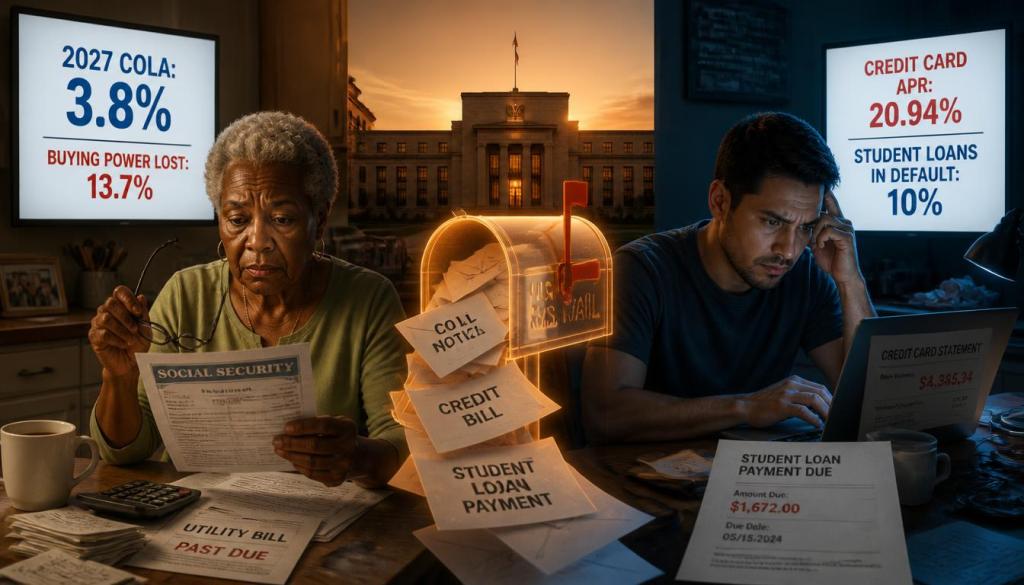
Social Security recipients will learn their 2027 cost-of-living adjustment (COLA) in mid-October, and early projections point to the largest increase in four years . The Senior Citizens League forecasts a 3.8% bump , while AARP projects 3.6% . The official announcement is expected October 14, once September inflation data is released .
What that means in dollars: A 3.8% adjustment would raise the average retired worker’s monthly benefit by about $73.62 . A 3.6% increase would add roughly $75 per month . That’s an extra $800 to $900 per year.
But here’s the catch: The COLA is based on the Consumer Price Index for Urban Wage Earners and Clerical Workers (CPI-W), which does not reflect the costs retirees actually face — especially housing and healthcare . Between 2016 and 2026, Social Security benefits lost 13.7% of their buying power, according to The Senior Citizens League . Even a larger COLA may not close that gap.
“Don’t expect your upcoming COLA to actually keep pace with inflation.”
— The Motley Fool analysis
The reason: The CPI-W tracks wage earners, not retirees. And with the war in Iran driving oil prices above $100 a barrel, inflation has surged again — meaning the costs the COLA is meant to offset are rising faster than the adjustment itself .
Credit Card Debt: Rates Near Record Highs as the Fed Hikes
The Fed’s rate hike pushed credit card borrowing costs even higher. The average credit card APR was 20.94% in Q2 2026, according to Federal Reserve data — among the highest readings in the history of the series . Before the pandemic, the average was around 17% .
The math is brutal for households carrying balances:
- The average American cardholder balance is approximately $6,600 .
- At a 21% APR, a quarter-point hike adds roughly $1.38 per month in interest — under $17 per year.
- But because minimum payments cover mostly interest, the principal barely shrinks. The balance gets repriced at every subsequent Fed meeting .
“A quarter-point hike in isolation is not going to break anybody, but the broader trend is really significant.”
— Ted Rossman, principal consumer finance analyst at Money Management International
The real pressure is cumulative: inflation pushing up gas and grocery bills while the cost of carrying the shortfall rises in parallel .
What you can do: If you’re carrying a balance, consider a balance transfer to a 0% APR card or a debt consolidation loan before rates climb further. Prioritize paying down high-interest debt over discretionary spending.
Student Loan Payments: Collections Are Back
Federal student loan collections resumed in 2025 after the pandemic-era pause ended, and the impact is already visible . The share of student loan balances past due rose to just over 10% in the first quarter of 2026, nearing pre-pandemic levels .
The numbers behind the strain:
- Approximately 42.3 million recipients hold $1.67 trillion in outstanding federal student loans .
- More than 5 million borrowers were already in default when collections resumed .
- The number of borrowers in default grew by more than 4.2 million between April 2025 and March 2026, surpassing the previous high of 8 million recorded in December 2019 .
The pause on wage garnishment was temporarily extended in January 2026 to give borrowers time to evaluate new repayment options. But that pause is temporary — the government’s authority to collect has not gone away .
What you can do: If you’re in default or at risk, contact your loan servicer immediately. Ask about Income-Driven Repayment (IDR) plans, loan rehabilitation, or consolidation. The worst thing you can do is ignore it — wage garnishment and tax refund offsets can resume .
The Bigger Picture: A Triple Squeeze
For many American families, the Fed’s rate hike isn’t an abstract economic event. It’s a triple squeeze:
- Credit card costs are rising — and for households carrying balances, the interest compounds with every Fed meeting .
- Student loan payments have resumed — and delinquency rates are climbing back toward pre-pandemic levels .
- Social Security’s buying power is eroding — even with a larger COLA, the adjustment formula doesn’t reflect the real costs retirees face .
For seniors on fixed incomes, the squeeze is particularly acute. They receive the COLA as their only “raise,” but it’s calculated on a formula that doesn’t account for their actual expenses . For working families, the combination of rising credit card costs and resumed student loan payments eats into budgets already strained by inflation.
The Bottom Line
The Fed’s rate hike is designed to fight inflation. But for households already stretched thin, it adds another layer of pressure. Social Security recipients will see a larger COLA — but it won’t keep pace with their real costs. Credit card holders will pay more in interest. And student loan borrowers are once again facing the reality of repayment.
The most important thing you can do is get involved in America. Contact your state representatives or visit Democrats.org to register to support and do what you can to make America better for all. The most important thing you can do is get involved in America.
What do you think should be done to help families caught in this squeeze? Should Congress act on Social Security, student loans, or credit card reform? Share your thoughts in the comments below.
Sources
IndexBox: “2027 Social Security COLA Forecast: 3.4%–3.6% Increase vs. 2026’s 2.8%” (September 20, 2026)
Congressman John Larson: “Social Security could get big boost for 2027” (July 14, 2026)
Nasdaq: “We Won’t Know Social Security’s 2027 COLA Until Oct. 14” (September 23, 2026)
Nasdaq: “This Is an Important Month for Social Security’s 2027 COLA” (July 19, 2026)
Investopedia: “Consumers Rack Up Credit Card Debt Amid Rising Prices” (July 9, 2026)
Greenpath: “Student Loans in 2026: What Borrowers Need to Know” (September 7, 2026)
American Default: “Federal Reserve Avg Credit Card APR (Q2 2026): 20.94%” (April 30, 2026)
Edgen: “Fed’s first hike in 3 years adds $6,600 card burden” (September 19, 2026)
Infobae: “El impago de préstamos estudiantiles en Estados Unidos vuelve a niveles récord” (July 22, 2026)
Emory University: “Student Loans, Wage Garnishment, and What Borrowers Need to Know in 2026” (February 16, 2026)
NYU: “Social Security COLA 2027: An early look” (September 12, 2026)
Quartz: “Social Security COLA for 2027 estimated at 3.6%” (September 10, 2026)
The People’s Weekly — urban intel with a holistic social approach.
[ai]


Leave a comment