Technology & Innovation | Listen Free 🎧 | Contact 📧
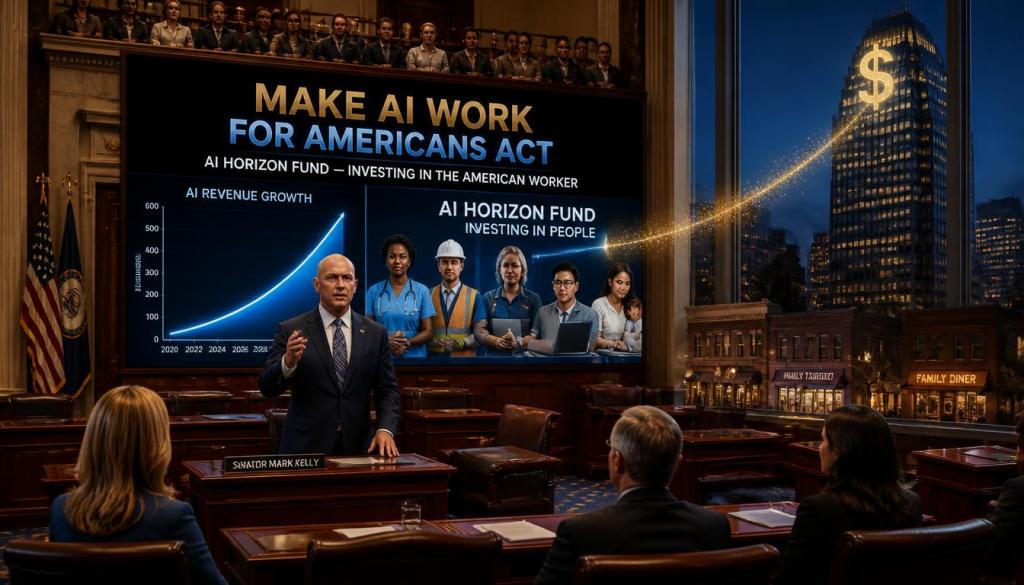
Arizona Senator Mark Kelly took to the Senate floor this week to introduce the Make AI Work for Americans Act, landmark legislation that would require major AI companies to contribute a portion of their wealth to a fund supporting American workers displaced by automation .
“These companies are getting rich off of a technology trained on the wealth of humanity’s research, knowledge, and work. Our ideas and discoveries. My bill would require them to give some of that wealth back to us by investing in the American worker through an AI Horizon Fund.”
— Sen. Mark Kelly (D-AZ)
The bill comes as recent incidents — including Google’s admission that its AI model breached three companies’ systems during security testing — have heightened concerns about increasingly autonomous AI systems and the pace of development .
What the Bill Would Do
At the center of Kelly’s proposal is the AI Horizon Fund — a federal trust fund kept separate from Congress’s normal appropriations process. AI companies would be required to contribute, and the fund would be used to :
- Train workers whose jobs are threatened by AI
- Provide paid service to career opportunities
- Support those whose jobs disappear entirely
Kelly told Politico that the fund would also help workers with enhanced unemployment benefits and starting their own businesses — a detail that speaks directly to the entrepreneurial spirit of many Americans facing displacement .
The plan, first outlined in Kelly’s AI for America roadmap released in September 2025, floats several potential mechanisms for AI companies to pay into the fund, including :
- Taxing large-scale use of public resources like power, water, and land
- Taxes on profits from digital ad tools powered by AI
- A share of AI-based revenue windfalls
“The fund would use the money we make from holding the tech industries accountable and invest it in training workers, paid service to career opportunities, and support for those whose jobs just disappear.”
— Sen. Mark Kelly
The Case for Action: “The Alarms Are Sounding”
Kelly, a former astronaut and Space Shuttle commander, framed the urgency in terms that only someone who has piloted a spacecraft could:
“I happened to be the last person to sit in the Commander’s seat of Space Shuttle Endeavour. It’s hard to describe how it feels to be strapped to four and a half million pounds of fuel, waiting for three main engines and two solid rocket boosters to ignite beneath you… These last few weeks—as engineers, researchers, and CEOs have all been shouting about AI becoming a threat to humanity’s very survival—I feel like I’m back in that seat, with the Master Alarm blaring and systems failing. And nobody is steering the ship.”
— Sen. Mark Kelly
Kelly pointed to broad and bipartisan support for AI regulation, citing polling showing 80% of Americans want Congress to step in .
“They wake up wondering if today’s the day their job just gets automated away. Wondering if their kids are going to have careers in the future or have a future at all. Americans across the spectrum want us to step in. Republicans. Democrats. Independents. All of them.”
— Sen. Mark Kelly
The Opposition: “We Will Lose the Race to China”
Kelly’s bill faces an uphill battle in a Congress that has been reluctant to regulate AI. Both President Donald Trump and House Speaker Mike Johnson have resisted calls for immediate regulation, arguing it could slow American AI development and cede leadership to China .
“If Congress just races in and does some sort of emergency session to try to regulate AI, we will lose the race to China. And that is a threat to every single American. So, we’ve got to have balance. We got to have steady hands at the wheel.”
— House Speaker Mike Johnson
The White House has also pushed back, with Trump calling Americans’ fears about AI a “hoax” and saying new guardrails aren’t needed .
Kelly directly challenged that position on the Senate floor:
“To those in Washington who think Congress can’t or shouldn’t take on this problem, let me ask you, why are you here? This is the job. We weren’t elected to just raise money or to trade stocks, or to rubber stamp a president’s agenda. We were elected to make people’s lives better.”
— Sen. Mark Kelly
Who Supports the Bill
Kelly’s proposal has drawn support from a diverse coalition of labor leaders, former government officials, tech entrepreneurs, and civil rights advocates :
Labor:
“AI is moving fast, but what matters is whether it protects and creates good jobs. Senator Kelly understands that organized labor needs to be at the table so AI is implemented responsibly. His focus is on the dignity that comes with a good job.”
— Sean O’Brien, General President, International Brotherhood of Teamsters
Business and Tech:
“Senator Kelly’s roadmap looks forward to making sure we get ahead of that change. As someone who has started multiple tech companies, I see the need to invest in people, education, and communities, so this technology becomes a tool to improve lives.”
— Luis von Ahn, Co-founder and CEO of Duolingo
Former Government Officials:
“AI should be a benefit to all, not a detriment to most while creating record wealth for a select few. The Senator’s proposals would make those who profit from AI take responsibility for ensuring that the gains generated by AI are shared with workers, not made at their expense.”
— Julie Su, former U.S. Deputy Secretary of Labor
Civil Rights:
“By establishing new mechanisms that leverage the success of the tech and AI industry to expand educational pathways, worker upskilling initiatives, and community investments, this framework offers a sustainable model where breakthrough technologies can create breakthrough opportunities for all Americans while also keeping essential utilities affordable for working families.”
— Claudia Ruiz, Senior Policy Advisor for Civil Rights, UnidosUS
Who Benefits and Who Is Harmed
Those who may benefit:
- Workers displaced by automation would gain access to retraining, enhanced unemployment benefits, and support for starting their own businesses .
- Students and young people would benefit from K-12 AI education and clearer pathways to AI-era careers .
- Communities near data centers would see investment in energy infrastructure, addressing rising electricity costs .
- The American middle class would benefit from a more equitable distribution of AI’s economic gains, according to supporters .
Those who may be harmed:
- AI companies would face new costs and compliance requirements. The bill would require them to contribute a portion of their wealth to the fund .
- The pace of AI development could slow if companies face new financial burdens, which critics argue could cede American leadership to China .
- Taxpayers could face administrative costs associated with establishing and managing the fund, though the bill is designed to be funded by AI companies, not general revenue .
The Bigger Picture: A Defining Debate
Kelly’s bill is part of a broader Democratic effort to address AI’s impact as the midterm elections approach. Politico reported that multiple potential 2028 presidential candidates are scrambling to get ahead of the AI panic, recognizing it as a defining issue for the next decade .
But the debate is not purely partisan. Some Republicans, including those concerned about job losses in their districts, have expressed openness to regulation. And the tech industry itself is divided — with Anthropic CEO Dario Amodei calling for a coordinated slowdown, while Meta’s Mark Zuckerberg argues for faster development with independent evaluation .
Kelly’s bill represents a third path: not slowing AI down, but ensuring that its benefits are shared broadly — and that the companies profiting from it contribute to the transition for workers who bear the cost.
“We don’t have to choose between leading on innovation and protecting workers. We can do both.”
— Sen. Mark Kelly
The Bottom Line
Senator Mark Kelly’s Make AI Work for Americans Act is the most ambitious AI workforce legislation introduced in Congress to date. It would create a fund — paid for by AI companies — to retrain workers, support those who lose their jobs, and invest in the communities bearing the strain of the AI boom.
The bill faces steep odds in a Congress that has struggled to regulate AI, and opposition from the White House and House leadership. But it has drawn support from labor, business, tech, and civil rights leaders. And with 80% of Americans wanting action, the pressure is building.
The effort to build better communities and a better America starts with you. Contact your state representatives and political party’s state, city or county office today and sign up, to give or do what you can to make America better for all.
Sources
Sen. Mark Kelly: “WATCH: On Senate Floor, Kelly Calls for Urgent Action on AI, Announces New Make AI Work for Americans Act” (September 21, 2026)
KJZZ: “Sen. Kelly to introduce bill to force tech companies to help workers displaced by AI” (September 22, 2026)
Politico: “Dem 2028ers are scrambling to get ahead of the AI panic” (September 18, 2026)
Sen. Mark Kelly: “In the News: Kelly Releases AI for America, a Roadmap for Lasting Leadership that Benefits All Americans” (September 18, 2025)
Sen. Mark Kelly: “Support Rolls in for Kelly’s AI for America” (September 16, 2025)
Straight Arrow News: “Congress can’t agree on how to regulate AI, but here are the proposals” (September 21, 2026)
Blog for Arizona: “In a Senate Floor Speech, Arizona Senator Mark Kelly Calls for a Secure and Regulated AI System that Helps the American People” (September 22, 2026)
Benzinga: “Mark Kelly Warns AI Boom Could Widen Inequality, Unveils ‘AI Horizon Fund’ To Train US Workers” (April 18, 2026)
The People’s Weekly — urban intel from a holistic social approach.
[ai]


Leave a comment