Politics & Policy | Listen Free 🎧 | Contact 📧
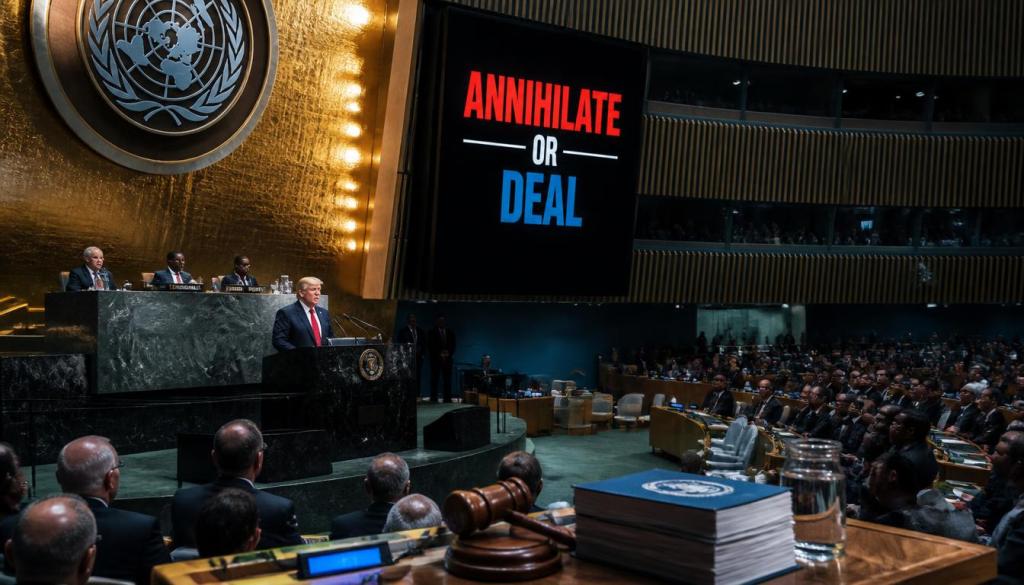
President Donald Trump addressed the United Nations General Assembly on Tuesday, presenting world leaders with a stark choice regarding the war with Iran: “annihilate” the country or reach a deal — with the latter likely coming after the November midterm elections.
Speaking at the UN’s annual gathering in New York, Trump said he believed a deal would be reached “just after the elections” scheduled for November . The remarks come as the conflict enters its seventh month, with no clear endgame in sight and the costs — both human and economic — continuing to mount.
The Iranian delegation walked out of the General Assembly hall as Trump began discussing U.S. military operations against Iran, according to reports from the session . Iranian President Masoud Pezeshkian and Foreign Minister Abbas Araghchi were not present during Trump’s address, though lower-level officials remained briefly before the entire delegation exited.
The State of the War: A Conflict Without a Clear Exit
Trump’s UN speech comes at a pivotal moment in a war that has defied his initial predictions of a quick resolution. When the U.S. and Israel launched strikes against Iran in late February, Trump called it a “short-term excursion” that would end in weeks . Seven months later, the conflict has escalated, with renewed clashes near the Strait of Hormuz pushing oil prices higher .
The military situation:
- The U.S. has maintained a naval blockade of Iranian ports, intercepting approximately 25 boats per day, “most of them at night,” according to Trump .
- Iran’s Revolutionary Guard has vowed to “intensify” its retaliation in the event of new U.S. attacks, with spokesman Hossein Mohebi warning that “this time, we will not content ourselves with responding, but our approach will be offensive, and America will regret its action and be more humiliated than ever” .
- Iranian President Pezeshkian accused the U.S. of doing “everything they can to block every possible route in order to force our nation and our people to surrender, because they were unable to do that through military means” .
The diplomatic situation:
- Trump has said negotiations remain possible but are “not his preferred option” .
- Iran is “wary” of another round of talks, having twice been attacked by the U.S. and Israel during active negotiations .
- The Gulf Cooperation Council has called for Iran and its allied groups to cease attacks and allow free transit through the Strait of Hormuz and Bab el-Mandeb Strait, warning of “worldwide fallout” from disruptions to oil markets and supply chains .
The Cost to American Households: $100 Billion and Counting
The war’s economic toll on American consumers has been staggering. According to the Watson Institute at Brown University, American consumers have incurred approximately $100.9 billion in additional fuel costs since the war began — equivalent to approximately $770 per U.S. household .
The breakdown:
- Gasoline: Prices have surged 39.2%, adding $55 billion in costs — an average of $422 per household .
- Diesel: Prices have skyrocketed 60.8%, adding $46 billion — an average of $348 per household .
- Current prices: The average U.S. gasoline price has exceeded $4.15 per gallon, the highest in three months, compared to roughly $3.20 a year ago and $2.98 before the conflict began . Diesel prices have reached approximately $5.90 per gallon, surpassing the record set in 2022 .
Energy expert Tom Kloza has warned that the United States is heading into “the most expensive autumn in history” in terms of gasoline and diesel prices .
The Political Fallout: Approval at Record Low
The war’s economic consequences are taking a direct toll on Trump’s political standing.
A Reuters/Ipsos poll conducted September 17-20 found Trump’s approval rating at 32% — the lowest of his political career, spanning both his first and second terms . The survey of 1,277 adults has a margin of error of ±3 percentage points .
Key findings:
- Republican support is eroding: Approval among Republicans fell from 82% to 73% in just one week .
- Cost of living is the breaking point: Only 17% of respondents approve of Trump’s handling of the cost of living, while 71% disapprove — a net disapproval of 43 points, worse than in January .
- Republicans are losing faith on prices: For the first time, a majority of Republicans (51%) disapprove of Trump’s handling of inflation, compared to 44% who approve .
The Reuters analysis noted that “dissatisfaction among Republicans on the subject has been growing since Trump launched the war on Iran in February that has pushed gasoline and diesel prices sharply higher” .
The Midterm Landscape: Democrats Hold Advantage
With less than 50 days until the November 3 elections, Democrats hold a significant advantage. A New York Times/Siena University poll released September 15 showed Democrats leading Republicans 51% to 43% among likely voters on the generic congressional ballot .
Key numbers:
- Voters trust Democrats over Republicans on healthcare (60%-36%), immigration (52%-45%), and the cost of living (51%-43%) .
- Among voters earning less than $50,000 annually, Democrats lead 63% to 31% .
- Enthusiasm gap: 61% of Democrats say they are almost certain to vote, compared to 56% of Republicans .
An NBC News poll released September 20 showed Democrats leading by a narrower 50%-45% margin among registered voters . That poll also found that 56% of voters disapprove of Trump’s job performance, and 55% say his policies have hurt the economy .
However, the NBC poll noted that Democrats are still more unpopular than Trump himself and the broader GOP, and voters describe the Republican Party as “extreme” more often than the Democratic Party .
Who Benefits and Who Is Harmed
Those who benefit from the current trajectory:
- Defense contractors and oil companies that profit from prolonged conflict and elevated energy prices.
- Democrats, who are capitalizing on voter anger over the cost of living and the war’s unpopularity.
- Republicans in safe districts who can distance themselves from an unpopular president.
Those who are harmed:
- Working families of all backgrounds — Black, white, Latino, and Asian — who are paying an average of $770 more per year for fuel .
- Truckers, farmers, and small businesses dependent on diesel, which has seen the steepest price increase .
- Republicans in competitive districts, who must defend a president with a 32% approval rating and a war that 71% of voters disapprove of .
- American credibility on the world stage, as the war drags on without a clear objective or exit strategy.
The Bottom Line
Trump’s UN address offered world leaders a choice between “annihilation” and a deal — but for American families, the choice has already been made. They are paying the price for a war that was supposed to be over months ago, and their frustration is showing up in the polls.
With less than 50 days until the midterms, the question is not whether the war will end — Trump says it will end “right after the elections” . The question is whether voters will wait that long, or whether they will deliver their own verdict at the ballot box first.
The effort to build better communities and a better America starts with you. Contact your state representatives and political party’s state, city or county office today and sign up, to give or do what you can to make America better for all.
Sources
Reuters/Ipsos: “Trump’s approval rating hits lowest level of his political career” (September 21, 2026)
Pars Today: “War with Iran leaves Americans with $100 billion in additional energy costs” (September 9, 2026)
CGTN: “Trump says Iran war will end right after US midterm elections” (September 10, 2026)
USA Today: “Democrats have advantage over GOP, new poll indicates ahead of midterms” (September 15, 2026)
KBS: “Trump’s approval rating at 32%, lowest of his career” (September 22, 2026)
Washington Examiner: “Democrats hold five-point lead over Republicans among registered voters: Poll” (September 20, 2026)
The Irish News: “Iran ‘wary’ of fresh US talks as Middle East wars loom over UN General Assembly” (September 21, 2026)
The People’s Weekly — urban political intelligence with a holistic social approach.
[ai]
 The People's Weekly
Leave a comment