Law & Justice — Listen Free 🎧 | Contact 📧
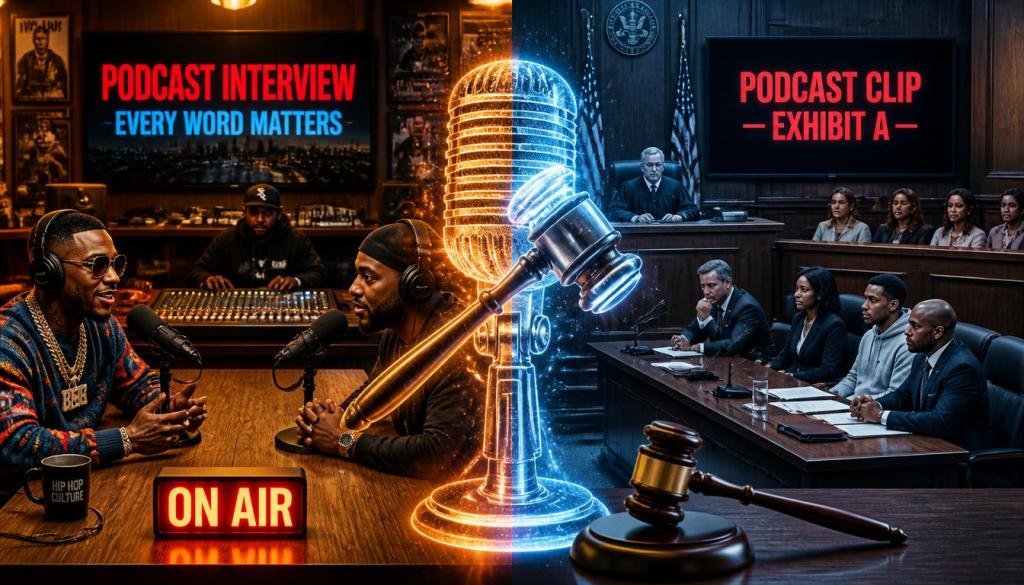
With Lil Durk’s fate in the hands of a federal jury, Boosie Badazz is focused on a different part of the trial than the verdict hip-hop is waiting on. His concern is how easily a podcast conversation can follow someone from a studio into a courtroom .
The Baton Rouge rapper posted a warning on X Thursday after watching interviews become evidence in several high-profile criminal cases. He argued that artists need to think beyond music when considering what prosecutors might eventually use against them .
“THESE LAST WELL KNOWN CASES THAT HAVE WENT TO TRIAL PODCAST INTERVIEWS HAVE BEEN USED AS CRITICAL EVIDENCE TO TRY AND CONVICT THE DEFENDANTS. WATCH WHAT U SAY ON THESE PODCAST. DON’T ANSWER A QUESTION THAT U KNOW CAN JEOPARDIZE YOUR FREEDOM.”
— Boosie Badazz
He ended with a comparison that has followed rap through years of arguments over lyrics and criminal prosecutions: “I THINK ITS MORE DAMAGING THAN THE MUSIC” .
The Lil Durk Trial: A Podcast Clip in Closing Arguments
Boosie’s warning arrives while jurors deliberate in Lil Durk’s federal murder-for-hire trial in Los Angeles. Prosecutors allege that Durk, whose legal name is Durk Banks, helped finance and direct a 2022 plot targeting Quando Rondo. Saviay’a “Lul Pab” Robinson was killed in the shooting. Durk has pleaded not guilty .
The case gives Boosie a timely example. Prosecutors used a clip from Durk’s 2023 appearance on DJ Akademiks’ Off The Record during closing arguments. Akademiks had asked Durk about people telling him to “slide for Von,” referring to calls for retaliation after King Von was killed in 2020. Durk said he no longer heard those comments .
Prosecutors pointed not only to his response, but also to Akademiks’ reaction, arguing that the exchange supported their theory that something had changed after the public pressure. Akademiks later said his facial expressions were for entertainment and denied that they carried the meaning prosecutors assigned to them .
The defense objected to how the government used the interview and sought an emergency hearing after closing arguments. The judge denied that request, leaving the jury to consider the evidence already admitted .
Keefe D: The Interview That Convicted
Boosie’s warning also lands less than two weeks after Duane “Keefe D” Davis was convicted of first-degree murder with a deadly weapon in Tupac Shakur’s 1996 killing .
Davis’s media appearances and memoir made up a substantial portion of the prosecution’s case, along with recorded conversations with investigators . The jury took less than three hours to convict him after a weeks-long trial in Las Vegas .
Prosecutors relied heavily on Davis’s own accounts of the shooting, including statements made during interviews with investigators, media appearances, and his 2019 memoir Compton Street Legend. His defense maintained that those accounts were exaggerated or fictionalized .
The legal turn in that case is worth understanding. Davis first gave his account to LAPD in 2008 under what is called a proffer agreement, an arrangement where a person tells investigators what they know and the government agrees not to use those specific statements directly against them. A detective told him that night that nothing he said could be used against him .
That protection covered the room he was sitting in. It did not cover BET, it did not cover VladTV, and it did not cover a book with his name on the cover. Judge Carli Kierny ruled that once Davis took the story public, he gave the protection away .
The Broader Pattern: Podcasts as Evidence
The warning from Boosie reflects a growing reality in hip-hop: the microphone doesn’t stop at the studio. In an era of podcast culture and social media, every public statement can become evidence.
The trend is clear:
- Lil Durk’s trial featured podcast clips as critical evidence in closing arguments
- Keefe D’s conviction was built largely on his own media appearances and memoir
- Yella Beezy is reportedly next in line for a trial where interviews could be used
The legal principle is simple: once you speak publicly, you waive certain protections. Prosecutors can and will use your own words against you.
What This Means for Hip-Hop Culture
For hip-hop artists, the warning is clear: the podcast circuit that has become essential for promotion and visibility can also become a liability. In a genre where authenticity and storytelling are prized, the line between entertainment and self-incrimination has never been thinner.
Boosie’s message is not about silence. It’s about strategy. “Don’t answer a question that you know can jeopardize your freedom” .
As Lil Durk’s jury continues to deliberate, and as more high-profile cases move through the courts, the lesson is being written in real time: in the courtroom, your words are your own—and they can be used to convict you.
Sources
HotNewHipHop: “Boosie Warns Artists After Podcast Clips Surface In Major Rap Trials” (September 9, 2026)
Hindustan Times: “Lil Durk trial: Why defense wants emergency hearing on DJ Akademiks interview; Fresh drama after closing arguments” (September 9, 2026)
Breaking Belize News: “30 Years Later: Keefe D found guilty of murder in 1996 killing of Tupac Shakur” (August 31, 2026)
NewsBreak: “The Interviews Convicted Keffe D: Lil Durk And Yella Beezy Are Next In Line” (September 1, 2026)
The People’s Weekly — urban intel with a holistic social approach.
[ai]
 The People's Weekly
Leave a comment