Politics & Policy — Listen Free 🎧 | Contact 📧
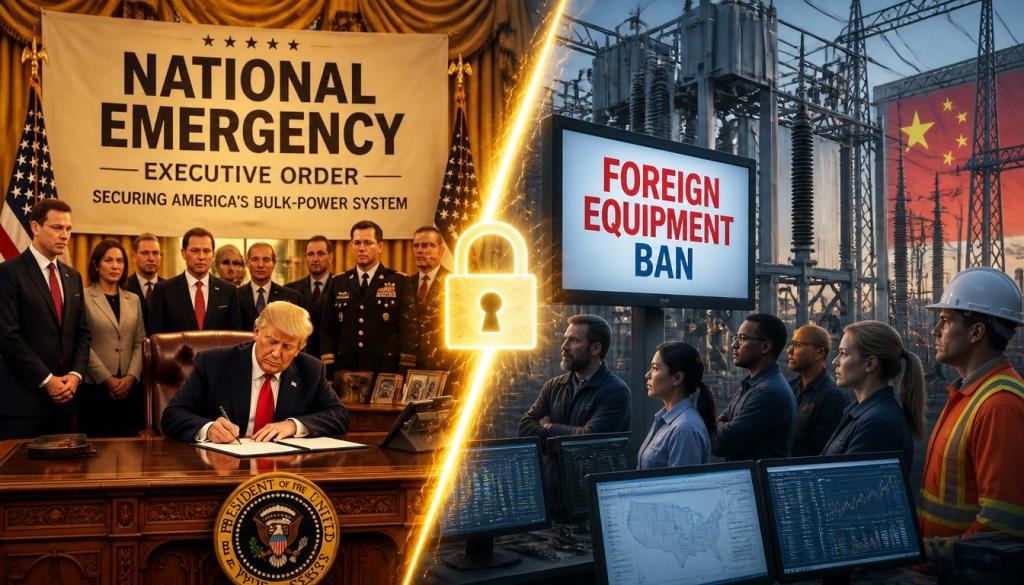
President Donald Trump on Wednesday signed an executive order declaring a national emergency over foreign-made equipment in the U.S. power grid, citing growing electricity demand that he said makes the American power system a target for “hostile governments”.
The order, designated as Executive Order 14420, generally prohibits the purchase or installation of certain foreign-produced bulk-power system electric equipment — including associated critical software and digital capabilities that could pose cybersecurity or operational risks. It does not apply to facilities used for local distribution of electric energy.
What the Executive Order Does
The order declares a national emergency under the International Emergency Economic Powers Act and the National Emergencies Act with respect to the “unusual and extraordinary foreign threat” to the United States involving bulk-power systems produced abroad that may present national security vulnerabilities.
Trump stated in the order: “I find that the situation with respect to the foreign supply of bulk-power system electric equipment constitutes an unusual and extraordinary threat, which has its source in whole or substantial part outside the United States”.
Key provisions include:
- Prohibition on purchasing or installing certain foreign-produced equipment
- Authority for the Secretary of Energy to impose conditions on continued use and operation of such equipment
- Direction for the Secretary of Energy to identify equipment that may pose security risks
- Requirements for federal procurement to prioritize U.S.-manufactured energy infrastructure
The order pointed to what it called “minimal restrictions on acquisition or operation in the United States of foreign-produced bulk-power system electric equipment,” which it said “augment the ability of some foreign entities to create and exploit vulnerabilities”. It also warned that foreign-produced equipment could contain “digital backdoors built into their systems that allow a foreign country to access that equipment remotely”.
Equipment covered includes:
- Substation transformers
- Large generators
- Industrial control systems
- Battery energy storage systems
For equipment already installed, the Secretary of Energy could require potentially vulnerable foreign-manufactured equipment to be “identified, isolated, monitored, secured, disconnected, replaced, or removed” if it posed an unacceptable security risk.
Why the Administration Says It’s Necessary
The White House cited the rapid growth of advanced manufacturing, artificial intelligence, and defense production as increasing America’s dependence on foreign components necessary for reliable electricity.
The administration said continued reliance on foreign sources of bulk-power system electric equipment creates a supply chain vulnerability to the U.S.. It also warned that certain foreign actors are increasingly creating and exploiting vulnerabilities in the U.S. bulk-power system, which provides electricity that supports national defense, emergency services, critical infrastructure, and the economy.
Broader context: The order is part of a series of Trump administration actions on national security and supply chains, including a June 2026 order on AI and cybersecurity, a July 2026 order on defense supply chains, and an August 2026 proclamation on foreign-produced drones.
China’s Response
China’s Foreign Ministry responded to the declaration on Thursday, with spokesman Lin Jian stating that China “opposes the overstretching of the concept of national security and the suppression of foreign enterprises”.
Lin called on the U.S. to provide a “fair, just and non-discriminatory environment” for companies of all countries. He made the comments at a regular press briefing in Beijing in response to a reporter’s question about Trump’s declaration.
Industry Context
The order comes amid growing concerns about the security of U.S. critical infrastructure. Reuters reported that the executive order is Washington’s latest move to address technological threats from China. The European Commission also decided earlier this year to ban Chinese-made inverters from publicly funded energy projects.
Reuters previously reported that U.S. experts, while dismantling and inspecting grid-connected equipment for security risks, found abnormal communication devices in some Chinese-made solar inverters that were not listed in the product’s technical documentation.
According to International Energy Agency data, China accounts for about 80% of global battery and solar inverter manufacturing capacity. The order comes amid mounting bipartisan concern that Chinese-manufactured components in the U.S. power system could contain vulnerabilities foreign adversaries can exploit.
The Bottom Line
Trump’s declaration of a national emergency over foreign-made power grid equipment represents a significant escalation in the administration’s efforts to secure critical infrastructure and reduce dependence on foreign suppliers — particularly China. The order gives the administration broad authority to restrict foreign equipment in the U.S. bulk-power system and prioritize domestic manufacturing.
China has pushed back, warning against the “overstretching of the concept of national security.” With the midterms less than 75 days away, the order also carries political weight as Trump continues to frame his administration as tough on national security and China.
Sources
White House: “Fact Sheet: President Donald J. Trump Declares a National Emergency to Secure America’s Bulk-Power System” (August 26, 2026)
U.S. News & World Report / Reuters: “Trump Signs Order Banning Some Foreign Equipment From US Energy Grid” (August 26, 2026)
Bloomberg: “Trump Signs Order to Ban Some Foreign Energy Equipment From Grid” (August 26, 2026)
Lokmat Times / ANI: “Trump signs executive order banning foreign equipment from US grid” (August 27, 2026)
ExecutiveActions.org: “Declaring a National Emergency to Secure the United States Bulk-Power System” (August 26, 2026)
The People’s Weekly — urban intel from a holistic social approach.
[ai]
 The People's Weekly
Leave a comment