Health & Personal Awareness — Listen Free 🎧 | Contact
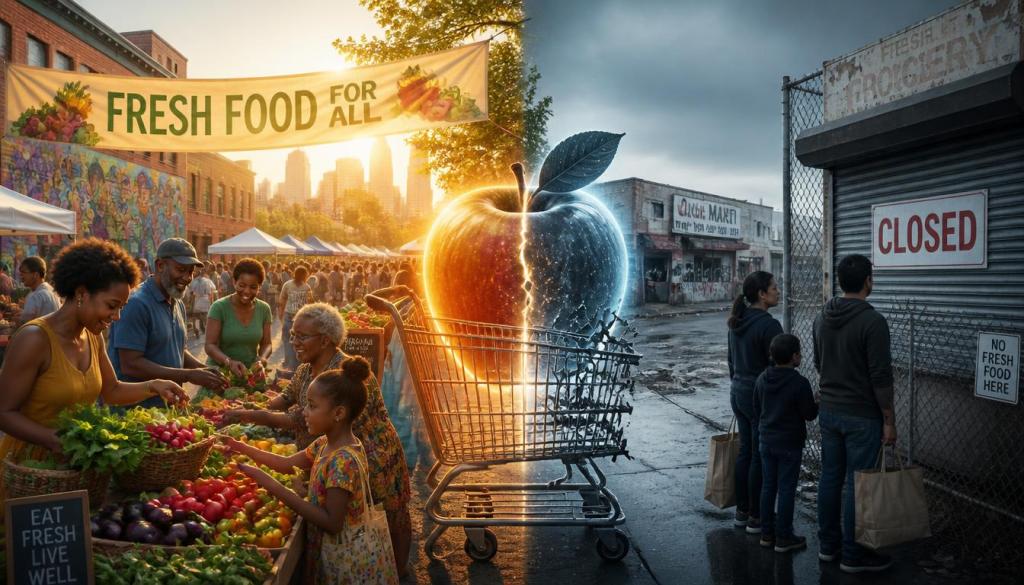
As grocery prices climb and federal food assistance shrinks, communities across urban America are facing a crisis that doesn’t make headlines but touches millions of lives: food deserts. New data from the NAACP’s Black Communities’ Health: In Plain Sight interactive map, which captures the voices of nearly 23,000 residents, reveals the stark reality of food access in Black and Brown communities across the country.
The Map: Nearly 23,000 Voices, One Clear Message
The NAACP, in collaboration with Sanofi, launched a first-of-its-kind interactive health equity map that brings the voices of nearly 23,000 residents to life at the ZIP-code level. The map allows users to explore how race, gender, and geography intersect to shape access to healthy food, quality healthcare, and stable housing.
The findings are striking:
- Proximity doesn’t equal access: While 94% of respondents have a grocery store nearby, lower-income households face greater barriers — only 38% of those earning less than $20,000 have a store within five minutes, compared to 56% of those earning $100,000 or more.
- Quality care gap: Only 28% of respondents earning less than $20,000 live within five to ten minutes of a quality hospital, compared to roughly one-third of those earning $60,000 or more.
- Clean air, uncertain water: While 81% of respondents describe their neighborhood air quality as good, only 38% say the same about their water quality — a disparity that widens by income.
As Dr. Chris Pernell, Director of the NAACP Center for Health Equity, put it: “This map is not just data; it’s about sharing their testimony. It shows, block by block and ZIP code by ZIP code, where racial inequities have shaped health outcomes for generations.”
Food Deserts: When Grocery Stores Disappear
Buffalo, New York
In Buffalo’s Schiller Park neighborhood, the Save A Lot on Genesee Street permanently closed in May, leaving neighbors — many without cars — with far fewer options for groceries within walking distance. Congressman Tim Kennedy (NY-26) stood outside the shuttered store this month and called on the House to pass three pieces of legislation aimed at combating food deserts.
“When a grocery store closes in a neighborhood like Schiller Park, for families with limited access to transportation, it can mean the difference between fresh food and processed food, and between affordable groceries and expensive, unhealthy options from a corner store.”
— Congressman Tim Kennedy
Lorain, Ohio
Ten months after the Meister Road Apples Market shut down, neighbors are fighting to stop the property owner from turning the building into a storage facility. Jim Brown, 78, told News 5 Cleveland: “It was walking distance for everyone. [If] you needed something quick, you came here.”
Now, the next closest grocery stores are nearly two miles away — a distance that’s insurmountable for seniors, people without cars, and families already stretched thin. Some neighbors have called the area a food desert. Mary Springowski, Lorain City Council member-at-large, said: “I don’t agree with that because it’s so congested in the other areas that they’re going to have to expand this way.”
Chuck Jubick, who lives within walking distance of the former Apples, put it bluntly: “We need food over here.”
Madison, Wisconsin
In a cautionary tale, the city of Madison spent more than $8 million over eight years to build a supermarket in the Bay Creek neighborhood to prevent a “food desert.” Yet when the store opens this month, it will be just across the street from an existing grocery store. The project raises questions about whether government intervention alone can solve the food desert problem without careful planning.
The Federal Funding Rollback
The Trump administration’s rollback of federal grants is compounding the crisis. In Thomasville, Georgia, a predominantly Black neighborhood called Dewey City was awarded a $19.8 million Community Change Grant from the EPA to address environmental health risks — including lead paint, mold, and asbestos. But the funding was stripped just months after winning it, part of a broader rollback of diversity, equity, and inclusion programs.
Earl Williams, community development director of the Thomasville Community Development Corp., told vAnalyst: “This place has been neglected. But it’s worth bringing it back online.”
Jalonne White-Newsome, an associate professor at the University of Michigan who served in the Biden administration as the first federal chief environmental justice officer, warned: “I unfortunately believe we’re going to see a reversal in the health profile of this country. This current federal regime has decided that humanity and public health and justice don’t mean anything.”
What’s Being Done
Despite the challenges, communities are fighting back.
Legislation:
Three bills are pending in the House to address the food desert crisis:
- The Food Deserts Act (H.R. 484): Would direct the Department of Agriculture to award grants to states to establish revolving loan funds supporting the opening and operation of grocery stores in underserved communities.
- The Healthy Food Access for All Americans Act (H.R. 2473): Would create tax credits and grants for grocery stores, food banks, and mobile markets that operate in food deserts.
- The Healthy Food Financing Initiative Reauthorization Act (H.R. 3506): Would reauthorize and fund the USDA’s Healthy Food Financing Initiative through 2030.
Community Partnerships:
In Wyandotte County, Kansas, local organizations like Vibrant Health are filling the gap left by a public health department that suspended services due to staffing shortages. Vibrant Health serves more than 20,000 people in the region with medical, dental, and behavioral health services.
Mental Health and Trauma Support:
In Lexington, Kentucky, after a mass shooting left 16-year-old Di’Zhon Robertson dead, community leaders turned the Dunbar Community Center into a mental health hub. More than 30 service providers volunteered their services. Devine Carama, Executive Director of One Lexington, said: “If our adults are having trouble navigating their emotions, can you imagine what our children are dealing with?”
The Bottom Line
Food deserts are not just about convenience — they’re about survival. When a grocery store closes, families are forced to choose between expensive, unhealthy options and going without. The NAACP’s new health equity map makes it impossible to ignore the scope of the problem.
The question is not whether we have the evidence. The question is whether we have the will to act.
Sources
NAACP: “NAACP, Sanofi Announce Interactive Health Equity Map” (August 6, 2026)
House.gov: “Kennedy Calls for Passage of Three Bills to Combat Food Deserts” (August 4, 2026)
News 5 Cleveland: “Lorain neighbors reject plan to turn former grocery store into storage facility” (August 5, 2026)
Washington Post: “A Wisconsin city spent millions on a grocery store. It didn’t go well.” (August 13, 2026)
vAnalyst: “Public health improvements stall amid DEI crackdown” (August 15, 2026)
WKYT: “Lexington community leaders launch mental health hub after shooting” (August 18, 2026)
Kansas City Star: “KCK abruptly stops key health services” (August 13, 2026)
The People’s Weekly — urban intel from a holistic social approach.
[ai]
 The People's Weekly
Leave a comment