Technology & Innovation — Listen Free 🎧 | Contact 📧
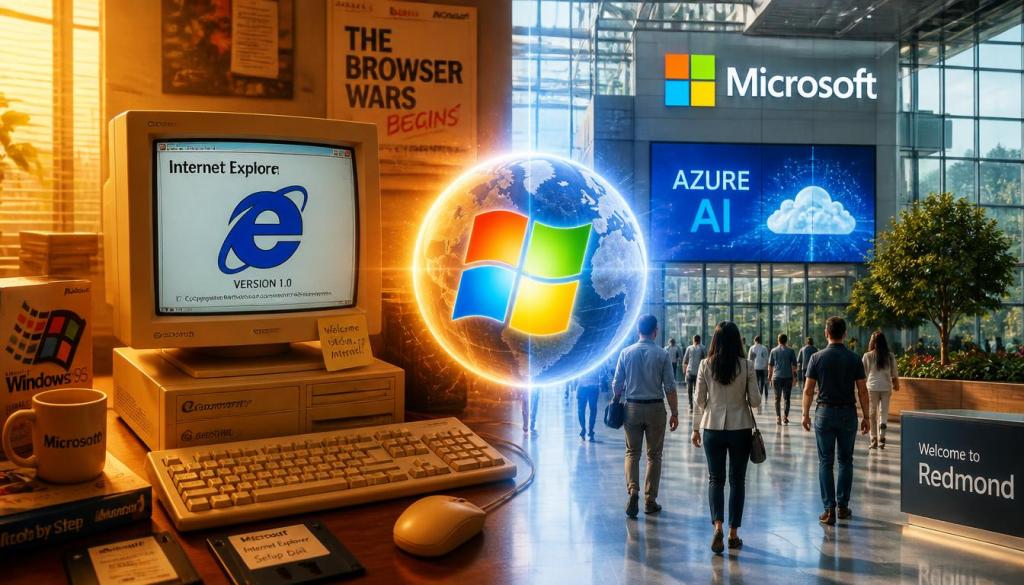
August 16 marks a pivotal moment in technology history. On this day in 1995, Microsoft released Internet Explorer 1.0 — a move that would ignite the “browser wars,” reshape the internet, and cement Microsoft’s dominance in the digital age .
But the story of Microsoft on August 16 goes far beyond a single browser launch. It’s a story of ambition, competition, and the relentless drive to control the future of computing.
1995: Internet Explorer 1.0 Launches — And the Browser Wars Begin
On August 16, 1995, Microsoft released the first version of Internet Explorer, its entry into the rapidly growing web browser market . The browser was derived from Spyglass Mosaic, which Microsoft had licensed from Spyglass Inc. .
The Context:
The web was still in its infancy. Netscape Navigator dominated the browser market, and Microsoft was playing catch-up. But the company had a weapon Netscape didn’t: Windows 95, which was released just days later on August 24 .
By integrating Internet Explorer into Windows 95, Microsoft made its browser the default choice for millions of users. It was a strategic masterstroke — and the beginning of the “browser wars” that would define the late 1990s .
The Consequences:
The bundling of Internet Explorer with Windows would eventually lead to antitrust charges. In 1998, the Department of Justice and 20 state attorneys general sued Microsoft, accusing the company of using its dominance to thwart competition from Netscape and others .
The case would drag on for years, culminating in a 2001 settlement that imposed restrictions on Microsoft’s business practices . But by then, the damage to Netscape was done. Internet Explorer had won the browser wars — and Microsoft had cemented its control over the desktop.
Beyond the Browser: Other Microsoft Milestones on August 16
1994: Windows NT 3.5 Released
A year before Internet Explorer, Microsoft released Windows NT 3.5 on August 16, 1994. The operating system was a key development in enterprise computing, offering enhanced security and stability that made it a popular choice for businesses . It paved the way for future versions of Windows that would become essential tools in the corporate world.
Microsoft’s Legacy: From Altair to AI
The August 16 browser launch is just one chapter in Microsoft’s remarkable story.
1975: The Beginning
On April 4, 1975, childhood friends Bill Gates and Paul Allen founded Microsoft (originally “Micro-Soft”) in Albuquerque, New Mexico, to produce software for the Altair 8800, an early personal computer . Allen saw the Altair on the cover of Popular Electronics and convinced Gates that the personal computing revolution had arrived .
1981: The IBM Deal
In 1980, IBM asked Microsoft to produce an operating system for its first personal computer. Microsoft purchased QDOS from Seattle Computer Products for $25,000, modified it, and renamed it MS-DOS. In a shrewd move, the contract allowed Microsoft to sell the operating system to other companies — a decision that would make Microsoft essential to the entire PC industry .
1985: Windows 1.0
On November 20, 1985, Microsoft launched Windows 1.0, a graphical operating system that replaced text-based commands with dropdown menus, icons, and mouse functionality . It wasn’t an immediate success, but it laid the groundwork for the Windows dominance that would follow.
1986: Going Public
On March 13, 1986, Microsoft went public at $21 per share. Shares ended the day at $35.50, generating $61 million for the company. Between 1986 and 1996, Microsoft’s shares would climb more than one hundredfold .
1990: Microsoft Office
The company unveiled Microsoft Office in 1990, bundling Word, Excel, and PowerPoint together. As The Seattle Times noted, it was a key to Microsoft’s success: “It was offering three products for one price while its competitors had all grown their businesses off a single product” .
1995: Windows 95
On August 24, 1995, Microsoft released Windows 95, one of the biggest product launches in tech history. The operating system featured the Start button, the taskbar, and plug-and-play functionality. TV commercials featured the Rolling Stones singing “Start Me Up,” and 7 million copies were sold in the first five weeks .
2000-2014: The Ballmer Era
Steve Ballmer, Gates’s friend from Harvard, took over as CEO in 2000. Under Ballmer, Microsoft launched the Xbox gaming console (2001), acquired Skype (2011), and released Windows 8 (2012) — a major overhaul designed to compete with smartphones and tablets .
2014-Present: The Nadella Era
Satya Nadella became CEO in 2014, steering Microsoft toward a cloud-first, AI-driven future . Under Nadella, Microsoft Azure has become the second-largest cloud provider globally (23% market share), trailing only Amazon Web Services . The company acquired LinkedIn for $26.2 billion in 2016 and Activision Blizzard for $68.7 billion in 2023, expanding its gaming footprint .
The Bottom Line
Microsoft’s journey from a small Albuquerque startup to a $3.71 trillion company is a story of vision, strategy, and the power of timing. The August 16, 1995 release of Internet Explorer was a pivotal moment — not just for Microsoft, but for the internet itself.
Gates and Allen saw the future and built the tools to shape it. And the company they founded continues to define how we work, play, and connect.
Sources
The Centre for Computing History: “Microsoft” (August 7, 2026)
TheStreet: “History of Microsoft: Company timeline & facts” (March 3, 2026)
Washington Times: “From Gates to Nadella: Microsoft through the years” (February 4, 2014)
victoriannews.com.au: “August 16, 1995: Microsoft launches Internet Explorer” (August 16, 2026)
Britannica: “Microsoft Corporation” (August 6, 2026)
The New York Times: “Path to Today’s Microsoft” (February 5, 2014)
Microsoft News: “Facts About Microsoft” (October 22, 2014)
LinkedIn: “August 16th of tech, wealth, and startup investing” (August 15, 2024)
History Channel: “Microsoft founded | April 4, 1975” (October 8, 2015)
ABP Live: “50 Years Of Microsoft: A Quick Timeline” (April 3, 2025)
Computer Hope: “Today in computer history: August 16th” (August 16, 2026)
The People’s Weekly — urban intel from a holistic social approach.
[ai]
 The People's Weekly
Leave a comment