Economics & Investing — Listen Free 🎧 | Contact 📧
The U.S. economy unexpectedly shed 23,000 jobs in July, but the weak jobs report sent stocks soaring to record highs as investors bet the Federal Reserve will keep interest rates on hold.
The S&P 500 rose 47.68 points, or 0.6%, to 7,757.64 — topping the all-time high it set earlier in the week. The Dow Jones Industrial Average gained 151.83 points, or 0.3%, to 54,036.93, and the Nasdaq composite jumped 342.26 points, or 1.3%, to 26,690.62. For the week, the S&P 500 gained 3.58%, the Nasdaq rose 5.19%, and the Dow climbed 2.96%.
Why Bad News Is Good News
The Labor Department’s report showed nonfarm payrolls decreased by 23,000 jobs last month — well below the 80,000 gain economists had forecast. Previously reported job gains for May and June were also revised sharply lower, with a combined 103,000 jobs cut from payrolls.
The weak data eased concerns that the Federal Reserve will need to raise interest rates at its September meeting. Market expectations for a rate hike dropped to about 44%, down from 55% in the prior session and 67% a week ago.
Technology stocks, with their big market values, did much of the heavy lifting for the broader market. Nvidia jumped 2.3% and Broadcom rose 1.7%. The bond market reacted even more strongly, with the yield on the 10-year Treasury falling to 4.64%.
The Market’s Mixed Signal
As one analyst noted: “The market should be reacting to weak job numbers and higher inflation and the possibility of a slow-growth economy that may need to have rates raised rather than cut, and yet it’s not. We’re setting records, so go figure”.
Palantir Technologies delivered what CEO Alex Karp called an “otherworldly” quarter — second-quarter revenue jumped 93% year-over-year to $1.94 billion, sending shares up 29.5%. Elon Musk’s SpaceX surged 15.8% a day after the expiry of the first of several share lockup restrictions following its record public offering in June.
Trumpflation Threatens to End Wall Street’s Record Rally — Four Inflation Pressures Converging
President Trump’s policies are driving U.S. inflation higher, creating what analysts call a “quadruple whammy” of inflationary pressures that threatens to end Wall Street’s historic bull market rally.
The Four Pressures
1. Tariffs. President Trump’s tariffs are the first driver behind rising inflation. Trailing 12-month inflation climbed from 2.4% in February to a peak of 4.2% in May, above the Fed’s 2% long-term target. Nearly half of tariff-paying firms say more price increases are still coming as they spread the added costs over a longer timeline.
2. The Iran War. Iran responded to Trump’s Feb. 28 attack by shutting the Strait of Hormuz — a channel that carries roughly one-fifth of the world’s petroleum liquids each day. Gas prices rose at their fastest pace in three decades.
3. Sticky Core Prices. Core inflation remains elevated above the Fed’s target, resisting the modest pullback in headline figures.
4. AI-Related Cost Pressure. The massive spending on AI infrastructure is creating new cost pressures across the economy. Any factor that slows AI data center construction significantly increases the likelihood of a stock market crash under President Trump.
The Stock Market Is Priced for Perfection
The stock market entered 2026 at its second-priciest valuation in history and has only gotten pricier as the year has rolled on. An inflation “double whammy” awaits equity markets in the second half of 2026, “significantly increasing the likelihood of a stock market crash under President Trump”.
Meanwhile, the Joint Economic Committee estimates that tariffs and the war with Iran have cost each household more than $3,100 from 2025 through May of 2026. As one CNBC report noted, “Trump might ‘love the inflation,’ but consumers are feeling the pain”.
What This Means for Urban Consumers
1. Your Grocery Bill Is Getting Hit From Both Sides
What’s happening: Grocery prices have jumped significantly in U.S. cities. The Consumer Price Index for All Urban Consumers rose 3.5 percent over the 12 months up to June. Meanwhile, tariffs have raised consumer prices almost immediately, adding nearly a full percentage point to the CPI. The Iran war and resulting gas price surge have driven up transportation and shipping costs, which get passed directly to you at the register.
Why it matters for you: Urban families pay more for everything because city supply chains are longer, real estate costs are higher, and stores pass on more overhead. The 3.5% CPI spike isn’t just a number — it’s what’s actually happening in cities. Combine that with tariffs on imported food and packaging, and your weekly shopping trip is costing you significantly more than it did two years ago.
What you can do:
- Shop multiple stores and buy generic/store brands instead of name brands
- Cook based on sale prices, not cravings
- Delay non-essential purchases until they go on sale
- Use couponing apps and social media deal groups to find discounts
2. Your Job Is Less Secure — And So Is Your Spending Power
What’s happening: The U.S. economy unexpectedly shed 23,000 jobs in July. Retail trade lost 7,500 jobs and leisure/hospitality lost 61,000 jobs — the sharpest one-month drop since the pandemic. Consumer-facing parts of the economy are weakening first.
Why it matters for you: If you work in retail, hospitality, or any consumer-facing industry, you’re in the most vulnerable sector right now. Job losses in these sectors mean fewer hours, less stability, and more competition for open positions. A weak labor market also means consumer spending will lose momentum — which means more businesses will struggle, creating a downward spiral.
What you can do:
- Boost your income through gig work, part-time jobs, or selling unused items
- Diversify your skills so you’re not stuck in one vulnerable sector
- Build an emergency buffer — aim for at least one month of expenses to start
- Use employer benefits like 401(k) matching and HSAs
3. Housing Costs Are Outpacing Everything Else
What’s happening: Rent has climbed roughly 41% since 2019. Auto insurance is up 32%. Both are materially outpacing headline CPI. In New York City, a one-bedroom apartment now costs $2,500. The classic budgeting rule — 30% of income on housing — is no longer realistic for most urban renters.
Why it matters for you: In cities, the 50/30/20 budget rule (50% needs, 30% wants, 20% savings) often doesn’t work anymore. If you’re in a high-cost city, a 60/20/20 or even 70/20/10 split may be more realistic. The “30% rule” is outdated — what matters is having room to save and handle emergencies.
What you can do:
- Consider roommates or relocating to lower-cost areas
- If you’re planning to stay less than 7 years in a high-cost area, lean toward renting
- Audit your spending — even small habit tweaks can free up cash
- Cut unused subscriptions — they add up fast
- Set specific financial goals to stay on track
4. The “Inflation Tax” Is Real — Here’s How to Fight Back
What’s happening: Tariffs, the Iran war, and corporate price hikes have created a “hidden tax” on urban families. The Joint Economic Committee estimates that tariffs and the war with Iran have cost each household more than $3,100 since 2025. Meanwhile, inflation has remained a key concern, with urban consumer confidence deteriorating.
Why it matters for you: Your money buys less. Every dollar you earn is worth less than it was a year ago. And wages, while nominally ahead of inflation, aren’t keeping up with the specific costs that hit urban families hardest — housing, groceries, and transportation.
What you can do:
- Audit your emergency fund and reprice it for 2026 inflation
- Pay yourself first — allocate a small amount to savings before you spend anything else
- Pay off debt a little each month to eliminate that cost entirely
- Use cash advances only as a last resort, and look for interest-free options if needed
- Consult a licensed financial advisor if you’re experiencing sustained financial hardship
The Remedy: What Urban Consumers Must Do Now
The economic pressures facing urban families are real — but they are not insurmountable. Here’s a concrete action plan:
1. Build a 2026-Ready Budget. The old rules don’t work anymore. Stop treating 50/30/20 as gospel. In high-cost cities, a 60/20/20 or even 70/20/10 split may be more realistic. What matters is having room to save and handle emergencies.
2. Audit Your Spending. Even small habit tweaks can free up cash. Cut unused subscriptions. Cook based on sale prices. Delay non-essential purchases. Use couponing apps and social media deal groups to find discounts.
3. Diversify Your Income. If you work in retail, hospitality, or any consumer-facing industry, you’re in the most vulnerable sector right now. Boost your income through gig work, part-time jobs, or selling unused items. Diversify your skills so you’re not stuck in one vulnerable sector.
4. Build an Emergency Buffer. Aim for at least one month of expenses to start. Even a small buffer can prevent a financial shock from becoming a crisis.
5. Stay Informed. Knowledge is power. Understanding how tariffs, the Iran war, and inflation are affecting your wallet is the first step to fighting back. Follow trusted sources that break down complex economic issues in plain language.
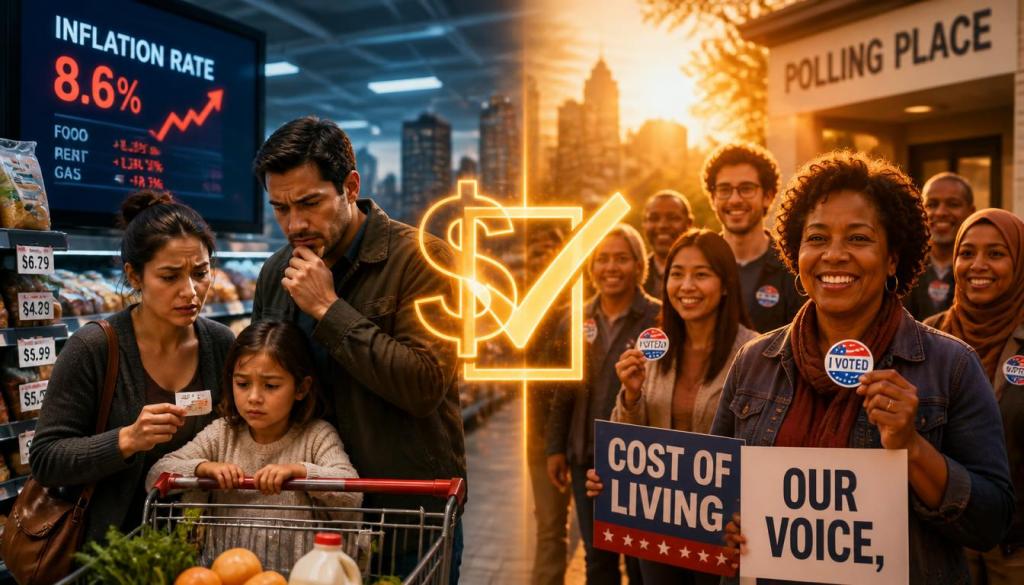
6. Get involved and VOTE. Join the effort for a better America by signing up to give or do what you can at Fight for the People PAC or Democrats.org. Our greatest weapon is our voice and our vote. Get involved and VOTE!
The Bottom Line: Your Vote Is Your Voice
Wall Street celebrates weak jobs data because it means the Fed won’t raise rates. But for working families, job losses and a slowing economy are not good news at all.
The cost of living is the single most important issue shaping how Americans will vote in November. Over half of registered voters say the economy and high prices will be “an important factor” in their vote for Congress this year. The party in power is expected to feel the brunt of voters’ bitterness.
This is where you come in.
The midterm elections are less than 90 days away. At stake are 435 seats in the House of Representatives and 35 seats in the Senate — as well as elections for state governors and local election races. The outcome will determine whether working families get relief or more of the same.
Why your vote matters:
- 54% of likely voters say the cost of living is the single most important issue shaping their vote — outpacing the next issue by nearly 4-to-1
- 37% of voters believe Democrats have a better approach to the economy — the first time Americans have viewed Democrats as better stewards of the economy than Republicans in nearly a decade
- 70% of Democrats and Democratic-leaning Independents say “it really matters” which party controls Congress
- Voter turnout will be key — the big question is whether economic problems will increase people’s interest in voting
The choice is clear: You can vote for the party that has imposed tariffs, launched an unpopular war, and watched your grocery bills soar. Or you can vote for the party that is fighting to lower costs, protect your rights, and build an economy that works for everyone.
Don’t let anyone tell you your vote doesn’t matter. In 2026, it matters more than ever. The party that controls Congress will decide whether working families get relief — or more of the same.
Register. Show up. Vote.
Sources
CNBC: “Here’s how we played the massive rebound in AI stocks this week” (August 8, 2026)
Reading Eagle / AP: “US stocks jump as employers unexpectedly cut 23,000 jobs, raising hopes that rate hikes can wait” (August 7, 2026)
MarketWatch: “S&P 500 closes at a record as jobs data ease rate-hike worries” (August 7, 2026)
Nasdaq: “An Inflation Quadruple Whammy, Headlined by Trumpflation, Threatens to Crush the Stock Market” (August 8, 2026)
China Daily: “Economic strain mounts ahead of midterm elections” (July 30, 2026)
Xinhua: “World Insights: U.S. economic anxiety could reshape Congress in midterm elections” (August 5, 2026)
China Daily: “Americans watch prices rise amid tariffs and conflict with Iran ahead of midterm elections this fall” (July 29, 2026)
星岛新闻: “伊战胶着美国难挽狂澜,中选逼近’老特’输少当赢” (August 5, 2026)
CNBC: “Trump might ‘love the inflation,’ but consumers are feeling the pain, experts say” (June 11, 2026)
Nasdaq: “An Inflation Double Whammy Awaits Wall Street, Making a Stock Market Crash Likelier Under President Donald Trump” (July 25, 2026)
The People’s Weekly — urban intel with a holistic social approach.
[ai]
 The People's Weekly
Leave a comment