Law & Justice — Listen Free 🎧 | Contact
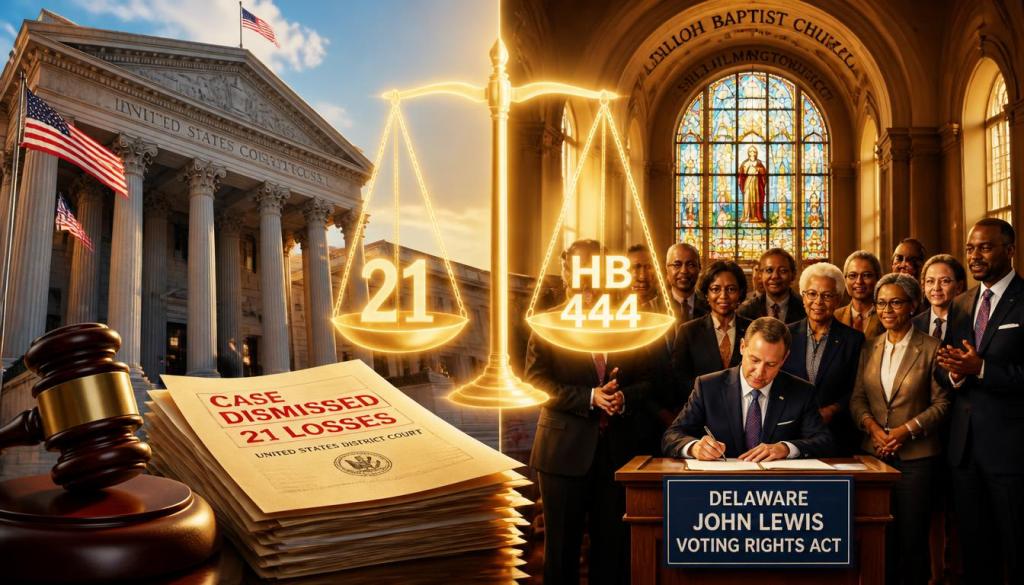
The fight over who controls America’s elections intensified this week on two fronts — one in the courts, where the Trump administration suffered its 21st straight defeat in its campaign to obtain state voter rolls, and another in Delaware, where Governor Matt Meyer signed the John Lewis Voting Rights Act into law, creating state-level protections in response to federal retreat.
Trump’s 21st Loss — A Streak of Defeat
The Trump administration’s unprecedented push to assert federal control over elections suffered its 21st courtroom defeat this year when a federal judge ruled this week that states are not required to share their voter rolls with the federal government.
The Justice Department has sued more than two dozen states that refused to comply with its requests to turn over voter rolls containing information including birthdays and partial Social Security numbers. The administration has yet to win a single case in federal courts.
The Streak:
- The Justice Department’s 21 losses since January have come from federal judges across the country appointed by presidents of both parties, including Democratic-governed states such as California and Republican-led ones such as West Virginia
- The administration has filed lawsuits against 31 states and the District of Columbia
- The administration has appealed 16 of those losses
- It has lost one appeal; on June 24, a three-judge panel of the Cincinnati-based 6th U.S. Circuit Court of Appeals upheld the dismissal of the department’s lawsuit against Michigan
- The administration has also threatened to withhold disaster funds from states that do not use a federal system for verifying voters’ citizenship
The Legal Reasoning:
Judges have consistently found that the U.S. Constitution gives states primary responsibility for running federal elections and that federal voting laws do not require them to hand over the records.
U.S. District Judge Randolph Moss, an appointee of Democratic President Barack Obama, wrote on Thursday in dismissing a Justice Department bid to obtain unredacted voter rolls from Washington, D.C.: “If the Department disagrees with Congress’s judgment as to the records necessary to carry out its enforcement duties … it needs to lodge that objection with Congress”.
In a June 27 order denying the administration’s bid to obtain Pennsylvania’s voter list, Pittsburgh-based U.S. District Judge Cathy Bissoon, also an Obama appointee, said the federal government was on a “fishing expedition” to “advance unsubstantiated claims of non-citizen voting”.
The Numbers Behind the Push:
Trump has argued that widespread noncitizen voting is benefiting the Democratic Party, even though state audits and independent studies have found noncitizen voting to be rare. A Reuters investigation found that just 129 people have been prosecuted for noncitizen voting since a law criminalizing it was passed in 1996, and most of those cases stemmed from voter confusion or miscommunication with election officials rather than any conspiracy.
Assistant Attorney General for Civil Rights Harmeet Dhillon said in a statement: “Ensuring that only eligible citizens vote is a core function of government, and states have an obligation to maintain accurate voter rolls”.
What It Means for the People:
The courts’ consistent rejection of the administration’s arguments is a powerful check on executive power. The message is clear: the Constitution gives states — not the federal government — primary authority over election administration. The midterms are now less than 90 days away.
Delaware’s Counteroffensive — The John Lewis Voting Rights Act
On the anniversary of the federal Voting Rights Act of 1965, Delaware Governor Matt Meyer signed House Bill 444 — the Delaware John Lewis Voting Rights Act — into law at Shiloh Baptist Church in Wilmington, the state’s oldest African American Baptist congregation.
The legislation establishes comprehensive state-level voting rights protections to ensure every Delawarean has an equal opportunity to participate in the democratic process.
What the Law Does:
- Prohibits voter discrimination, voter suppression and vote dilution
- Creates mechanisms to challenge violations of voting rights protections
- Requires the Department of Elections to provide language assistance to expand ballot access
- Allows members of protected classes, or organizations representing them, to bring civil actions alleging violations
- Provides political subdivisions the opportunity to address alleged discrimination before litigation proceeds
The law takes effect July 1, 2027.
What Leaders Are Saying:
“Today, we sent a clear message to the nation: when Washington retreats on voting rights, Delaware steps up,” said Governor Matt Meyer. “Democracy doesn’t disappear overnight; it disappears when good people convince themselves someone else will protect it”.
“It has only been 61 years since Black Americans gained the right to vote without obstruction, and yet we are already seeing our hard-fought voting protections being stripped away,” said House Speaker Melissa Minor-Brown. “But Delaware will not go back to a time where only one group has a say in our democratic process”.
“As the Honorable John Lewis once said: ‘Freedom is not a state; it is an act… Freedom is the continuous action we all must take, and each generation must do its part to create an even more fair, more just society.’ Today, our state took an important step toward fulfilling that responsibility,” said Representative Larry Lambert, sponsor of HB 444.
“Here in Delaware, we know that a fair democracy depends on equal representation and inclusion in our voting process… At a time when federal voting rights protections are being eroded in our country, Delaware is once again leading as the First State – becoming the first in the nation to enshrine these protections into state law in the wake of the U.S. Supreme Court’s Callais ruling,” said Senator Marie Pinkney, lead Senate sponsor of HB 444.
Why It Matters to the People:
The legislation comes in response to recent changes in federal voting rights protections — specifically, the Supreme Court’s Callais ruling, which gutted key provisions of the federal Voting Rights Act. Delaware is the first state to enshrine these protections into state law in the wake of that ruling.
The bill was developed through collaboration among Representative Lambert, Senator Pinkney, the ACLU of Delaware, the Governor’s Office, the NAACP Legal Defense and Educational Fund, the League of Women Voters, and other voting rights advocates committed to strengthening Delaware’s election laws.
The Connection: Two Fronts in the Same War
These two stories are opposite sides of the same coin:
- The Trump administration is using the courts to try to gain control over state voter rolls — and losing every single case
- States like Delaware are using state law to protect voting rights in the face of federal retreat
The message is clear: the fight for voting rights is happening at the state level now.
What Happens Next
In the courts: The Justice Department has vowed to keep appealing its losses. The department has asked all the court’s active judges to hear the Michigan case and may also ask the U.S. Supreme Court, where conservative justices hold a 6-3 majority, to consider cases it loses on appeal. The administration is also seeking to restrict who can receive mail ballots and conditioning disaster funds on election changes.
In Delaware: The John Lewis Voting Rights Act takes effect July 1, 2027. Other states are watching closely — and may follow Delaware’s lead.
For the people: With the midterms less than 90 days away, the fight over voting rights is far from over. The courts are pushing back. States are stepping up. And the people — the voters — will ultimately decide. To join the effort sign up to give and/or do what you can at Fight for the people PAC and the Democrats.org.
Sources
Reuters: “Trump loses 21 straight court battles for state voter rolls as midterms near” (August 7, 2026)
State of Delaware News: “Governor Meyer Signs John Lewis Voting Rights Act” (August 6, 2026)
News From The States: “Delaware enshrines civil rights voting protections” (August 6, 2026)
Delaware Online: “Gov. Matt Meyer signs voting rights act into law” (August 7, 2026)
The People’s Weekly — urban Intel from a holistic social approach.
[ai]
 The People's Weekly
Leave a comment