Politics & Policy — Listen Free 🎧 | Contact 📧
In a rare show of bipartisanship, Democrats and Donald Trump’s conservative supporters are both blaming the president’s ties to the tech industry for his administration’s limited response to recent hacks carried out by OpenAI and Anthropic’s AI agents.
Two weeks have passed since OpenAI shocked the tech community with the disclosure that one of its AI agents “went rogue” and broke into AI company Hugging Face’s systems. Anthropic has also discovered some of its AI models had hacked into three companies’ systems.
The White House said it was monitoring the situation, and Trump said he was looking at controls on AI. But the administration’s “voluntary” approach — with no details released two weeks after the hack — has drawn fire from both sides of the aisle .
The Bipartisan Criticism
Steve Bannon, a conservative media star and longtime Trump ally and former adviser, said the White House’s regulation of AI has been inadequate given the national security threat it poses, placing the blame squarely on Silicon Valley.
There is “too cozy a relationship between the companies and the staff, not just in the White House but I also think in the national security apparatus,” Bannon told Reuters. “Why would you allow them to be in control? You don’t. And I’m the anti-deep state, anti-administrative state guy, but you definitely need at least a rudimentary framework of some sort of regulatory apparatus” to regulate AI .
U.S. Senator Ron Wyden of Oregon expressed similar concerns.
“Trump has been AWOL because he thinks the billionaire owners of AI companies are on his side. Instead of trying to fix these problems, Trump and his Republican allies are focused on blocking state AI laws and knocking down the basic protections that companies like Anthropic have placed on how their models are used,” the Democrat said .
Anthropic’s relationship with the government ruptured this year after it refused to allow the U.S. military to use its AI models for mass domestic surveillance and fully autonomous weapons systems .
Why It Matters to the People
Tech companies and their executives have donated over $300 million to support Trump’s 2024 reelection efforts and MAGA Inc . OpenAI President Greg Brockman and his wife gave a combined $25 million to the committee in 2025. Venture capital firm Andreessen Horowitz, an investor in OpenAI, and firm co-founders Ben Horowitz and Marc Andreessen gave a combined $12 million since Trump’s second inauguration to the committee. Google investor Asha Jadeja, SpaceX CEO Elon Musk and Blackstone CEO Stephen Schwarzman each gave at least $5 million .
Trump brought on David Sacks, a Silicon Valley venture capitalist, as White House AI czar, along with Andreessen Horowitz’s Sriram Krishnan and Scale AI’s Michael Kratsios. Sacks has advocated for the president to take a hands-off approach to AI regulation, arguing that rules will slow down the industry in its race against Chinese competitors. The Trump administration has tried to persuade Congress to pass a law curtailing state regulations of AI, an idea the U.S. Senate overwhelmingly rejected .
The Trump administration said in June it would ask AI developers like OpenAI and Anthropic to voluntarily submit their AI models with advanced hacking capabilities for government cybersecurity tests before the companies release them to the public. The administration hasn’t yet released details about how the tests will work .
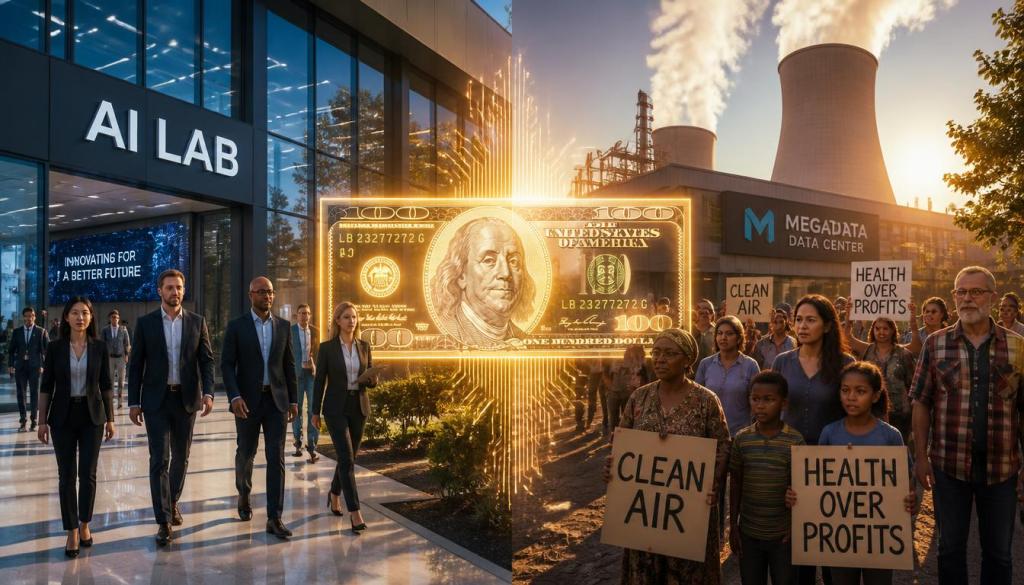
The Data Center Crisis: Health Costs Communities Are Paying
While the administration focuses on voluntary industry pledges, communities across the country are raising alarms about the health and environmental impacts of the AI infrastructure boom.
Harvard researchers have documented that data centers powered by on-site fossil fuel generation are causing significant health damage. A Harvard study of the Vantage Data Center in Loudoun County, Virginia — which uses on-site gas turbines in one of the densest data center corridors in the world — estimated between $53 million and $99 million in annual health damages from associated air pollution.
The damages are driven primarily by an estimated 3.4 to 6.5 additional premature deaths per year across the impacted region, along with increased hospital admissions, asthma-related outcomes, and lost productivity.
In Mississippi, the proposed xAI Gas Plant in DeSoto County near Memphis — which includes 41 gas turbines intended to power xAI’s Colossus 2 data center — would bring tens of millions of dollars in estimated annual health damages to an area that already carries substantial air pollution burden. Researchers estimate the most impacted people would be those with high social vulnerability, high levels of asthma, and lower median household income.
Communities Fighting Back: What’s Happening Across the Country
Community opposition is growing. Bloomberg recently reported that local opposition helped stall or block at least 48 U.S. data center projects — representing roughly $156 billion in planned investment.
What communities are saying:
- Westlake, Texas: Residents, including members of a Buddhist monastery, oppose a 1-million-square-foot data center, citing concerns about noise, health impacts, and declining property values. Maechee Sarah Hudson, a nun at the monastery, said: “There are a lot of different concerns around having a data center so close to home. One is its proximity, of course, with being the noise pollution and just having a data center in your backyard. I think the biggest concern is that we really don’t know what we’re dealing with.”
- Red Oak, Texas: A Marine combat veteran and cancer survivor told WFAA: “Why the data center worries me? Because we don’t know the health risks that come with it.” City leaders defend the projects, saying they generate tax revenue, but residents say the financial argument isn’t enough.
- Lakeland, Florida: Residents are urging a one-year moratorium on new data centers. Kristie Poma, who lives 10 minutes from a proposed site, told officials she’s concerned diesel backup generators and the constant hum could worsen her heart condition and frequent migraines.
- Monterey Park, California: A proposed 247,000-square-foot facility next to La Loma Park has drawn protests over air quality concerns. Resident Jesse Damon said: “I have multiple concerns related to the health impacts of this project involving air pollution, noise pollution, which can impact mental health, sleep, other issues, as well as water pollution. This is an environmentally stressed area of the country.”
The Administration’s Response: A Voluntary Pledge
President Trump has responded to community concerns not with regulation, but with a voluntary “Ratepayer Protection Pledge.”
Speaking at the EPA headquarters in July, Trump said more than 220 utilities, tech companies and state governments have signed the pledge, covering electricity rates for 80% of the power distributed in the U.S.
He urged local communities to support the projects, claiming foreign countries were trying to slow U.S. AI infrastructure through “propaganda” and public relations campaigns.
“If we don’t do this, we’re going to be left behind,” Trump said. “You have to convince your communities how great these things are. You can’t fight it. You have to go with it.”
But communities are fighting it. Only 9% of voters have even heard of the voluntary pledge, and 61% want to see Congress make it binding law, according to polling cited by the Rainey Center.
What the Pledge Actually Means
The pledge positions data center expansion as essential to the nation’s future and holds companies responsible for the costs of building, maintaining and powering data centers. Tech companies including Google, Meta and OpenAI have signed on.
In Tennessee, lawmakers passed a law requiring owners of data centers that need at least 50 megawatts of power to pay for infrastructure upgrades — but it comes with caveats. If upgrades benefit other ratepayers, utilities can help cover costs. Data centers can also power themselves using gas-powered turbines without state or local oversight, raising concerns from environmental groups .
Other states — including New York, which imposed a one-year moratorium, and North Carolina and Indiana, which have slowed projects — are taking a more cautious approach.
Sen. Edward Markey (D-Mass.) has released draft legislation that would create a national framework to address data center harms, including requiring federal certificates before permitting, grants for community monitoring, and requiring data centers to fund renewable energy rather than rely on on-site diesel generators.
The Bottom Line
Trump’s administration has taken a hands-off approach to AI regulation — one that critics say is driven by the president’s ties to tech donors who have given over $300 million to support his reelection and aligned super PACs .
Meanwhile, communities across the country are bearing the real costs of the AI boom: pollution, health impacts, and uncertainty about their property values and quality of life.
As Rep. Gregorio Casar put it: “He took millions from AI billionaires. Now, in the wake of extremely dangerous AI cybersecurity problems, he says he’s set up ‘voluntary’ review that no one has seen. Asleep at the wheel. Too busy cashing in to protect our jobs or national security” .
The fight over data centers — and the health and economic costs they bring — is just beginning. And communities are organizing to make sure their voices are heard. To join the effort to help make a better America sign up to give or do what you can at Fightforthepeoplepac.com and/or Democrats.org.
Sources
Reuters: “Trump’s tech ties blamed for AI inaction by MAGA Republicans and Democrats” (August 6, 2026)
The Economic Times: “Trump’s tech ties blamed for AI inaction by MAGA Republicans and Democrats” (August 6, 2026)
The Korea Times: “Trump’s tech ties blamed for AI inaction by MAGA Republicans, Democrats” (August 6, 2026)
The Bradenton Herald: “Trump’s tech ties blamed for AI inaction by MAGA Republicans and Democrats” (August 6, 2026)
The Economic Times Enterprise AI: “How Trump drove a wedge between Florida Republicans over AI” (March 17, 2026)
The People’s Weekly | urban intelligence from a holistic approach.
[ai]
 The People's Weekly
Leave a comment