Health and Personal Awareness — Listen Free 🎧 | Contact 📧
A new bill introduced in the U.S. House of Representatives would give low-income households $60 a month to spend on fresh fruits and vegetables. The Fresh Bucks for Fresh Produce Act, introduced July 2, 2026, aims to address food insecurity by connecting eligible families with local produce through a federal pilot program.
The legislation would direct the U.S. Department of Agriculture to establish the Fresh Bucks Pilot Program, awarding grants to states to fund monthly payments. Priority would be given to states targeting food-insecure communities, and the USDA would be required to ensure geographic diversity by awarding at least one grant to states in the Pacific Northwest, Northeast, Western, Midwest, and Southern regions.
Who Qualifies
Households earning 80% or less of the area median income would be eligible. Households already enrolled in SNAP would automatically meet the income requirement and could be auto-enrolled with minimal additional paperwork.
Income caps would vary by location, as they are based on the area median income standard. According to estimates from Nexstar based on HUD data, the cap could be approximately $63,000 in Bismarck, North Dakota, and $113,000 in San Francisco, California. These figures are estimates — the exact income limits would be determined by the USDA in consultation with the Department of Housing and Urban Development upon implementation.
Key Eligibility Details:
- Household definition: One or more individuals living together who customarily purchase and prepare food at home
- College students: Those under 18 would be considered part of their parents’ or caregivers’ household
- SNAP recipients: Automatically meet income requirements; states must incorporate opt-in or auto-enrollment mechanisms and minimize additional paperwork
How Payments Would Work
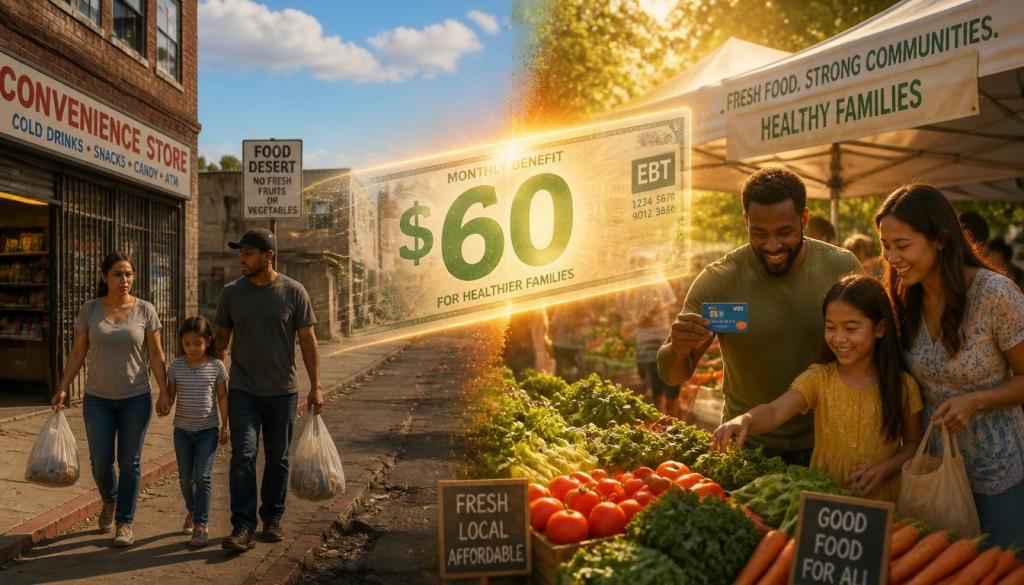
Each eligible household would receive $60 per month, loaded onto an electronic benefits transfer (EBT) card. Payments would be valid for 30 days and must supplement — not replace — other benefits the household already receives.
What You Can Buy:
- Fresh, frozen, or dried fruits and vegetables with no added fat, sugar, or salt
- Herbs
- Plant starts that grow qualifying foods
Where You Can Shop:
- Farmers markets
- Independent grocers
- Farm stands
- Supermarkets
- Any other retailers the USDA deems appropriate
How States Would Run the Program
States would need to apply for grants and explain how they would reach low-access areas through mobile markets, delivery models, and partnerships with community organizations or clinics.
What Grant Funds Can Cover:
- Administrative costs, including staffing, coordinating with community organizations, contracting with EBT providers, and acquiring technology systems
- Technical and financial assistance for eligible retailers
- Culturally relevant, plain-language marketing materials in multiple languages
- Data collection and reporting
Program Study and Duration
Study Requirements:
The USDA would study the program’s effectiveness, collecting data on:
- Household food security levels before and after participation
- Daily fruit and vegetable consumption
- Barriers to access, including distance to retailers, transportation constraints, and availability and pricing of qualifying foods
Reporting Timeline:
- Initial report to Congress: 6 months to 1 year after enactment
- Final report: 5 years after enactment, including a recommendation on whether to continue or expand the program
Program Length:
The pilot program would terminate after five years unless Congress acts to extend it.
Who Introduced the Bill
Rep. Pramila Jayapal (D-WA) introduced the bill, joined by Reps. Alma Adams, Nanette Barragán, Chris Deluzio, Shomari Figures, Jahana Hayes, Eleanor Holmes Norton, Andrea Salinas, Adam Smith of Washington, and Shri Thanedar. The bill has 10 cosponsors and was referred to the House Committee on Agriculture.
The legislation was inspired by a pilot program in Seattle, which led to higher food security and participants having better access to produce.
Why It Matters to Urban Communities
The bill targets food deserts and food-insecure communities — urban neighborhoods where access to fresh produce is scarce. States applying for grants would be required to submit a plan for reaching low-access areas, including through mobile markets, delivery models, and partnerships with community organizations or clinics.
For millions of urban residents living in food deserts, $60 a month could mean the difference between relying on convenience store snacks and having access to fresh produce. An estimated 37 million Americans receive benefits under SNAP, and recent changes have cut the number of people who qualify for food assistance.
What Happens Next
The bill was referred to the House Committee on Agriculture after being introduced on July 2. Members of that committee now have the opportunity to review the bill and make changes before potentially introducing it to the whole House for a vote. Then it would be up to the Senate to pass it and the president to sign it.
Rep. Jayapal urged Congress to take swift action: “We must (vote to) pass this legislation to expand the program nationwide and get families in every corner of the country healthy produce they can afford.”
The bill has quite a few hurdles to overcome before it becomes law. But for families struggling to put fresh food on the table, it represents a concrete step toward food security and better health.
Sources
NewsNation: “Some families may get $60 monthly for produce in new bill. Who qualifies?” (August 2, 2026)
News4Jax: “House bill proposes $60 monthly produce payments for food-insecure households” (August 3, 2026)
Newsweek: “SNAP recipients would get more money each month under new bill” (July 8, 2026)
GovInfo: “119 HR 9581 IH: Fresh Bucks for Fresh Produce Act” (July 2, 2026)
GovTrack: “H.R. 9581: Fresh Bucks for Fresh Produce Act” (July 2, 2026)
Congress.gov: “H.R.9581 — 119th Congress (2025-2026)” (July 2, 2026)
AI
 The People's Weekly
Leave a comment