Daily Intel Report | Listen Free 🎧 | Join the Effort 🫱🏻🫲🏾
As President Trump escalates his campaign to nationalize elections and secure emergency defense funding for the Iran war, his legislative agenda is colliding with multiple political realities. The SAVE America Act faces an uncertain path forward as GOP leaders push competing priorities, while federal courts have unanimously rejected the administration’s demands for state voter roll data — and election experts warn that never before has the main threat to the system come from the White House.
Defense Funding Battle Intensifies as Republicans Split
The Trump administration is scrambling to secure $1.5 trillion in emergency defense funding for the ongoing war in Iran — but key Republicans are skeptical about the Pentagon’s urgent requests.
In a closed-door briefing earlier this month, Pentagon officials sat down with House spending leaders from both parties to make an urgent case for more cash to fund the U.S. war in Iran. But when pressed by members of both parties for details, Pentagon officials were unable to offer any meaningful specifics about why they need the money so quickly — frustrating Republicans and Democrats alike.
The administration is now unfurling a full-court press: The Pentagon has invited dozens of House members for marathon meetings, including face time with Secretary of Defense Pete Hegseth. Select members have been invited to Camp David, and Vice President JD Vance trekked to the basement of the Capitol on Wednesday to sell the plan to GOP rank-and-file.
But several GOP members told CNN they still lack critical information about the military’s capacity and needs — and aren’t convinced by what they have heard. Even those Republicans who support the funding push fear that a fraught political gamble could lead to a legislative implosion just months before the midterm elections.
“It’s a risky proposition,” Senate Majority Leader John Thune told reporters, referring to other House GOP efforts to pass a party-line bill for defense and other priorities. “Is the juice worth the squeeze?”
Conservative opposition is emerging: Some conservatives have threatened to vote against the funding because it would simply go on the nation’s credit card. Others argue they aren’t clear why the Pentagon is in such desperate need for money after billions were infused to the Defense Department as part of the last sweeping party-line policy bill.
Rep. Brian Fitzpatrick, who said he recently turned down a visit to Camp David because he wasn’t interested in a “sales pitch,” said he still has many questions: “That’s a lot of money to blow through in a very short period of time, and I’m not saying they didn’t, but they shouldn’t just expect us to go along with whatever they say.”
One Republican member who spent Tuesday night at the Pentagon argued that even after a nearly four-hour meeting at the defense headquarters, they still weren’t convinced: “To me they didn’t make any compelling argument. The microphones didn’t even work. They are asking for $1.5 trillion and they had chips and dip.”
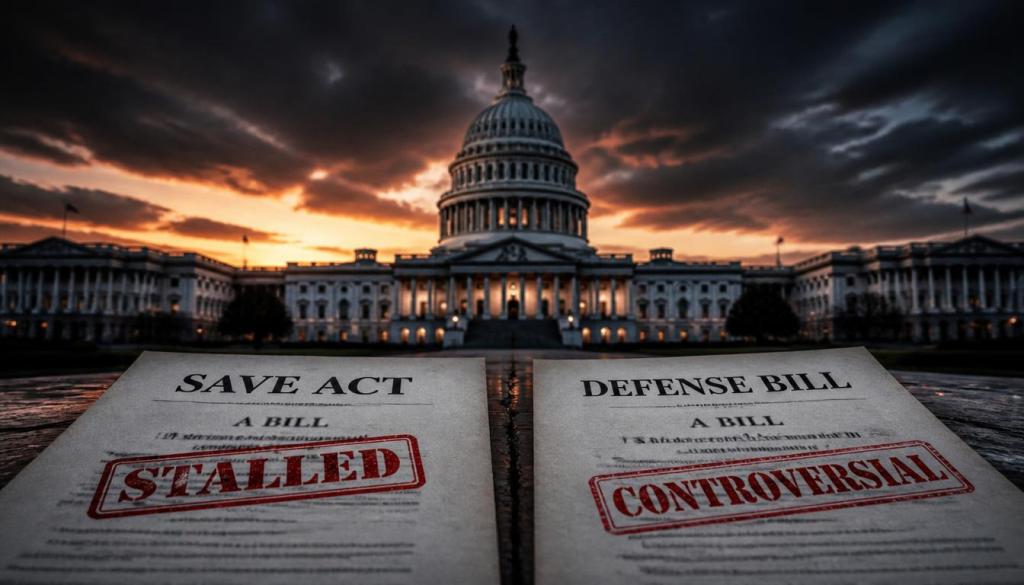
SAVE Act Stalled: Republican Leaders Move Competing Priorities
At the heart of the legislative confusion is the SAVE America Act — Trump’s signature election security bill requiring photo identification and proof of citizenship to vote in federal elections.
The bill is stalled on Capitol Hill. House GOP leaders are now moving a “clean” government funding bill without it — a move that inherently leaves out Trump’s elections bill.
But GOP leaders are also exploring other paths: House GOP leaders are planning to attach the SAVE Act to “every must-pass piece of legislation they send to the Senate.” The “clean” CR is one strategy, but not the only one.
The bill’s critics argue that in a country with no national identity card and where roughly half the population lacks a passport, those requirements could make voting more difficult for more than 21 million people. Many of those affected, they note, would be women who changed their surnames upon marriage.
The 90-day NVRA deadline: The National Voter Registration Act requires systematic removals of ineligible voters to be completed 90 days before an election — by early August. Even if the bill passed tomorrow, it would be “almost impossible to implement those changes” before November. Sen. Thom Tillis called the timeline “disingenuous.”
The reconciliation path is uncertain: Republicans could potentially save face with Trump if they are able to make progress toward passing a watered-down version of the elections measure as part of a filibuster-skirting reconciliation bill. House Budget Republicans approved a fiscal blueprint that would include up to $10 billion for election matters — like incentivizing states to implement stricter voter-ID laws.
But it is not clear if provisions related to the SAVE Act will pass muster with the Senate’s parliamentarian, who will have to decide what is germane under Senate rules. If the president’s voting bill isn’t permitted, that could sink the prospects in the House.
The Senate filibuster hurdle: The bill faces an even steeper climb in the Senate, where it needs 60 votes to overcome a Democratic filibuster. Senate Majority Leader John Thune has said Senate Republicans are “very unlikely” to eliminate the filibuster for the SAVE Act — a further blow to the bill’s prospects.
Rep. Chip Roy, a conservative from Texas, warned: “The SAVE America Act needs to be in. If there is not a mandatory here on ensuring the voter rolls are correct, citizenship is being checked, voter ID is being checked then we have a real problem.”
Thune poured cold water on the House’s budget timeline, responding to the speaker’s suggestion that the Senate would adopt the House’s budget framework before August recess with: “That’d be news to me.”
Courts Unanimously Reject Voter Roll Demands
While the legislative battles continue, the administration’s legal campaign to obtain state voter rolls has suffered a series of unanimous defeats.
The Justice Department has lost all 16 federal court decisions issued so far over its demands for voter lists containing personal information such as addresses, dates of birth, and driver’s license and Social Security numbers — data local officials contend would create a “sweeping surveillance tool.”
What makes this remarkable:
- Bipartisan opposition: GOP officials in states including Idaho, Kentucky, Utah and West Virginia also fought the requests. Idaho Secretary of State Phil McGrane told federal officials to “stop threatening your friends in Idaho.” Utah Lt. Gov. Deidre Henderson called DOJ demands “truly bizarre behavior.”
- Trump-appointed judges rule against him: Fifteen U.S. District Court judges — nine appointed by Republicans, including seven appointed by Trump — have rejected the department’s demands as unlawful.
- Unanimous legal reasoning: Judges have ruled unanimously that states run elections, not the federal government.
U.S. District Judge David Carter in Los Angeles was among the earliest to reject the administration’s demands, ruling on January 15: “The government’s request is unprecedented and illegal. It is not for the Executive, or even this Court to authorize the use of civil rights legislation as a tool to forsake the privacy rights of millions of Americans. That power belongs solely to Congress.”
Acting Attorney General Todd Blanche told the Senate Judiciary Committee that some judges sided with some of the department’s positions — and that most cases remain under appeal.
Americans Trust Local Election Officials
Polling shows that Americans trust local election officials (60%) more than President Trump (43%) or Congress (35%) to run elections — important context showing why the administration’s claims may not resonate with voters.
The Bigger Picture: A Coordinated Assault on Democracy
Sean Morales-Doyle of the Brennan Center for Justice, a leading nonpartisan voting-rights institute, told EL PAÍS that Thursday’s speech was merely the latest step in “a coordinated campaign to undermine confidence in elections” that has been underway for the past year and a half.
“Everything he has tried so far has failed because the president has no authority over how elections are run,” Morales-Doyle said in a telephone interview. “When he realized he was running out of ideas, he chose to dust off old conspiracy theories and circulate intelligence reports that contained nothing new.”
He issued a stark warning: “It’s important for people to understand that all of this is noise meant to undermine their confidence in the elections. And that never before has the main threat to the system come from the White House.”
The combination of developments this week reveals a coordinated assault:
- Trump’s primetime address recycled debunked claims about the 2020 election, accusing China of obtaining public data on 220 million voters — though the rival power allegedly did nothing with the information.
- The SAVE Act remains stalled as GOP leaders push competing priorities — and the 90-day NVRA deadline makes implementation before November “almost impossible.”
- Courts have unanimously rejected the administration’s voter roll demands — including judges appointed by Trump himself — ruling that the federal government has no authority to demand states’ sensitive voter data.
- The EAC remains gutted — no commissioners to certify voting systems or provide oversight, just months before the midterms.
- The administration is seeking to nationalize elections through funding threats and legal pressure, despite the Constitution’s explicit grant of election administration authority to states.
The Bottom Line
The Trump administration is facing multiple legislative and legal setbacks as it seeks to nationalize elections. The SAVE America Act remains stalled as GOP leaders push competing priorities — and the 90-day NVRA deadline makes implementation before November “almost impossible.” Federal courts have unanimously rejected the administration’s demands for state voter roll data — with rulings from seven Trump-appointed judges among those finding the requests unlawful. Meanwhile, the administration is scrambling to secure $1.5 trillion in emergency defense funding for the Iran war amid deep Republican skepticism.
Never before has the main threat to the U.S. election system come from the White House. It’s time to pay attention, get involved, and vote.
What You Can Do Right Now
Check Your Voter Registration. Visit your state’s election website or Vote.org to confirm your registration and update your address. Make sure you’re ready to vote in November.
Contact Your State Election Officials. Let them know you support free, fair, and accessible elections and oppose federal overreach.
Speak Out. Contact your members of Congress. Tell them you oppose the SAVE America Act and the administration’s threats to withhold election funding. Demand they protect the integrity of the 2026 midterms.
Talk to Your Neighbors. Many people don’t know about the unanimous court rulings rejecting the administration’s demands or the broader coordinated assault on democracy. Spread the word.
Support the Effort. Support Democrats at every level who will defend the right to vote and protect our democratic institutions. Join the effort for a better America at fightforthepeoplepac.com and/or Democrats.org. Be the voice.
Sources
- CNN: “Key Republicans skeptical as Trump administration scrambles for more defense money” (July 20, 2026)
- EL PAÍS English: “Trump steps up his campaign to undermine trust in fair elections” (July 20, 2026)
- Orlando Sentinel: “Trust local elections officials over Trump and state leaders” (July 20, 2026)
- USA Today: “Trump’s effort to get state voter rolls hits a brick wall in courts” (July 18, 2026)
- Politico: “Capitol agenda: Trump leans in on his SAVE America pitch” (July 16, 2026)
- Roll Call: “GOP leaders eye pairing SAVE Act with must-pass bills” (July 20, 2026)
Written and composed with AI.
 The People's Weekly
Leave a comment